
Think about the last time you searched online for a product or service. Did you immediately choose the first business that appeared on Google? Probably not. You may have compared different websites, checked customer reviews or explored the company’s services before making a decision.
That’s because people don’t just look for information. They want to know whether they can trust the business behind it.
Today, the way people search is changing. Along with Google, users are turning to ChatGPT, Google AI Overviews and other AI-powered platforms to research products, compare services and find answers.
For businesses, this creates new opportunities. AI can help us research faster, analyse information and explore new ideas. But understanding customers, choosing the right strategy and building meaningful relationships still require human expertise.
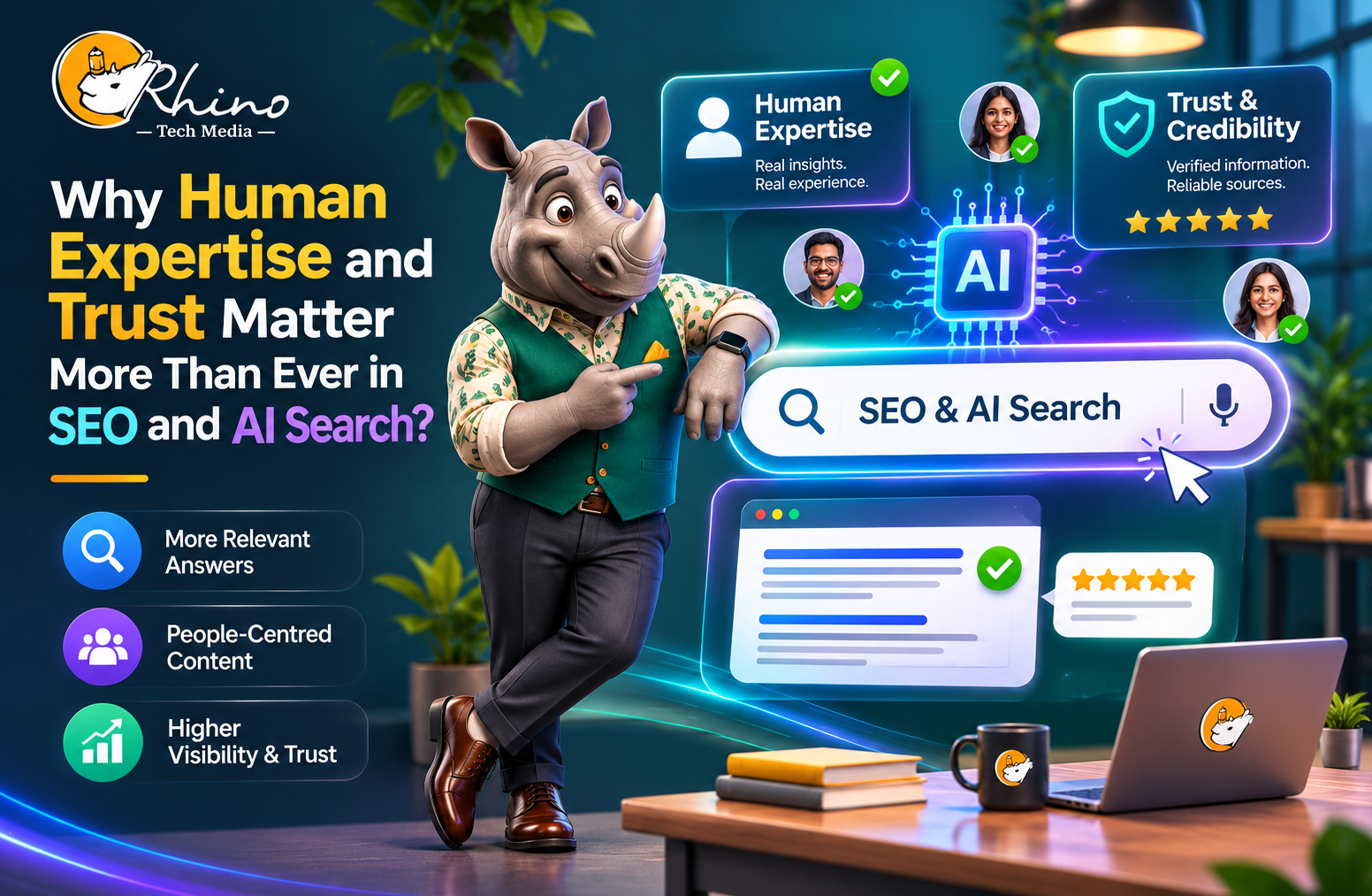
The real opportunity lies in combining the efficiency of AI with the experience, creativity and judgement of people.
Let’s explore why this combination matters for the future of SEO and digital marketing.
1. How AI Is Changing the Way People Search
Imagine a small business owner looking for ways to attract more customers online.
Earlier, they might have searched Google for digital marketing tips and visited several websites. Today, they can ask ChatGPT for suggestions, compare marketing approaches and explore different service providers.
This is changing how businesses approach search engine optimisation.
Traditional SEO practices remain important:
- Keyword research and search intent.
- Website structure and technical optimisation.
- Quality content and relevant backlinks.
- Mobile-friendly design and page experience.
However, businesses must also consider how their information appears across AI-powered search experiences.
According to Google Search Central, established SEO best practices remain relevant for appearing in Google AI Overviews and AI Mode.
What should businesses focus on?
- Answer questions customers genuinely ask.
- Explain products and services clearly.
- Publish accurate and useful information.
- Keep website content organised and updated.
- Demonstrate genuine industry knowledge.
The goal is to make your business easier to discover and your information worth trusting, regardless of where people search.
2. Why Human Expertise Makes AI More Valuable
AI tools can help digital marketing teams research keywords, analyse information, generate content ideas and identify opportunities.
But knowing which suggestions are right for a particular business requires professional experience.
Consider an online clothing store that receives plenty of website visitors but very few orders.
AI might suggest improving product descriptions, targeting relevant keywords and creating better landing pages. These are useful starting points.
However, an experienced SEO professional can investigate website analytics and customer behaviour to identify the actual problem. Perhaps customers are leaving because delivery charges appear too late or product information is incomplete.
That understanding helps the business make the right improvements instead of blindly following general recommendations.
How human expertise improves AI-assisted marketing?
- Better decisions: Professionals identify which suggestions match actual business goals.
- Industry knowledge: They understand customer expectations and market challenges.
- Creativity: They develop campaigns and messages that connect with the intended audience.
- Accuracy: They verify information before using it in marketing activities.
- Practical experience: They know how to turn research and insights into workable strategies.
AI helps us work more efficiently, while human expertise helps us decide where to focus our efforts.
3. Google’s E-E-A-T: Why Experience and Trust Matter?
Have you ever read an online article and wondered whether the person who wrote it actually understands the subject?
This is where Google’s E-E-A-T framework becomes relevant.
E-E-A-T stands for:
- Experience: First-hand knowledge or involvement with a subject.
- Expertise: Relevant skills and subject knowledge.
- Authoritativeness: Recognition as a reliable source.
- Trustworthiness: Accurate, transparent and dependable information.
Google identifies trust as the most important element.
E-E-A-T is not a single direct Google ranking factor. Instead, Google’s systems use various signals to identify helpful and reliable content.
According to Google’s Helpful Content guidance, content should primarily provide value to people rather than exist simply to attract search engine traffic.
How can businesses demonstrate E-E-A-T?
- Add genuine author biographies and professional backgrounds.
- Share actual project experiences and case studies.
- Include credible research and industry references.
- Keep important website information updated.
- Explain services through practical examples.
- Provide transparent company and contact information.
For example, a digital marketing agency publishing an article about SEO can explain how it approaches keyword research, website optimisation and campaign performance.
This gives readers practical insights rather than another article filled with basic definitions.
4. Why Customer Reviews and Brand Reputation Matter?
Imagine two digital marketing agencies offering similar services at comparable prices.
The first has an attractive website filled with promotional statements but provides little information about its work.
The second explains its services, displays genuine customer feedback and shares examples of previous projects.
Which one would make you feel more comfortable contacting?
Most customers want some reassurance before spending their money.
Research also supports this behaviour. According to BrightLocal’s Local Consumer Review Survey 2026:
- 97% of consumers read reviews for local businesses.
- 41% of consumers always read reviews when browsing for businesses.
These findings highlight how customer feedback influences the way people evaluate businesses.
Practical ways to strengthen online reputation
- Encourage customers to share honest feedback.
- Respond professionally to positive and negative reviews.
- Display genuine testimonials.
- Explain services and pricing clearly.
- Avoid unrealistic promises.
- Maintain consistent business information across online platforms.
A strong reputation develops when businesses consistently deliver a positive customer experience, not simply through promotional campaigns.
5. Creating Content That Helps People and Performs in AI Search
Suppose someone searches, “How can SEO help my small business?”
They probably don’t want a complicated explanation filled with technical terms. They want to understand how SEO can help attract potential customers, improve website visibility and generate enquiries.
This is why understanding search intent matters.
AI can help identify common questions and organise research, while experienced content creators can turn those findings into clear, useful explanations.
Five practical ways to improve website content
1. Understand your audience
Speak with customers and sales teams to identify the questions people ask before purchasing a product or choosing a service.
2. Use simple language
Explain technical concepts in a way that readers without marketing knowledge can understand.
3. Include genuine examples
Use practical business situations, relevant case studies and real experiences.
4. Support claims with reliable sources
Link to official documentation, research and credible industry publications.
5. Keep content updated
Review older articles, correct outdated information and improve explanations when necessary.
These practices make your website more useful to readers while supporting Google’s people-first content principles.
6. How Digital Marketing Professionals Can Use AI Effectively?
AI is becoming a valuable part of everyday digital marketing activities. The opportunity is to use it alongside professional knowledge rather than depend on it for every decision.
Here are some practical examples:
| Marketing activity | How AI helps | Where human expertise matters |
| SEO research | Organises keyword ideas | Selects relevant keywords based on search intent |
| Content marketing | Suggests topics and outlines | Adds original insights and brand understanding |
| Social media | Explores campaign ideas | Creates messages that connect with audiences |
| Competitor analysis | Organises available information | Identifies meaningful business opportunities |
| Performance analysis | Helps interpret reports | Decides which improvements to implement |
For example, AI can help a marketing team explore different campaign ideas. However, experienced marketers need to understand the target audience, brand positioning and campaign objectives before selecting the right approach.
Businesses looking for professional support can also explore Rhino Creative Agency’s digital marketing services in Chennai, covering SEO, social media marketing, content marketing, PPC and other digital marketing solutions.
The right strategy should always reflect the business, its customers and the results it wants to achieve.
7. What Businesses Should Focus on as Search Continues to Evolve
Search technology will continue to develop, and businesses will need to adapt. However, customers will still expect useful information, honest communication and services that deliver real value.
To build a stronger online presence, businesses should:
- Invest in original and helpful website content.
- Maintain accurate product and service information.
- Build a positive and consistent online reputation.
- Use AI tools to improve research and productivity.
- Work with professionals who understand their industry.
- Measure marketing performance against meaningful business goals.
These efforts help businesses stay relevant across traditional search engines and emerging AI-powered platforms.
Conclusion
The future of SEO is not about choosing between human expertise and artificial intelligence. It is about bringing them together to achieve better results. AI can help marketing teams research faster, analyse information, explore creative ideas and save time. Human expertise makes those efforts meaningful through practical experience, professional judgement and an understanding of customer needs. For businesses, this means looking beyond rankings and focusing on the value they provide to their audiences. Publish helpful information, share genuine experiences, maintain a trustworthy online presence and use technology with a clear purpose. As search continues to evolve, businesses that combine the right tools with the right expertise will be better prepared to grow. AI helps us work smarter, but human expertise helps us make the right decisions.
