
Could You Recognise a Scam Before It’s Too Late?
Imagine receiving a WhatsApp message saying your bank account will be blocked unless you update your KYC immediately. The message looks official, the logo seems genuine, and the link takes you to what appears to be your bank’s website.
Would you trust it?
Online scams are becoming harder to recognise. Fraudsters are now using artificial intelligence (AI) to create convincing messages, clone voices, manipulate videos and impersonate people or organisations.
A message from a familiar contact or a video featuring a well-known personality may look genuine. But appearances can be misleading.
The scale of cyber fraud in India is a serious concern. According to the Government of India, 24,02,579 financial cyber fraud complaints were reported in 2025, involving approximately ₹22,495 crore.
These figures cover financial cyber fraud complaints, not just AI-powered scams. However, they highlight why everyone needs to be more careful online.
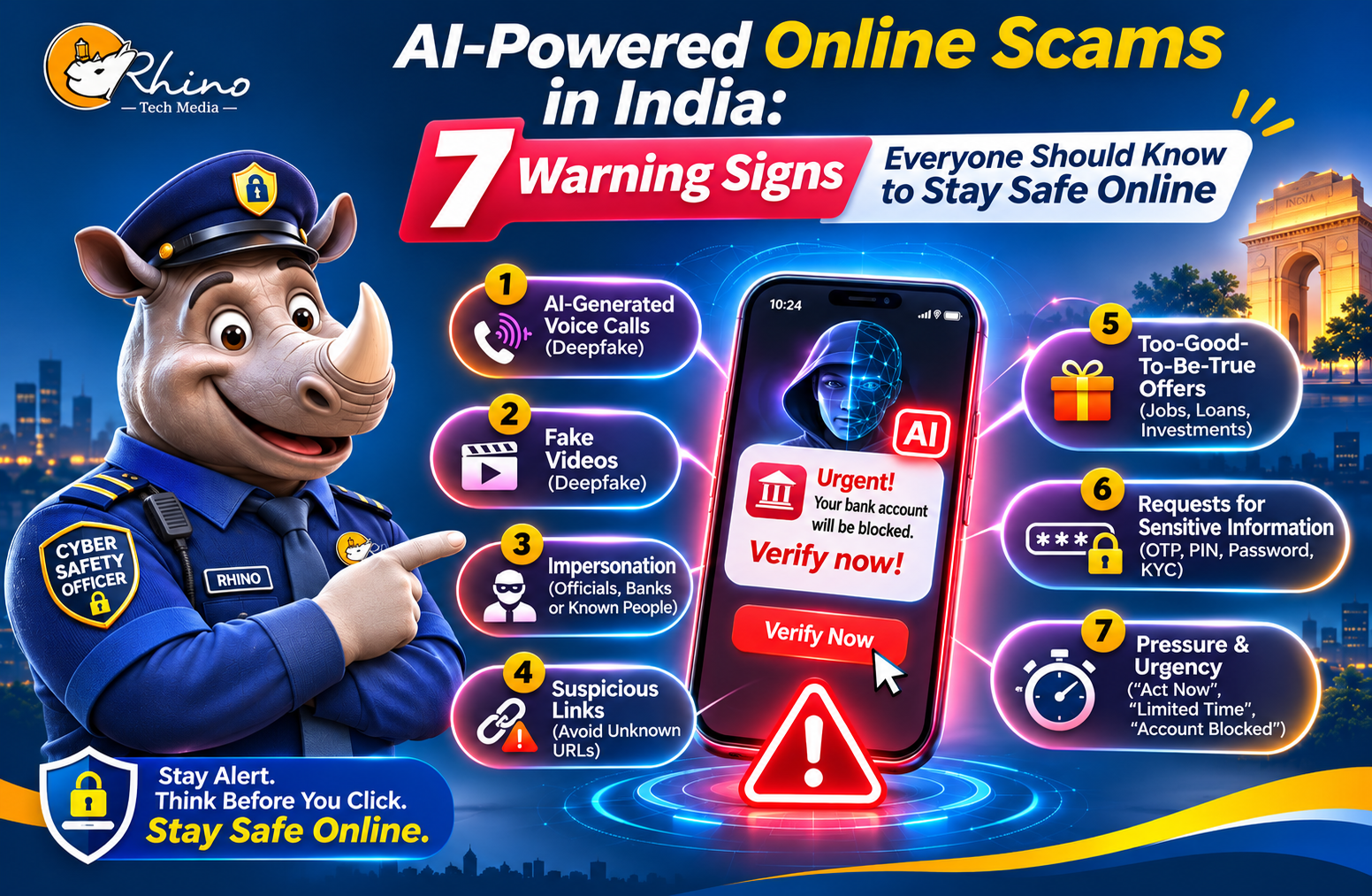
Here are seven common warning signs to watch out for.
1. Suspicious WhatsApp Messages and Phishing Links
You’re busy with work when a WhatsApp message arrives claiming that your electricity connection will be disconnected or your bank account will be suspended.
It asks you to click a link and complete an urgent verification.
This is a common phishing tactic. Fraudsters create messages that look like they come from banks, delivery companies, government departments or familiar brands.
Watch out for:
- Unexpected messages asking you to update KYC.
- Links requesting passwords, OTPs or banking details.
- Messages creating panic with words like “urgent” or “account blocked”.
- Unknown numbers pretending to represent trusted organisations.
How to stay safe: Never click suspicious links. Visit the official website or contact the organisation using its verified customer support details.
Learn more from CERT-In’s online safety advisories.
2. Fake Shopping Websites Offering Unbelievable Discounts
You find a smartphone worth ₹40,000 advertised for just ₹9,999. The website looks professional, the product images are attractive, and the discount seems too good to miss.
You place the order, make the payment and wait. But the product never arrives.
Fake shopping websites often use attractive offers, copied product images and fake reviews to convince customers to pay.
Watch out for:
- Prices that are unusually low.
- Websites with incomplete contact information.
- No clear return or refund policy.
- Pressure to pay immediately through unfamiliar payment methods.
How to stay safe: Check the website address carefully, read independent customer reviews and verify the seller before making a payment. Avoid rushing into deals simply because they look attractive.
3. AI Voice Cloning: When a Familiar Voice Asks for Money
Imagine receiving a call from someone who sounds exactly like your son, daughter or close relative.
They say they’re in trouble and urgently need money. You recognise the voice, panic and transfer the amount.
But the caller isn’t your family member.
AI voice-cloning technology can imitate someone’s voice using audio samples. Fraudsters may use publicly available recordings or other voice clips to create convincing impersonations.
Watch out for:
- Unexpected emergency calls requesting money.
- Callers insisting that you keep the conversation secret.
- Excuses for avoiding a video call.
- Pressure to transfer money immediately.
How to stay safe: Hang up and call the person directly using their saved number. You can also agree on a family verification phrase for emergency situations.
Remember, a familiar voice alone is not proof of identity.
4. Deepfake Videos Promoting Fake Investments
A video featuring a famous businessperson or public figure appears on social media. They seem to recommend an investment scheme promising quick profits.
It looks convincing, so you consider investing.
However, the video may have been manipulated using AI.
Deepfakes can alter a person’s face, voice or expressions to make them appear to say things they never actually said.
Watch out for:
- Guaranteed returns or unrealistic profit claims.
- Celebrity investment endorsements without verification.
- Videos directing viewers to unknown investment platforms.
- Requests to deposit money quickly to secure an opportunity.
How to stay safe: Verify investment opportunities through official company websites and regulated sources. Never invest based only on a social media video.
Read CERT-In’s deepfake advisory to understand the risks.
5. UPI Scams and Fake Payment Confirmations
You are selling an old phone online. A buyer sends a payment screenshot and says the money has been transferred.
But nothing appears in your bank account.
In another common trick, someone sends you a QR code and asks you to scan it to receive money.
These tactics exploit confusion around digital payments.
Watch out for:
- Screenshots used as proof of payment.
- QR codes sent with instructions to enter your UPI PIN to receive money.
- Requests to share your UPI PIN or OTP.
- Unknown payment requests that you are asked to approve.
How to stay safe: Check your actual bank balance or transaction history before handing over goods. Never share your UPI PIN. You do not need to enter it to receive money.
For more guidance, visit NPCI’s UPI fraud awareness page.
6. Fake Police Calls and Digital Arrest Threats
You receive a call from someone claiming to be a police officer or government official.
They say your Aadhaar, bank account or phone number is connected to a criminal investigation. They threaten arrest and demand money to resolve the issue.
Some scammers use video calls, fake documents and official-looking backgrounds to make their claims seem genuine.
This is commonly known as a digital arrest scam.
Watch out for:
- Threats of immediate arrest over a phone or video call.
- Demands for money to avoid legal action.
- Instructions to stay on a call or keep the matter secret.
- Requests for bank details or transfers to verify your identity.
How to stay safe: Do not transfer money because of threats made over a call. End the conversation and independently contact the relevant authorities through official channels.
7. Fake Work-From-Home Jobs and Easy-Money Offers
You come across an online job promising ₹3,000 to ₹5,000 a day for simple tasks such as liking videos, rating products or writing reviews.
Initially, you may receive a small payment. Then the recruiter asks you to deposit money to unlock higher-paying tasks.
Once you pay, the demands continue or the contact disappears.
Fraudsters use attractive job offers and fake recruiter profiles to target people looking for flexible income.
Watch out for:
- Jobs promising unusually high earnings for little effort.
- Registration fees or deposits before starting work.
- Recruiters communicating only through unverified accounts.
- Requests to transfer money to complete tasks.
How to stay safe: Verify the company and job listing independently. Never pay someone simply to receive a job opportunity.
What Should You Do If You Become a Victim?
If you accidentally click a suspicious link or transfer money to a fraudster, don’t waste time blaming yourself. Take action immediately.
- Call 1930: Report financial cyber fraud as soon as possible.
- Visit the official portal: File a complaint at cybercrime.gov.in.
- Contact your bank: Request assistance in blocking or securing affected accounts and transactions.
- Change compromised passwords: Secure your email, banking and social media accounts.
- Save the evidence: Keep transaction details, phone numbers, messages, screenshots and links.
Quick reporting may help authorities and banks take action to prevent further losses.
Conclusion: Think Before You Click, Trust or Transfer
Online scams are no longer limited to suspicious emails or messages from unknown numbers. With AI, fraudsters can make fake voices, videos, websites and identities look surprisingly convincing.
A call from a familiar voice, an attractive online deal or a message carrying an official logo may seem harmless. But taking a few seconds to verify it can save you from financial loss and unnecessary stress.
Make it a habit to check links before clicking, verify payment requests and confirm unexpected emergencies directly with the person involved. Also, help your parents, children and friends understand these warning signs. A simple conversation could prevent someone from becoming the next victim.
At Rhino Tech Media, we believe digital awareness is an important part of staying safe in an increasingly connected world. Stay informed, stay alert and make online safety a daily habit.
Visit Rhino Tech Media for more insights on technology, digital trends and online safety.
