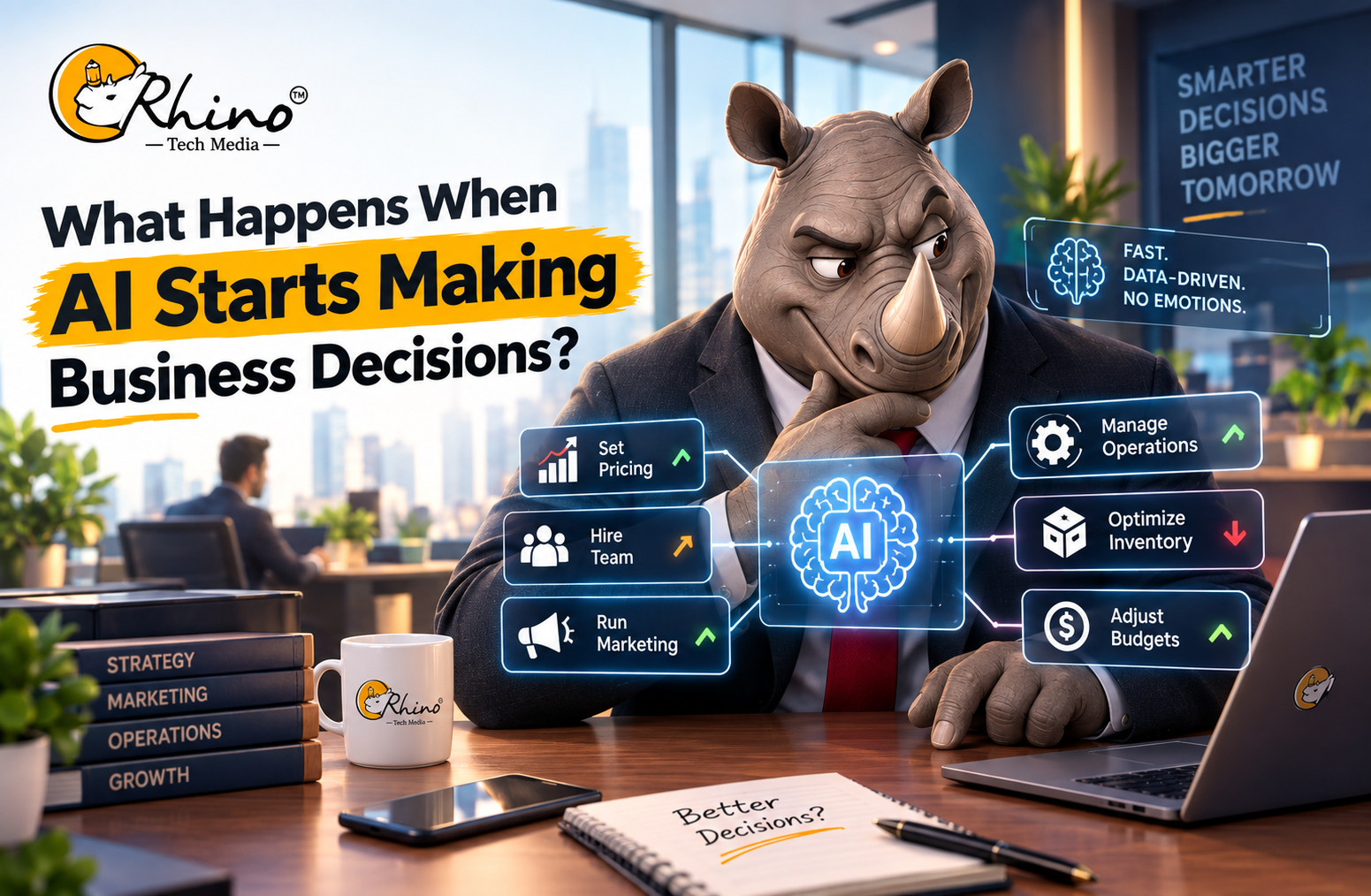
AI is already changing the way businesses work.
It can write emails, answer customer questions, analyse sales data, predict demand, and even tell a sales team which leads are worth following up with.
But there’s a bigger shift happening.
AI is starting to influence actual business decisions.
And that raises an interesting question: what happens when a business stops using AI just as a helpful tool and starts letting it make decisions?
The answer is exciting, but it also comes with some important things businesses need to think about carefully.
AI Is Moving From Assistance to Decision-Making
Until recently, most businesses used AI to help employees complete their work faster.
For example, a manager might ask AI to analyse last month’s sales and identify the best-selling products.
Now, AI can go a step further.
It can look at sales history, customer behaviour, inventory, pricing, and market trends and recommend what the business should do next.
In some systems, that recommendation can even trigger an action automatically.
That’s a major change.
According to McKinsey’s 2025 State of AI report, 71% of respondents said their organisations regularly use generative AI in at least one business function.
This shift is also connected to the rise of agentic AI — systems that can plan, decide, use tools, and take actions with less human intervention. Rhino Tech Media explores this transition in Agentic AI: From Tools to Digital Workers.
So this isn’t something businesses need to prepare for five or ten years from now.
It is already happening.
Where Is AI Making Business Decisions?
You might be surprised by how many areas AI can influence.
Sales and Marketing
Imagine a company has 500 potential leads.
A salesperson could spend hours going through them one by one.
AI can analyse things such as:
- Website activity
- Previous purchases
- Email engagement
- Customer behaviour
- Demographic information
It can then identify which leads appear most likely to become customers.
The salesperson still makes the final call, but AI helps them focus their time where it matters.
Customer Service
AI can also decide how customer enquiries should be handled.
A simple question about delivery status might be answered automatically.
A complicated complaint could be sent directly to a human employee.
This means customers can get quick answers without forcing staff to handle every routine request.
Finance
AI is also finding its way into financial operations.
Businesses can use it to identify unusual transactions, analyse spending, forecast cash flow, and spot potential risks.
But this is an area where human oversight becomes especially important.
A wrong financial decision can be much more expensive than a wrong product recommendation.
Inventory and Operations
Think about a retailer preparing for a busy season.
Instead of simply guessing how much stock to order, AI can analyse previous sales, seasonal demand, current inventory, and other relevant data.
It can then suggest how much stock the business may need.
That can help reduce both overstocking and stock shortages.
AI is also being used to improve workflows and reduce operational costs. Rhino Tech Media’s analysis of how companies are using AI to drive ROI, improve workflows, and cut costs provides examples from areas including logistics, manufacturing, customer service, and marketing.
The Big Advantage? AI Is Fast
One of AI’s biggest strengths is speed.
A person might spend several hours comparing spreadsheets, reports, and customer data.
AI can process huge amounts of information much faster.
That can help businesses:
- Spot trends earlier
- Respond to customers faster
- Reduce repetitive work
- Improve forecasting
- Make decisions using more data
- Give employees more time for important work
But there’s a catch.
Fast doesn’t always mean right.
AI can make a bad decision just as quickly as it can make a good one.
What If the AI Gets It Wrong?
This is where things become interesting.
Suppose an online store uses AI to decide which customers should receive a discount.
The system notices that a particular customer group rarely uses promotional offers.
So it recommends sending fewer discounts to them.
Sounds reasonable, right?
Maybe.
But what if those customers were previously given irrelevant offers?
Or what if their buying behaviour has recently changed?
The AI may simply be repeating an old pattern because that’s what the data shows.
This is why businesses should never assume that an AI recommendation is automatically unbiased or correct.
Trust is another major part of the equation. Rhino Tech Media looks at this issue in AI Can Make Decisions Better Than People Do. So Why Don’t We Trust It?, which explores concerns around transparency, bias, accountability, and human judgement.
AI Is Only as Good as the Data Behind It
There’s a simple rule in technology: garbage in, garbage out.
It applies to AI too.
If the information going into an AI system is incomplete, outdated, or inaccurate, the decisions coming out may also be unreliable.
Before trusting an AI system, businesses should ask:
- Where does the data come from?
- How often is it updated?
- Is important information missing?
- Could historical bias affect the results?
- How is the AI being tested?
The NIST AI Risk Management Framework recommends considering factors such as reliability, transparency, explainability, privacy, security, and fairness when managing AI risks.
These aren’t just technical concerns.
They can directly affect customers, employees, finances, and a company’s reputation.
Should We Let AI Make the Final Decision?
In some situations, yes.
In others, probably not.
The smarter approach is to decide which decisions AI can handle independently and which ones need a person involved.
Low-Risk Decisions
AI could potentially handle these automatically:
- Sorting routine enquiries
- Generating reports
- Identifying sales trends
- Recommending inventory levels
Medium-Risk Decisions
AI makes the recommendation, but an employee reviews it:
- Marketing budget changes
- Customer retention offers
- Supplier recommendations
- Lead prioritisation
High-Risk Decisions
A human should generally remain closely involved:
- Major financial decisions
- Employment-related decisions
- Sensitive customer decisions
- Safety-related decisions
The EU AI Act’s human oversight requirements also emphasise the importance of human oversight for high-risk AI systems.
How Can Businesses Use AI More Responsibly?
Businesses don’t need to avoid AI.
They just need to introduce it thoughtfully.
Start With Smaller Decisions
Don’t give an AI system control over your most important business decisions on day one.
Start with something low-risk.
Let it analyse sales data or forecast inventory first.
See how well it performs before expanding its role.
Keep People Involved
Employees should be able to question an AI recommendation.
They should also be able to override it when something doesn’t look right.
That human safety net can make a big difference.
Keep Checking the Results
AI systems shouldn’t be installed and forgotten.
Businesses should regularly look at:
- Accuracy
- Error rates
- Customer complaints
- Unexpected outcomes
- Human overrides
- Changes in performance
The NIST AI Risk Management Framework supports continuous risk management throughout an AI system’s lifecycle.
Make Responsibility Clear
If an AI system makes a recommendation, who is responsible for the outcome?
There should be a clear answer.
AI should support accountability, not make it harder to determine who made a decision.
The Future Isn’t AI vs. Humans
It’s easy to imagine a future where AI makes every important business decision.
That probably isn’t the best way to think about it.
AI is excellent at processing information, spotting patterns, and handling repetitive analysis.
People are still better at understanding context, relationships, business priorities, ethics, and situations where the data doesn’t tell the complete story.
The real opportunity is combining both.
AI can tell you what the numbers suggest.
A person can ask whether that recommendation actually makes sense for the business.
That combination can be much more powerful than either one working alone.
What Should Business Leaders Ask Before Using AI?
Before allowing AI to influence important decisions, ask a few simple questions:
- What decision are we trying to automate?
- What information will AI use?
- How reliable is that information?
- What happens if the AI gets it wrong?
- Who reviews the recommendation?
- Can someone override the decision?
- How will we measure whether the system is actually helping?
These questions don’t require a complicated AI strategy. They simply encourage businesses to think before handing over control.
Conclusion
AI is changing how businesses make decisions, from analysing customers to forecasting demand and managing operations.
But faster decisions don’t always mean better decisions. Businesses need reliable data, regular monitoring, and human oversight where it matters most.
The future isn’t about choosing between AI and people. It’s about combining AI’s speed and data analysis with human judgement.
Start with one business process, measure the results, and build your AI strategy from there.
