
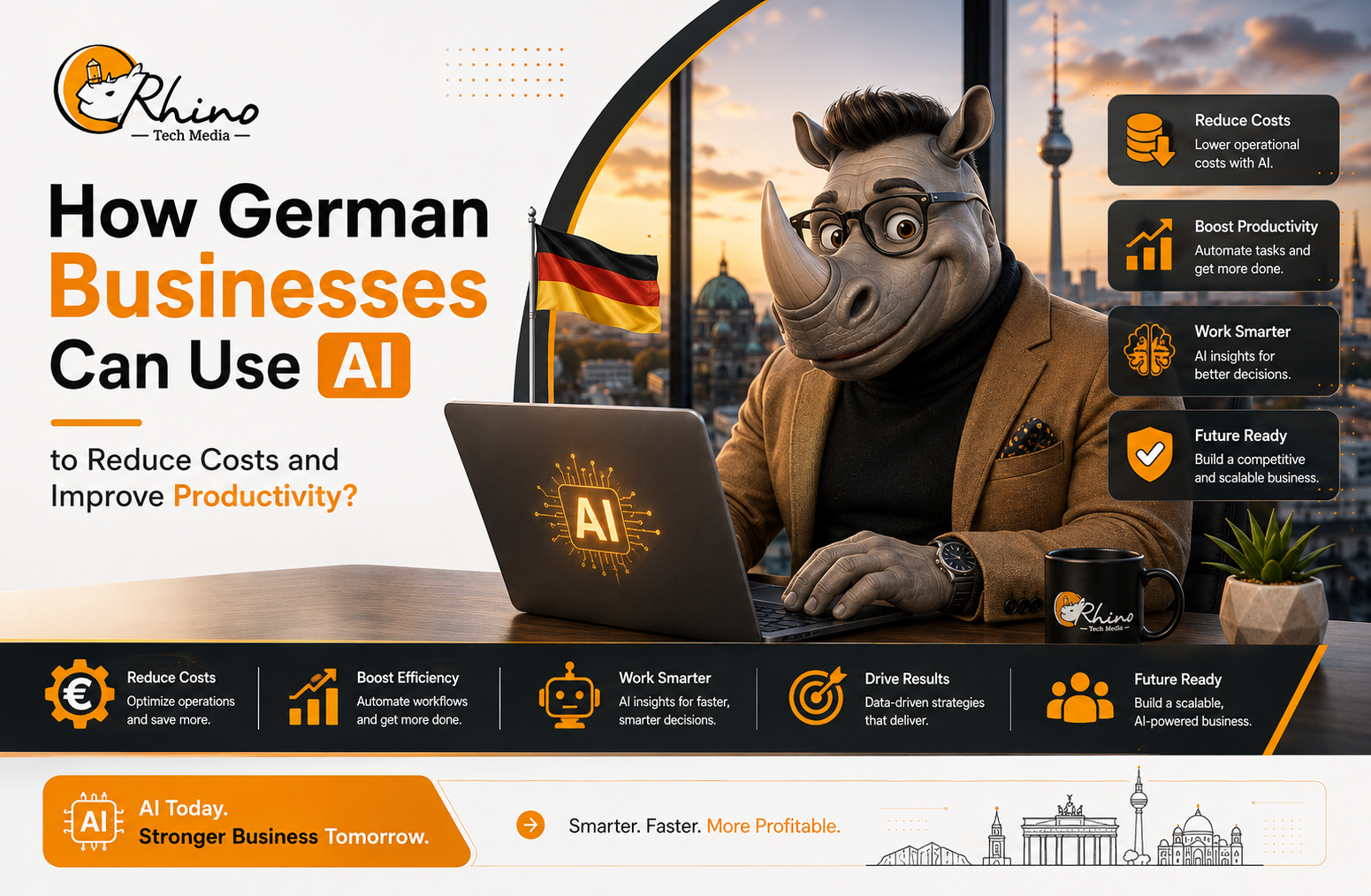
AI is no longer something German businesses can simply watch from the sidelines.
From small Mittelstand companies to large manufacturers, businesses are asking an important question: Can AI actually help us save money and get more done?
The answer is yes, but it depends on how the technology is used.
AI can take care of repetitive work, help employees find information faster, improve customer service and provide useful insights from business data.
The adoption numbers show that German companies are already paying attention.
According to Bitkom Research, 41% of German companies were already using AI in 2026, while another 48% were planning or discussing its use.
So, where can AI make a real difference?
Start With the Work That Takes Too Much Time
Think about the tasks employees repeat every day.
Copying information between systems, sorting emails, preparing reports, searching through documents and processing invoices can all consume valuable working hours.
AI can help automate or speed up many of these activities.
Businesses can use AI for:
- Invoice and document processing
- Email sorting
- Meeting summaries
- Data entry
- Report preparation
- Appointment scheduling
- Internal document searches
The benefit is straightforward. Employees have more time for work that requires their experience and judgment.
Make Customer Service Faster
Customers do not always want to wait until the next working day for a simple answer.
AI assistants and chatbots can help businesses respond to common questions, provide product information and direct complicated enquiries to the right employee.
German companies are already using AI in this area.
According to Bitkom, 88% of German companies using AI reported using it for customer contact in its 2025 survey.
A good AI customer service system does not have to replace your team.
It can handle straightforward questions while employees focus on customers who need a more personal response.
German Manufacturers Have a Major Opportunity
For Germany’s manufacturing sector, AI can do much more than write emails or summarize documents.
Consider a factory with expensive machinery.
A sudden machine failure can lead to downtime, delayed orders and costly repairs.
AI can analyze machine and sensor data to identify unusual patterns. Maintenance teams can then investigate potential problems before equipment fails.
This approach is known as predictive maintenance.
It can help reduce:
- Unexpected downtime
- Emergency repair costs
- Production delays
- Equipment problems
- Material waste
There is still plenty of room for improvement. Bitkom Research found that 72% of surveyed industrial companies said they were not yet making sufficient use of AI’s potential.
For manufacturers, this represents a significant opportunity.
Can AI Help Reduce Energy Costs?
Energy efficiency is another area worth exploring.
Businesses with offices, warehouses and production facilities often collect large amounts of energy data. The challenge is finding useful patterns in that information.
AI can help identify:
- Periods of high energy consumption
- Equipment using excessive energy
- Opportunities to optimize heating and cooling
- More efficient machine operating times
- Unusual consumption patterns
For energy-intensive businesses, small improvements can add up to meaningful savings over time.
Give Employees an AI Assistant
AI does not always need to replace a business process.
Sometimes, it simply helps an employee complete the task faster.
For example:
Sales teams can use AI to summarize customer information before meetings.
Marketing teams can analyze customer feedback more quickly.
HR teams can find information inside company policies.
IT teams can use AI to assist with documentation and troubleshooting.
According to Germany’s Federal Statistical Office, Destatis, German companies are already using AI for applications including text analysis, speech recognition, natural-language generation and workflow automation.
The key idea is simple: AI can work alongside employees and help them get more done.
Turn Business Data Into Better Decisions
Most businesses already have plenty of data.
Sales figures, customer activity, inventory records, website information and financial data can become difficult to analyze manually.
AI can help identify patterns and changes that deserve attention.
What business problem are we trying to solve?
Imagine an important customer has gradually reduced their orders over several months.
An AI-assisted reporting system could identify the trend early.
The sales team can then investigate what is happening and contact the customer.
That gives the business an opportunity to address the issue before it becomes a larger problem.
Data Protection Should Come First
There is one area German businesses need to take particularly seriously: data protection.
Companies should not simply upload confidential business information into any AI tool.
Businesses need to consider:
- GDPR requirements
- Cybersecurity
- Customer information
- Employee data
- Confidential documents
- Intellectual property
- EU AI Act requirements
According to Destatis, 62% of German companies that were not using AI cited uncertainty about legal consequences, while 60% cited data protection and privacy concerns.
A clear company AI policy can help employees understand which information can be used with AI and which information must remain protected.
How Can German SMEs Get Started?
You do not need to introduce AI across the entire company at once.
Starting with one process is often the smarter approach.
1. Find one time-consuming task
Look for something employees do repeatedly.
2. Calculate the current cost
Find out how many hours and resources the task requires.
3. Test an AI solution
Start with a small team or one workflow.
4. Measure the results
Track:
- Time saved
- Cost reduction
- Error rates
- Employee productivity
- Customer response times
5. Expand what works
If the results are positive, gradually introduce the solution to other areas.
Do Not Use AI Just Because It Is Popular
This may be the most important point.
AI should not become another expensive software subscription that employees rarely use.
Before investing in a tool, ask:
What business problem are we trying to solve?
If the answer is unclear, the company may not need that particular AI solution.
If employees spend 20 hours every week processing documents, for example, that is a clear problem worth exploring.
The strongest AI projects usually have a specific goal and measurable results.
What Could AI Mean for German Businesses?
There is no single AI strategy that works for every company.
For a manufacturer, AI might mean fewer machine breakdowns.
For a retailer, it could mean faster customer support.
For an office-based company, it could mean less administrative work.
For a professional services business, it could help employees analyze information faster.
The right starting point is to look at where your business is losing time, money or productivity.
Then ask whether AI can solve that problem.
Conclusion
AI can help German businesses reduce costs and improve productivity. Manufacturers can use it for predictive maintenance, service businesses for customer support, and offices for repetitive tasks.
Germany’s growing AI adoption shows that businesses are taking the technology seriously. But successful AI adoption is not about using every new tool. It is about finding real business problems and choosing the right solutions.
Start small, measure the results, protect business data and expand what works.
With the right approach, AI can help German businesses work smarter, save time and create lasting value.
