
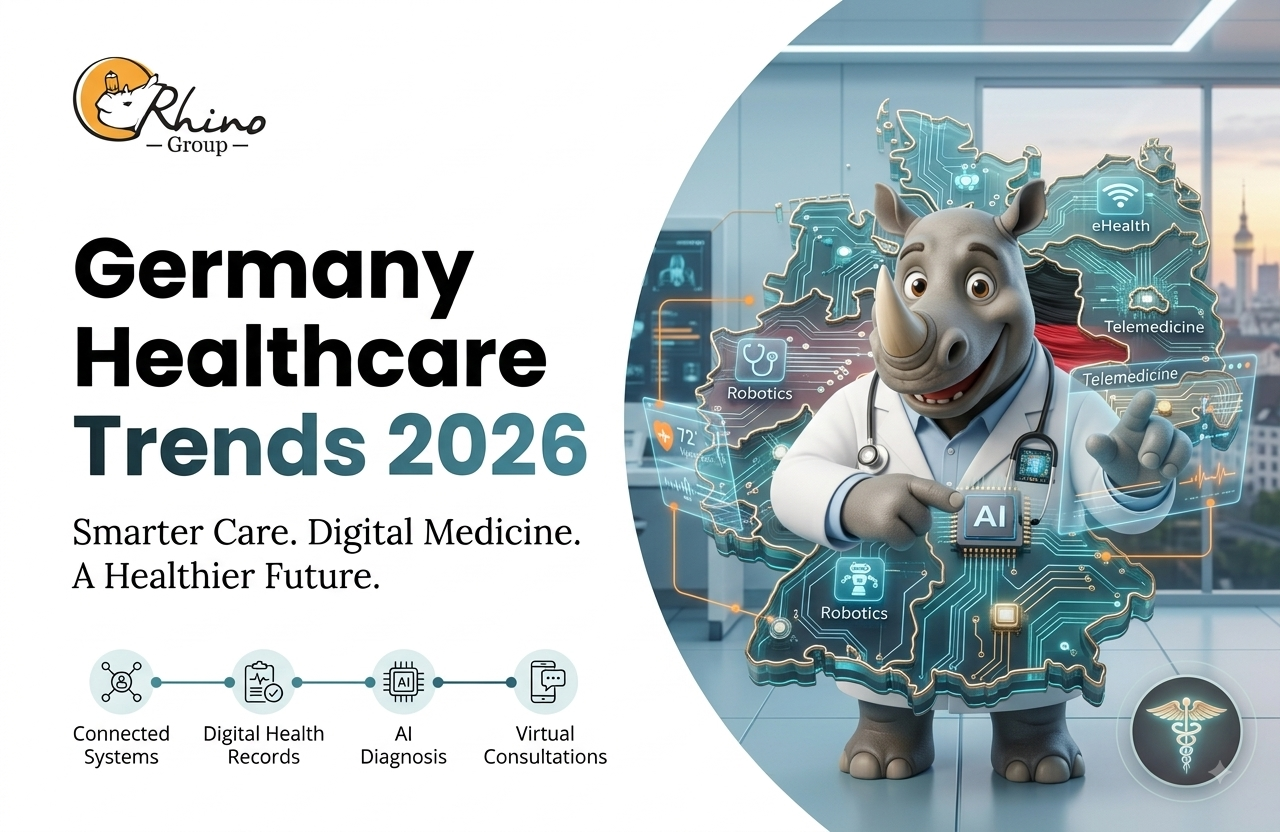
Smarter Care. Digital Medicine. A Healthier Future.
Overview
Germany’s healthcare sector is entering a major transformation in 2026, driven by digitalisation, artificial intelligence, healthcare data, hospital reform, and the growing need for efficient, patient-centred care. The government’s updated Digitalisation Strategy places digital processes, health-data use, and benefit-oriented technologies at the heart of the healthcare system, with the broader goal of creating a digitally supported healthcare ecosystem by 2030.
At the same time, Germany is restructuring its hospital system, investing in modern infrastructure, addressing workforce pressures, and strengthening the financial sustainability of statutory health insurance. These developments are creating new opportunities for health-tech companies, medical-device manufacturers, pharmaceutical businesses, digital-health providers, and healthcare investors.
Key Healthcare Trends in Germany in 2026
- l AI-Powered Healthcare — Artificial intelligence is becoming increasingly important for clinical decision support, diagnostics, patient information, prevention, and the analysis of healthcare data. Germany’s digital strategy explicitly incorporates advances in AI into future healthcare development.
- l Electronic Patient Records Become Central — The electronic patient record (ePA) is evolving into a core component of Germany’s digital healthcare infrastructure, enabling medical information to be shared more efficiently and supporting more coordinated care.
- l Greater Use of Health Data — Germany is expanding the responsible use of health data for research, innovation, prevention, and healthcare delivery. The European Health Data Space is also influencing the country’s digital-health direction.
- l Hospital Modernisation and Specialisation — The hospital reform is restructuring healthcare capacity, encouraging greater specialisation and quality-focused treatment while also seeking to maintain access to care, particularly in rural areas.
- l Digital Primary Care — Germany is preparing digital elements for a stronger primary-care system, including electronic referrals, digital appointment services, and digital initial assessments.
- l Telemedicine and Digital Health Applications — Telemedicine and certified digital health applications (DiGA) are becoming increasingly integrated into everyday healthcare, giving patients more ways to access services and manage their health digitally.
- l Healthcare Automation and Interoperability — Digital communication between doctors, hospitals, pharmacies, and other healthcare providers is becoming more important as Germany works toward connected and interoperable healthcare processes.
- l Focus on Healthcare Efficiency — Cost pressures and workforce shortages are accelerating efforts to simplify administrative processes, automate routine tasks, and improve productivity across healthcare organisations. The 2026 digital-health legislation is designed partly to reduce administrative burdens.
- l Growth of Preventive and Personalised Care — Digital platforms and AI-supported tools are creating opportunities for personalised prevention, health monitoring, treatment guidance, and patient education.
- l Investment in Healthcare Infrastructure — The Hospital Transformation Fund is providing substantial long-term funding for modernising Germany’s hospital infrastructure, with funding of up to €50 billion through 2035.
Overall, Germany Healthcare Trends 2026 point toward a healthcare system that is becoming more digital, data-driven, AI-enabled, specialised, and patient-centred. The combination of healthcare reform, technological innovation, and infrastructure investment is likely to make Germany an increasingly important European market for digital health, medical technology, biotechnology, and healthcare innovation.
Artificial Intelligence Enters More Areas of Medicine
AI is becoming an increasingly important healthcare technology, particularly in areas involving large volumes of medical information.
AI-supported solutions can assist with image analysis, diagnostics, clinical decision-making, administrative processes, risk prediction, and personalised treatment.
Major areas of opportunity include:
- l Medical imaging and diagnostics.
- l Early disease detection.
- l Clinical decision support.
- l Predictive analytics.
- l Drug discovery and development.
- l Personalised medicine.
- l Automated documentation.
- l Hospital workflow optimisation.
- l Patient monitoring.
The long-term opportunity is to use AI not as a replacement for healthcare professionals, but as a tool that helps them make faster, better-informed decisions.
Electronic Patient Records Gain Greater Importance
The electronic patient record is becoming one of the most important components of Germany’s digital-health infrastructure.
In 2026, the focus is increasingly on making the ePA useful in everyday healthcare rather than simply establishing the technology. Planned improvements include better access to medical information, digital medication management, vaccination information, referrals, and other patient services.
Why it matters:
- l Doctors can access relevant patient information more efficiently.
- l Patients gain greater visibility over their health information.
- l Medication errors can be reduced through better information sharing.
- l Emergency teams can obtain important medical information more quickly.
- l Different healthcare providers can coordinate treatment more effectively.
The development of the ePA is therefore helping Germany move toward a more integrated model of patient care.
Healthcare Data Becomes a Strategic Asset
Germany is placing greater emphasis on making health data available for research and improved medical care while maintaining strong privacy and security protections.
In March 2026, the federal government approved the Medical Register Act, designed to establish clearer and more consistent rules for medical registers. Germany has more than 400 medical registers, and better standardisation could make their data more useful for research and healthcare improvement.
Key developments include:
- l Standardised medical registers.
- l Higher data-quality requirements.
- l Better opportunities for research.
- l Secure data sharing.
- l Greater use of anonymised and pseudonymised information.
- l Improved connections between healthcare data sources.
- l Alignment with the European Health Data Space.
This creates a stronger foundation for evidence-based medicine, medical research, biotechnology, and personalised healthcare.
Hospital Reform Reshapes Healthcare Delivery
Hospital reform remains one of Germany’s most important healthcare developments in 2026.
The reform aims to improve quality, increase specialisation, reduce inefficient structures, and create a more sustainable hospital system. At the same time, policymakers are seeking to preserve essential healthcare access in rural areas. The reform was adjusted in April 2026 to make implementation more practical and to provide additional flexibility for rural hospitals and cooperation between institutions.
The transformation includes:
- l Greater hospital specialisation.
- l Stronger quality requirements.
- l Defined groups of hospital services.
- l More cooperation between healthcare institutions.
- l Better utilisation of hospital capacity.
- l Protection of essential rural healthcare.
- l Long-term modernisation of hospital infrastructure.
The direction is clear: Germany is moving toward a hospital system that prioritises quality, specialisation, efficiency, and accessibility.
Telemedicine Continues to Expand
Telemedicine is becoming an increasingly important part of Germany’s healthcare landscape.
Digital consultations can improve access to healthcare, particularly for patients in rural and underserved areas. They can also support follow-up appointments, chronic disease management, remote monitoring, and selected specialist services.
Key applications include:
- l Video consultations.
- l Remote patient monitoring.
- l Digital follow-up care.
- l Chronic disease management.
- l Online medical assessments.
- l Digital health applications.
- l Remote specialist consultations.
The growth of telemedicine is particularly important as Germany seeks to provide high-quality healthcare despite geographical and workforce challenges.
Healthcare Workforce Shortages Drive Automation
Germany’s ageing population and growing demand for healthcare are increasing pressure on doctors, nurses, carers, and other healthcare professionals.
At the same time, healthcare organisations face significant administrative workloads. This is encouraging greater investment in automation and digital tools.
Technology can help by:
- l Automating administrative processes.
- l Reducing documentation workloads.
- l Supporting appointment management.
- l Improving workforce scheduling.
- l Assisting clinical documentation.
- l Automating repetitive laboratory and diagnostic tasks.
- l Supporting remote monitoring.
Automation is therefore becoming not only a technology trend but also a response to Germany’s workforce challenge.
Preventive and Personalised Healthcare Gain Momentum
Healthcare is increasingly shifting from treating illness to identifying risks earlier and supporting healthier lifestyles.
Digital platforms, health data, genetic information, wearable devices, and AI can support more personalised approaches to prevention and disease management.
Important areas include:
- l Early disease detection.
- l Personalised treatment.
- l Genetic and molecular testing.
- l Digital health monitoring.
- l Lifestyle management.
- l Preventive screening.
- l Risk assessment.
- l Precision medicine.
This trend is particularly relevant to oncology, cardiology, metabolic diseases, and other areas where early intervention can significantly improve outcomes.
Financial Sustainability Becomes a Major Priority
Germany’s healthcare system is facing increasing financial pressure. Healthcare expenditure is rising faster than some sources of insurance revenue, creating pressure on statutory health insurance.
In July 2026, the government approved legislation aimed at stabilising statutory health insurance contributions and controlling expenditure while maintaining healthcare provision.
Key priorities include:
- l Controlling healthcare expenditure.
- l Improving administrative efficiency.
- l Reducing unnecessary costs.
- l Strengthening the financial base of statutory health insurance.
- l Encouraging more efficient healthcare delivery.
- l Maintaining access to high-quality medical services.
This means that healthcare innovation in Germany increasingly needs to demonstrate not only clinical value but also economic value.
Cybersecurity and Data Protection Become Essential
Greater digitalisation also increases cybersecurity risks.
As patient records, diagnostic information, prescriptions, medical devices, and communication systems become increasingly connected, protecting sensitive health information becomes a critical priority.
Germany’s 2026 digital-health initiatives emphasise secure communication, stronger digital infrastructure, interoperability, and patient control over health data.
Key priorities include:
- l Protection of patient data.
- l Secure digital communication.
- l Cybersecurity for hospitals.
- l Strong authentication.
- l Reliable digital infrastructure.
- l Privacy-preserving data use.
- l Secure medical-device connectivity.
Trust will remain essential to the successful adoption of digital healthcare.
Investment Opportunities in Germany Healthcare
Germany’s healthcare transformation is creating opportunities across several high-growth segments.
Potential areas of investment include:
- l Digital health platforms.
- l Artificial intelligence in healthcare.
- l Medical technology.
- l Biotechnology.
- l Health-data infrastructure.
- l Laboratory and diagnostic technologies.
- l Telemedicine.
- l Remote patient monitoring.
- l Hospital digitalisation.
- l Elder-care technologies.
- l Pharmaceutical innovation.
- l Cybersecurity for healthcare.
Companies that can combine clinical effectiveness, regulatory compliance, data security, and measurable cost savings are likely to be particularly well positioned.
Conclusion
Germany Healthcare Trends 2026 point toward a new era of healthcare innovation. Digital infrastructure is becoming a fundamental part of medical care, AI is expanding its role in diagnostics and decision support, health data is becoming increasingly valuable for research, and hospital reform is reshaping how care is organised.
For healthcare companies and investors, Germany offers a mature but rapidly evolving market. The strongest opportunities are likely to emerge where technology, medical expertise, efficiency, and patient needs intersect.
The central message for 2026 is clear: Germany is not simply digitising healthcare — it is redesigning how healthcare works.
