
Overview
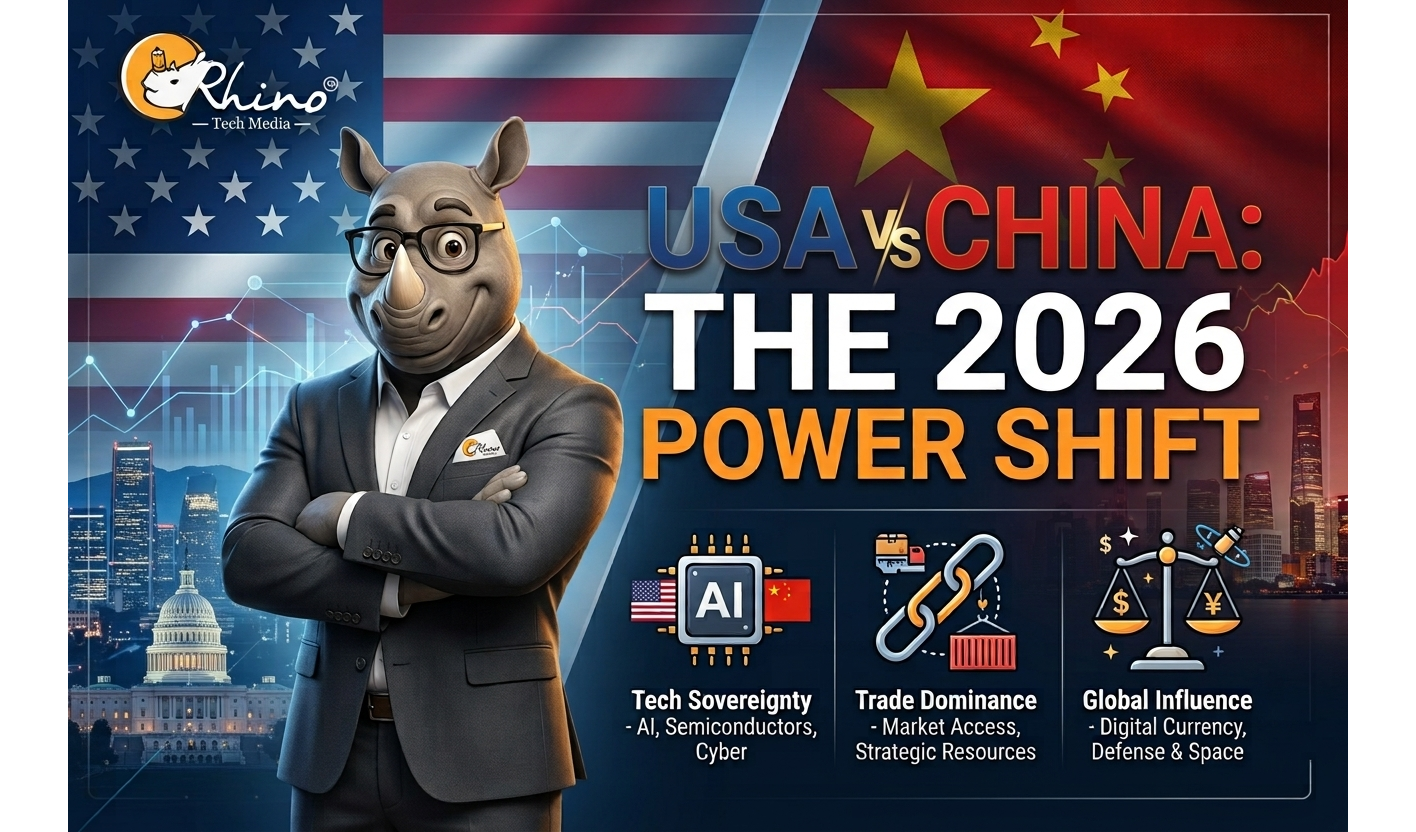
The US–China relationship in 2026 is evolving far beyond traditional trade disputes. Tariffs remain an important tool, but the deeper competition is increasingly focused on artificial intelligence, semiconductors, advanced manufacturing, robotics, critical minerals, energy technology and digital infrastructure. Both powers are seeking greater control over the technologies and supply chains that will shape future economic and strategic power.
The United States is strengthening domestic semiconductor capacity and using trade and technology measures to reduce strategic dependence on foreign supply chains. In January 2026, Washington introduced a 25% tariff on certain advanced computing chips, while broader semiconductor measures remain part of its industrial strategy.
China, meanwhile, is accelerating its own high-tech manufacturing and AI capabilities. Its exports of semiconductors and high-tech products have continued to grow strongly, supported by global demand for AI infrastructure.
The result is a new phase of competition in which technology itself has become a strategic asset. The US and China are increasingly competing not only over who sells more goods, but over who controls the infrastructure, technologies and supply chains that will define the next generation of global growth.
Key Trends Shaping the 2026 US–China Rivalry
- l AI becomes a strategic battleground: Both countries are competing for leadership in AI models, computing infrastructure, chips and applications. Recent disputes over Chinese AI models and access to advanced computing hardware demonstrate how closely AI is now connected to national security.
- l Semiconductors move to the center: Advanced chips have become one of the most important points of competition. The US is encouraging domestic production while restricting or controlling access to certain advanced technologies, while China is pushing to strengthen its domestic semiconductor ecosystem.
- l Tariffs remain a major economic weapon: Trade restrictions continue to influence manufacturing decisions, sourcing strategies and global supply chains. Recent US measures have targeted strategically important Chinese-linked sectors, including polysilicon used in semiconductor and solar production.
- l Critical minerals become strategic resources: Rare earths and other specialized materials are increasingly viewed as economic and national-security assets. China’s position in parts of these supply chains gives Beijing significant leverage, while Washington and its partners are seeking alternative sources.
- l Supply chains are being redesigned: Companies are increasingly diversifying production across countries such as Vietnam, India and Mexico to reduce exposure to US–China tensions. Major technology companies are also reconsidering where products are manufactured.
- l Robotics enters the competition: The rivalry is expanding into industrial and humanoid robotics. In 2026, the US introduced restrictions on certain foreign-made humanoid and quadruped robots, citing national-security concerns, highlighting the growing strategic importance of robotics.
- l Energy technology becomes part of the race: Solar technology, electricity infrastructure, batteries and advanced energy systems are increasingly connected to industrial competitiveness and AI development. This makes energy technology another important area of US–China competition.
- l Digital ecosystems are becoming more fragmented: Differences in AI models, technology standards, data policies and access to computing hardware could contribute to increasingly separate technology ecosystems.
- l Global companies face a more complex environment: Businesses operating across both markets must increasingly manage tariffs, export controls, technology restrictions, supply-chain risks and geopolitical uncertainty.
- l Third countries gain strategic importance: India, Southeast Asia, the Middle East, Europe and other regions are becoming increasingly important as alternative manufacturing locations, technology partners, energy suppliers and investment destinations.
The Bigger Picture
The 2026 US–China rivalry is therefore less about a traditional trade war and more about control of the technologies and infrastructure that will power the next global economy.
AI, semiconductors, robotics, critical minerals and energy are becoming interconnected pieces of a much larger competition for economic and technological influence. For businesses and investors, the key question is no longer simply where products are made, but who controls the technologies, resources and supply chains behind them.
The competition is likely to reshape global investment, manufacturing, trade routes and technology partnerships for years to come.
AI Becomes the New Strategic Battlefield
Artificial intelligence is at the center of the 2026 US–China technology competition.
Both countries are investing heavily in AI models, computing infrastructure, chips and commercial applications. The competition is also influencing decisions about which countries can access advanced computing technologies and participate in emerging AI ecosystems.
- l The United States is seeking to maintain leadership in advanced AI infrastructure and computing.
- l China is rapidly developing domestic AI capabilities and increasingly competitive AI models.
- l Access to advanced AI chips has become a major strategic issue.
- l AI development is increasingly connected to national security and economic competitiveness.
- l Countries outside the US and China are being pushed to develop their own AI strategies.
The emerging competition could create increasingly distinct AI ecosystems, with countries facing pressure to align their technology partnerships with either Washington or Beijing.
Semiconductors Become a Strategic Weapon
Semiconductors are among the most important technologies in the US–China rivalry because they power AI systems, smartphones, vehicles, defense equipment, data centers and advanced industrial machinery.
The United States has identified dependence on foreign semiconductor supply chains as an economic and national-security risk and is pursuing policies designed to increase domestic production.
China, meanwhile, is working to strengthen its domestic semiconductor capabilities and reduce reliance on foreign technology.
Key developments include:
- l Expansion of domestic chip manufacturing.
- l Restrictions on advanced semiconductor exports.
- l Greater investment in chip-design and manufacturing capabilities.
- l Competition over semiconductor manufacturing equipment.
- l Rising importance of advanced packaging and memory technologies.
- l Efforts to secure alternative sources for semiconductor materials.
The semiconductor race therefore extends beyond the chip itself. It encompasses the entire technology ecosystem required to design, manufacture and operate advanced computing systems.
Tariffs Are Becoming Part of Industrial Strategy
Tariffs remain an important instrument in the US–China economic relationship, but their role is changing.
Instead of focusing exclusively on protecting traditional industries, trade measures are increasingly being linked to strategic sectors and supply-chain security.
A recent example is the United States’ 2026 action targeting polysilicon, a material important to both semiconductor and solar supply chains. The measures were designed to strengthen domestic production and reduce strategic dependence.
This reflects a broader shift:
- l Trade policy is increasingly linked to national security.
- l Tariffs are being used alongside industrial subsidies and investment incentives.
- l Strategic materials are receiving greater policy attention.
- l Companies are reassessing the cost of sourcing from China.
- l Supply-chain resilience is becoming a business priority.
Critical Minerals Become the Next Battleground
The competition is moving deeper into the supply chain.
Critical minerals such as rare earth elements, lithium, graphite, gallium and other specialized materials are essential for batteries, semiconductors, renewable-energy technologies, electric vehicles and defense systems.
China holds a powerful position in several critical-mineral processing and manufacturing supply chains. U.S. policymakers are therefore increasingly focused on domestic production, recycling, substitution and partnerships with other countries.
The strategic consequences include:
- l Greater investment in domestic mining.
- l Development of alternative international suppliers.
- l Increased focus on mineral processing.
- l Expansion of recycling and material-substitution technologies.
- l New partnerships with resource-rich countries.
- l Greater competition for access to critical minerals.
This means the next phase of the US–China rivalry could be fought not only in laboratories and factories, but also across the global mining and processing industry.
Supply Chains Are Being Rebuilt
Companies are increasingly reconsidering the traditional model of concentrating production in China.
The objective is not necessarily to abandon China completely. Instead, many businesses are pursuing diversification, regional manufacturing and multiple sourcing strategies to reduce exposure to geopolitical disruptions.
Major trends include:
- l Manufacturing expansion in Southeast Asia.
- l Greater investment in India.
- l Growing importance of Mexico as a production hub.
- l Increased European focus on strategic manufacturing.
- l Development of alternative semiconductor supply chains.
- l Greater use of regional suppliers.
This creates opportunities for countries positioned between the world’s two largest economic powers.
Robotics Enters the US–China Competition
The rivalry is expanding beyond chips and AI models into physical AI and robotics.
Robotics is becoming strategically important for manufacturing, logistics, defense and industrial automation. China has developed a significant position in robotics manufacturing, while the United States is attempting to protect and develop domestic capabilities.
In 2026, U.S. restrictions on foreign-made humanoid and quadruped robots highlighted how robotics is increasingly being viewed through a national-security lens.
Why robotics matters:
- l Automation can increase manufacturing productivity.
- l Robots can reduce dependence on human labor.
- l AI allows robots to perform increasingly complex tasks.
- l Industrial robotics can strengthen domestic manufacturing.
- l Military and security applications create additional strategic concerns.
The convergence of AI + robotics + manufacturing could become one of the most important areas of technological competition during the next decade.
Energy Becomes Part of the Technology Race
AI and advanced manufacturing require enormous amounts of electricity.
As data centers expand, access to reliable and affordable power becomes an increasingly important competitive advantage. This connects the technology rivalry directly to energy policy.
The US–China competition therefore increasingly includes:
- l Nuclear power.
- l Solar technology.
- l Batteries.
- l Electricity grids.
- l Energy storage.
- l Data-center power infrastructure.
- l Industrial energy efficiency.
The country that can combine AI infrastructure with abundant, reliable energy could gain a significant economic advantage.
The Battle Is Expanding to Global Alliances
The US–China rivalry is no longer limited to Washington and Beijing.
Both countries are seeking relationships with countries that control important resources, manufacturing capacity, technology or strategic geographic positions.
The United States is building technology and supply-chain partnerships with allies and strategic partners, while China is developing alternative international cooperation networks.
Recent developments around Pax Silica illustrate how AI, semiconductors and critical minerals are becoming foundations for new strategic partnerships.
Countries gaining strategic importance include:
- l India
- l Japan
- l South Korea
- l Australia
- l Vietnam
- l Mexico
- l Brazil
- l Indonesia
- l Gulf economies
- l European countries
For these countries, the rivalry creates both economic opportunities and diplomatic challenges.
Businesses Face a New Risk Environment
For multinational companies, geopolitical strategy is becoming part of ordinary business planning.
Companies must increasingly evaluate not only price and efficiency, but also political risk, technology restrictions, supply-chain exposure and national-security policies.
Business priorities are shifting toward:
- l Supply-chain diversification.
- l Strategic inventory.
- l Multiple sourcing.
- l Regional manufacturing.
- l Cybersecurity.
- l Geopolitical risk management.
- l Technology compliance.
- l Domestic production.
The traditional goal of maximizing efficiency is increasingly being balanced against the need for resilience and strategic security.
The Global Economy Could Become More Fragmented
The long-term consequence of US–China competition could be a more fragmented global economic system.
Instead of one highly integrated technology and manufacturing network, the world could develop multiple interconnected but partially separated systems.
This could produce:
- l Higher supply-chain costs.
- l More regional manufacturing.
- l Greater government intervention.
- l Competing technology standards.
- l Increased investment in domestic production.
- l More strategic trade agreements.
- l Greater uncertainty for multinational companies.
At the same time, competition can accelerate innovation as both countries attempt to outperform each other in strategically important technologies.
What This Means for the Global Economy
The US–China rivalry is becoming one of the defining economic forces of 2026.
The competition is no longer simply about who exports more or imposes higher tariffs. It is increasingly about who controls the technologies, resources, infrastructure and industrial capabilities that will shape the future economy.
The major areas to watch are:
- l Artificial intelligence
- l Advanced semiconductors
- l Critical minerals
- l Robotics
- l Advanced manufacturing
- l Energy technology
- l Data centers
- l Cybersecurity
- l Electric vehicles and batteries
- l Global supply chains
The United States continues to hold major advantages in areas such as advanced technology, capital markets and innovation, while China possesses enormous manufacturing scale and significant strengths across critical-material processing and industrial production. The competition is therefore unlikely to be decided by a single technology or industry.
Conclusion
The US–China rivalry in 2026 is no longer simply a trade dispute—it is a competition over the technologies, resources and infrastructure that will define the next era of global economic power. Tariffs remain important, but the deeper contest now extends across AI, semiconductors, critical minerals, robotics, energy and advanced manufacturing.
The United States continues to hold major advantages in frontier AI, capital, advanced computing and semiconductor innovation, while China is rapidly strengthening its capabilities through cost-efficient AI, manufacturing scale, domestic semiconductor development and widespread technology adoption.
This rivalry is also reshaping the wider world. Countries such as India, Japan, South Korea, Southeast Asian economies and others are becoming increasingly important as alternative manufacturing locations, technology partners and strategic suppliers. Global trade is therefore being reorganized rather than simply reduced, with AI-related products and semiconductor equipment becoming major drivers of international commerce.
The biggest question for 2026 and beyond is not simply who wins the trade war, but who can build the strongest combination of technology, talent, computing power, energy, manufacturing capacity and resilient supply chains.
