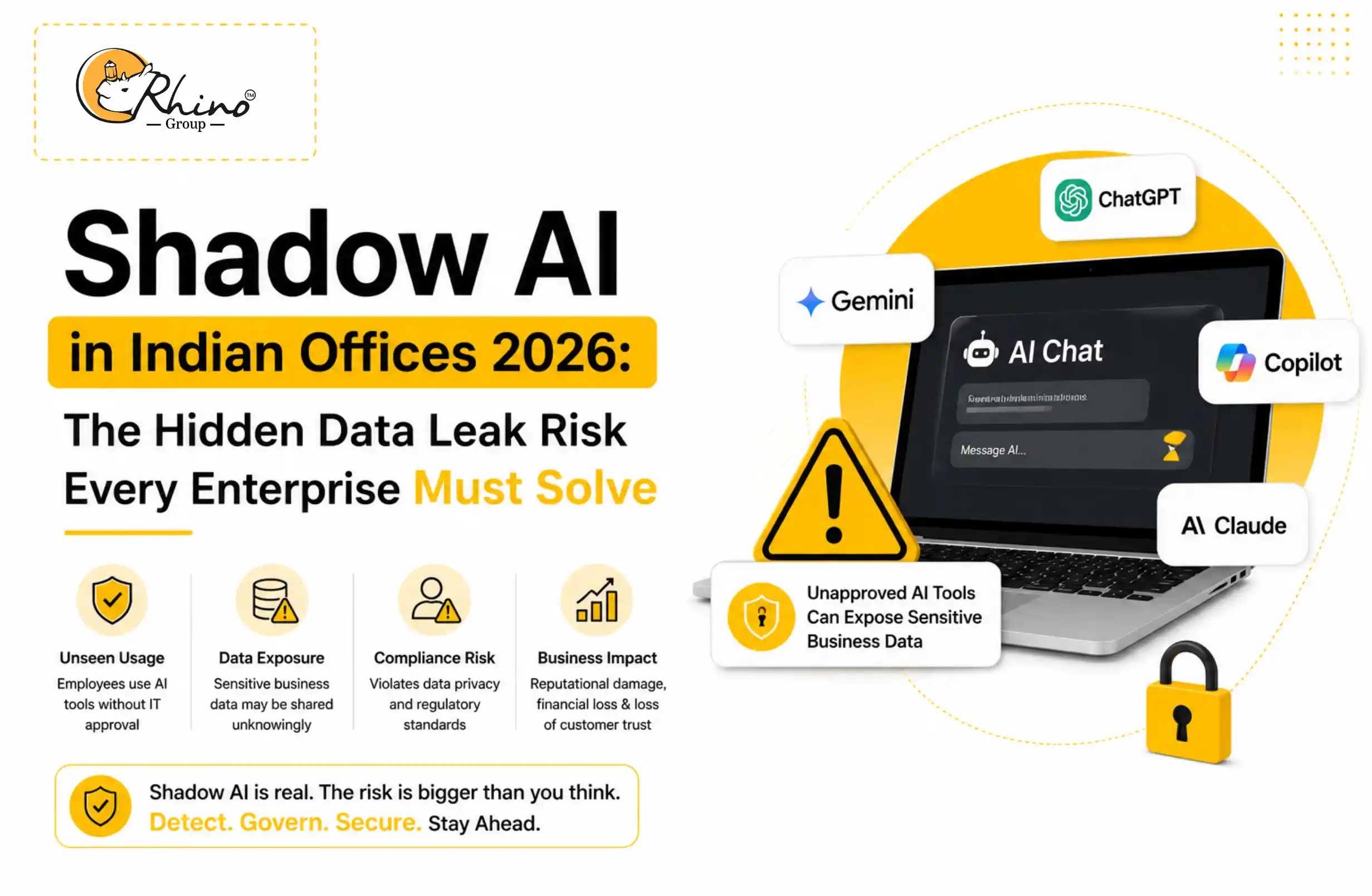
In 2026, Indian enterprises are facing a new kind of cybersecurity challenge, one that does not come from external hackers, but from within the organization itself. Employees across HR, finance, sales, legal, and IT departments are increasingly using generative AI tools like ChatGPT, Claude, and Gemini to complete daily tasks faster.
While this boosts productivity, it also creates a silent but serious risk known as Shadow AI, the unauthorized use of AI tools with sensitive company data.
From salary sheets and customer records to contracts and source code, critical information is being pasted into public AI platforms without IT approval. Under the DPDP Act 2026, such actions can lead to massive compliance violations and penalties.
This blog explains what Shadow AI is, why it is growing rapidly in India, the risks it creates, and how organizations can build a safe, governed AI ecosystem without slowing down innovation.
What is Shadow AI?
Shadow AI refers to the use of generative AI tools by employees without official approval or security oversight from the organization’s IT or compliance teams.
Unlike traditional Shadow IT, like using personal email or cloud storage, Shadow AI is more dangerous because:
- Data is processed externally on third-party servers
- Prompts may be stored or used for model improvement
- Sensitive information can be exposed instantly
Employees often use AI for:
- Writing emails and reports
- Summarizing contracts
- Debugging code
- Analyzing financial data
The issue is not intent, it is convenience. Employees are simply trying to work faster, but unknowingly exposing regulated data in the process.
Why Shadow AI is Growing Rapidly in India?
Several factors are driving the rise of Shadow AI in Indian workplaces:
- AI accessibility: Tools like ChatGPT and Copilot are freely available
- Lack of enterprise AI policies: Many companies still have no formal AI governance
- Productivity pressure: Employees are expected to deliver faster outputs
- Mobile-first usage: AI tools are accessible outside office networks
- Regulatory confusion: Limited awareness of DPDP compliance requirements
Recent industry observations suggest that a significant portion of employees regularly use AI tools without approval, especially in IT services, startups, and BFSI sectors.
Key Risks of Shadow AI in Enterprises
1. Data Leakage and Privacy Violations
Sensitive data such as PAN numbers, Aadhaar details, salary records, and health information can be exposed when pasted into AI tools. This may violate DPDP Act 2026 compliance rules and cross-border data transfer regulations.
2. Intellectual Property Exposure
Source code, product designs, and business strategies may unintentionally become part of external AI training datasets, risking competitive advantage.
3. Legal and Regulatory Non-Compliance
Different departments face unique risks:
- HR: Employee data exposure
- Finance: GST and financial data leaks
- Legal: Confidential contract breaches
- IT: Source code and architecture exposure
4. Supply Chain and Client Risk
A single employee prompt can expose entire client ecosystems, especially in IT services and consulting firms.
Industry Trends and Insights
- Studies suggest over 10% of prompts in AI tools contain confidential business data
- Indian enterprises are among the fastest adopters of generative AI in Asia
- BFSI and IT sectors are the most exposed due to high data sensitivity
- Regulatory frameworks like DPDP Act 2026 are tightening enforcement around digital data handling
These trends show that Shadow AI is not a future risk, it is already embedded in daily workflows across organizations.
How Enterprises Can Control Shadow AI
1. Discover Usage
Organizations must first identify how AI tools are being used:
- Monitor browser and application activity
- Classify data types being shared
- Identify high-risk departments
2. Define Clear AI Policies
A strong AI governance policy should include:
- Approved and banned AI tools
- Data classification rules
- Compliance responsibilities under DPDP Act 2026
- Consequences for violations
3. Deploy Secure AI Alternatives
Instead of banning AI, companies should provide safe alternatives:
- Enterprise ChatGPT or Copilot environments
- Private or self-hosted LLMs
- CRM-integrated AI tools with DLP controls
4. Detect and Prevent Risks
- Implement Data Loss Prevention (DLP) systems
- Block sensitive data patterns (PAN, credit cards, GST numbers)
- Add audit logs for AI usage
5. Train Employees Continuously
Regular awareness programs help employees understand:
- What data should never be shared
- Real-world breach consequences
- Safe AI usage practices
Conclusion
Shadow AI is redefining cybersecurity and compliance risks in Indian enterprises. Unlike traditional threats that originate from outside the organization, this risk emerges from everyday employee behaviour driven by speed, convenience, and the growing dependence on generative AI tools.
The reality is simple: employees are not trying to harm their organizations. They are trying to work more efficiently. However, without proper governance, even a single AI prompt can expose sensitive customer data, financial records, or proprietary business information. Under the DPDP Act 2026 compliance framework, such incidents are no longer just internal IT issues, they can result in severe financial penalties, reputational damage, and regulatory action.
The future of enterprise productivity will not be about restricting AI, but about governing it intelligently. Organizations that succeed will be those that combine innovation with strong enterprise AI governance frameworks, secure infrastructure, and continuous employee awareness.
By adopting secure AI platforms, enforcing clear policies, and building a culture of responsible usage, companies can turn Shadow AI from a hidden risk into a controlled advantage.
The next phase of digital transformation in India will belong to organizations that do not fear AI, but manage it wisely, securely, and strategically.
