
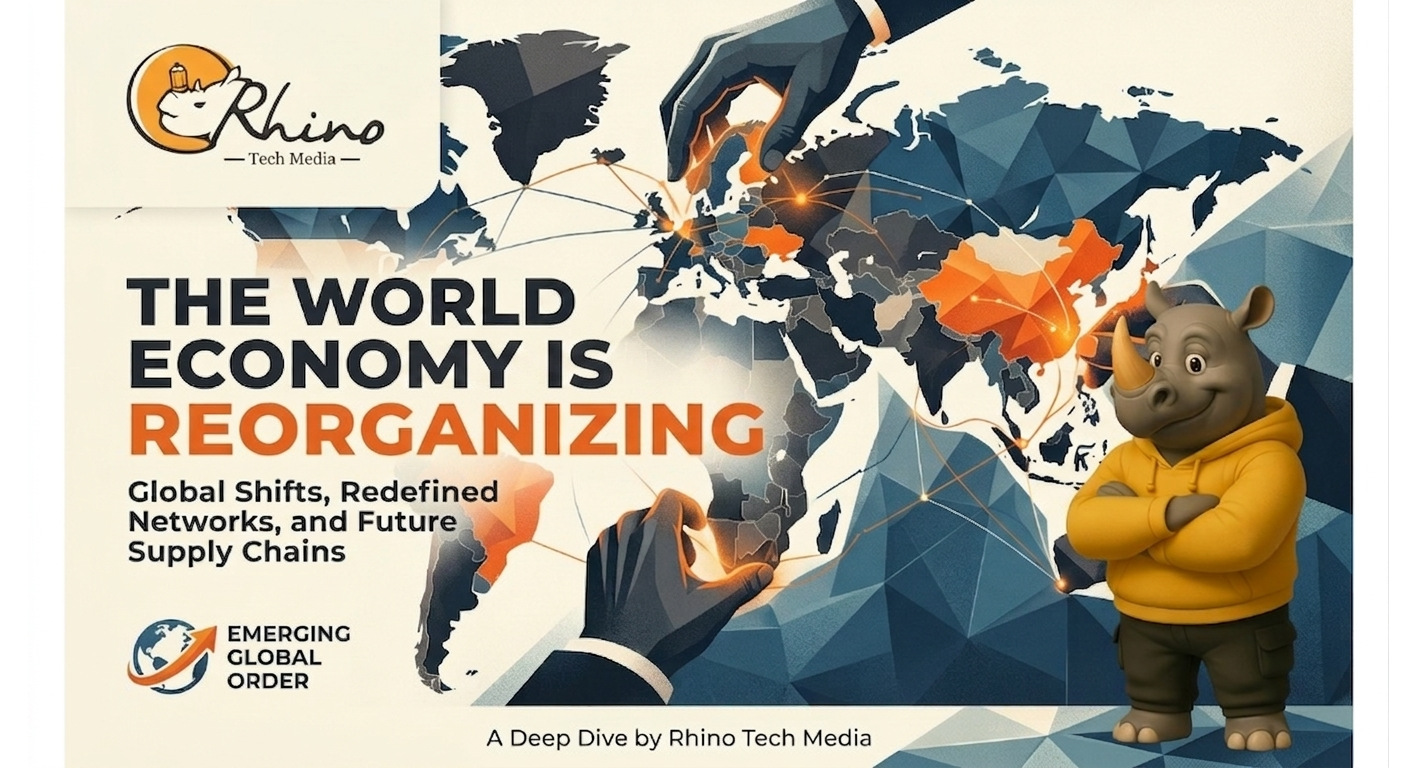
How Geopolitics Is Redrawing Trade, Investment & Power.
Overview
The global economy is entering a new era in 2026. For decades, globalization encouraged countries and companies to build increasingly interconnected supply chains, source materials from around the world and prioritize efficiency. Today, that model is being reshaped by geopolitical tensions, trade restrictions, national-security concerns and competition for strategic technologies.
Economic decisions are increasingly influenced by political relationships. Governments are seeking greater control over semiconductors, energy, critical minerals, artificial intelligence, telecommunications, defense technologies and essential supply chains. Businesses, meanwhile, are reconsidering where they manufacture, where they invest and which markets they depend on.
The result is not the end of globalization, but its transformation. Global trade is becoming more strategic, regionalized and security-driven, creating new winners, new risks and new investment opportunities.
Key Trends Shaping the New Global Economy
- l Geopolitical blocs are becoming more important
Strategic competition between major powers is influencing trade, technology, investment and diplomatic relationships. - l Global supply chains are being redesigned
Companies are diversifying suppliers and production locations to reduce dependence on politically sensitive markets. - l “China + 1” and supply-chain diversification accelerate
Businesses are increasingly looking toward countries such as India, Vietnam, Indonesia and Mexico for additional manufacturing capacity. - l Economic security becomes national security
Governments are treating semiconductors, energy, telecommunications, pharmaceuticals and critical minerals as strategic assets. - l Trade barriers are reshaping global commerce
Tariffs, export controls, sanctions and investment restrictions are changing the flow of goods, technology and capital. - l Semiconductors become a geopolitical priority
Advanced chips are essential for AI, defense, automobiles and digital infrastructure, making semiconductor production a major strategic competition. - l Energy independence gains importance
Countries are seeking reliable domestic and diversified energy supplies as electricity demand rises and geopolitical risks affect energy markets. - l Critical minerals become the next strategic battleground
Lithium, copper, nickel, cobalt, rare earth elements and other materials are increasingly important for batteries, renewable energy, electronics and defense. - l Investment is following geopolitical stability
Companies and investors are paying greater attention to political risk, regulatory environments and the resilience of infrastructure when choosing where to invest. - l Regional trade networks are expanding
North America, Europe, Asia and the Middle East are strengthening regional economic partnerships and supply-chain connections. - l India and Southeast Asia gain strategic importance
Their growing manufacturing capacity, large consumer markets and expanding digital economies position them to benefit from global supply-chain diversification. - l Technology is becoming a strategic weapon
AI, advanced chips, quantum computing, cybersecurity and telecommunications are increasingly viewed through both economic and national-security lenses. - l Defense spending is influencing industrial policy
Governments are increasing investment in defense technologies, drones, cybersecurity, aerospace and autonomous systems, supporting wider industrial ecosystems. - l Companies prioritize resilience over maximum efficiency
Businesses are increasingly willing to maintain alternative suppliers, inventories and production locations even when doing so costs more. - l A more fragmented—but still connected—world emerges
Globalization is not disappearing. Instead, international commerce is becoming more selective, diversified and shaped by strategic alliances.
What This Means for Business
The geopolitical landscape is becoming a core business consideration. Companies can no longer evaluate markets purely by cost, demand and growth potential. They must also consider political stability, trade policy, access to critical resources, technology restrictions and supply-chain resilience.
For investors, this transformation is creating opportunities across defense, energy, semiconductors, infrastructure, cybersecurity, logistics, critical minerals and advanced manufacturing.
The Bottom Line
2026 marks a shift from globalization built primarily around efficiency to globalization increasingly built around resilience and security.
The countries that can secure energy, technology, manufacturing capacity, critical minerals and strategic supply chains will have a growing influence over the next phase of the global economy.
From Globalization to Strategic Globalization
For decades, globalization was driven largely by one objective: efficiency.
Companies searched globally for cheaper labor, lower production costs, specialized suppliers and large consumer markets. This created highly interconnected supply chains stretching across multiple countries.
But geopolitical tensions have exposed vulnerabilities in that model.
Today, governments and companies are asking different questions:
- l Where are our critical suppliers located?
- l Can we access essential components during a crisis?
- l How dependent are we on one country?
- l Could tariffs or sanctions disrupt our business?
- l Where should we build our next factory?
- l Can we protect access to strategic technologies?
The new model is therefore less about simply finding the cheapest location and more about finding a combination of cost, resilience and strategic security.
Geopolitical Competition Becomes Economic Competition
The relationship between geopolitics and economics is becoming increasingly difficult to separate.
Major powers are competing not only for diplomatic influence but also for leadership in:
- l Artificial intelligence
- l Semiconductors
- l Quantum computing
- l Telecommunications
- l Space technology
- l Advanced manufacturing
- l Energy
- l Critical minerals
- l Defense technology
- l Digital infrastructure
Technological leadership increasingly translates into economic and military power.
As a result, governments are supporting domestic industries and restricting access to certain technologies when they believe national security is involved.
The new competition is increasingly about controlling strategic capabilities.
Trade Is Being Rewired
International trade remains essential to the global economy, but its structure is changing.
Tariffs, export controls, sanctions, subsidies and new trade agreements are influencing where companies manufacture and where products are sourced.
Businesses are responding by diversifying suppliers and creating alternative production locations.
This is producing a new generation of global supply chains that are designed to withstand disruption rather than simply minimize costs.
Key developments include:
- l More regional manufacturing
- l Greater supplier diversification
- l Increased inventory of critical components
- l Alternative shipping routes
- l New trade partnerships
- l Expansion of emerging manufacturing hubs
- l Greater government involvement in strategic industries
The Rise of “China + 1”
One of the clearest examples of supply-chain diversification is the China + 1 strategy.
Rather than completely abandoning China, many companies are adding another manufacturing location to reduce concentration risk.
Countries benefiting from this trend include:
- l India
- l Vietnam
- l Indonesia
- l Malaysia
- l Thailand
- l Mexico
These countries are attracting investment in electronics, automobiles, machinery, pharmaceuticals, consumer goods and other industries.
China remains a critical manufacturing and consumer market, but companies are increasingly seeking greater geographic diversification.
India’s Strategic Rise
India is becoming one of the most important beneficiaries of the restructuring of global supply chains.
Its combination of a large domestic market, expanding manufacturing capabilities, digital infrastructure, skilled workforce and government industrial policies is attracting international investment.
Growth opportunities include:
- l Electronics manufacturing
- l Semiconductors
- l Pharmaceuticals
- l Automobiles
- l Renewable energy
- l Aerospace
- l Defense
- l Digital services
- l Advanced manufacturing
India’s growing economic importance means it is increasingly positioned not simply as an alternative manufacturing location, but as a major global economic and geopolitical power center.
Southeast Asia Gains Ground
Southeast Asia is also becoming increasingly important in the new global production network.
Countries across the region are attracting investment from companies looking to diversify production while remaining connected to Asian supply chains.
The region offers:
- l Competitive manufacturing costs
- l Expanding consumer markets
- l Strategic geographic locations
- l Growing digital economies
- l Increasing infrastructure investment
- l Access to regional trade agreements
Vietnam, Indonesia, Malaysia and Thailand are particularly important parts of this transformation.
Mexico and the Rise of Nearshoring
North American companies are increasingly looking closer to home for manufacturing and supply-chain partners.
Mexico has benefited from its proximity to the United States and its integration into North American manufacturing networks.
Industries receiving attention include:
- l Automobiles
- l Electronics
- l Machinery
- l Aerospace
- l Medical equipment
- l Industrial components
This trend illustrates a broader movement toward nearshoring—producing goods closer to their final markets.
AI Is Becoming a Geopolitical Asset
Artificial intelligence is moving into the center of global competition.
Countries are competing to build:
- l Advanced AI models
- l AI computing infrastructure
- l Data centers
- l Semiconductor capacity
- l AI research ecosystems
- l Skilled AI workforces
- l Autonomous systems
AI leadership could influence productivity, military capabilities, scientific research and economic competitiveness.
This makes AI infrastructure increasingly comparable to other forms of strategic infrastructure.
AI + Chips + Data + Energy = Strategic Power
Energy Security Returns to the Center
Energy is another area where geopolitics and economics increasingly overlap.
The global energy transition is continuing, but countries also need reliable and affordable electricity.
The rapid expansion of:
- l AI data centers
- l Electric vehicles
- l Manufacturing
- l Cooling systems
- l Digital infrastructure
- l Industrial electrification
is increasing electricity demand.
This is creating renewed interest in:
- l Nuclear power
- l Natural gas
- l Solar
- l Wind
- l Hydropower
- l Battery storage
- l Hydrogen
- l Electricity-grid modernization
Energy security is increasingly becoming a prerequisite for economic competitiveness.
Defense Becomes an Industrial Strategy
Geopolitical tensions are also transforming defense spending.
Modern defense increasingly depends on technologies such as:
- l Artificial intelligence
- l Drones
- l Autonomous systems
- l Satellites
- l Cybersecurity
- l Advanced sensors
- l Robotics
- l Precision manufacturing
This is creating demand for advanced industrial capabilities and encouraging governments to strengthen domestic defense supply chains.
The defense sector is therefore becoming increasingly connected to the broader technology and manufacturing economy.
Cybersecurity Becomes Economic Security
As economies become increasingly digital, cyberattacks can affect much more than individual companies.
Potential targets include:
- l Electricity grids
- l Financial systems
- l Telecommunications
- l Transportation
- l Hospitals
- l Government infrastructure
- l Manufacturing systems
- l Cloud platforms
Cybersecurity is therefore becoming part of national economic resilience.
Businesses are investing in:
- l AI-powered threat detection
- l Zero-trust security
- l Identity protection
- l Cloud security
- l Critical infrastructure protection
- l Post-quantum security
Governments Return to Industrial Policy
One of the most important economic changes is the return of industrial policy.
Governments are increasingly supporting strategic industries through:
- l Tax incentives
- l Subsidies
- l Infrastructure investment
- l Research funding
- l Public procurement
- l Domestic-content requirements
- l Trade protections
The objective is to strengthen domestic capabilities in sectors considered essential to national competitiveness.
This represents a major shift from the previous era of relatively hands-off economic globalization.
Globalization Is Not Ending
Despite geopolitical fragmentation, the world economy remains deeply interconnected.
Companies still need:
- l International customers
- l Global capital
- l Foreign investment
- l Technology
- l Raw materials
- l Specialized suppliers
- l International talent
The more likely outcome is not deglobalization, but selective globalization.
Companies will continue operating internationally, but they will increasingly build networks around strategic relationships and risk management.
The New Winners and Losers
Geopolitical fragmentation will not affect every country or industry equally.
Potential winners include:
- l Countries attracting manufacturing investment
- l Semiconductor producers
- l Defense technology companies
- l Energy infrastructure providers
- l Cybersecurity firms
- l Critical-mineral producers
- l Logistics companies
- l Data-center operators
- l Renewable and nuclear-energy developers
- l Infrastructure companies
Potentially vulnerable areas include:
- l Highly concentrated supply chains
- l Businesses dependent on one foreign market
- l Companies exposed to trade restrictions
- l Industries reliant on strategically sensitive imports
- l Economies heavily dependent on a single commodity or trading partner
Conclusion
The global economy is entering a new era in which geopolitics and economics are becoming inseparable. Trade, investment and industrial decisions are increasingly shaped not only by market forces, but also by national security, strategic technologies, energy independence and supply-chain resilience.
Globalization is not disappearing, but it is changing. Companies are diversifying production, governments are rebuilding strategic industries, and countries are competing for leadership in AI, semiconductors, energy, critical minerals, infrastructure and advanced manufacturing.
For businesses and investors, this transformation creates both challenges and opportunities. The winners of the next phase of globalization are likely to be those that can balance efficiency with resilience, innovation with security, and global ambition with strategic flexibility.
