
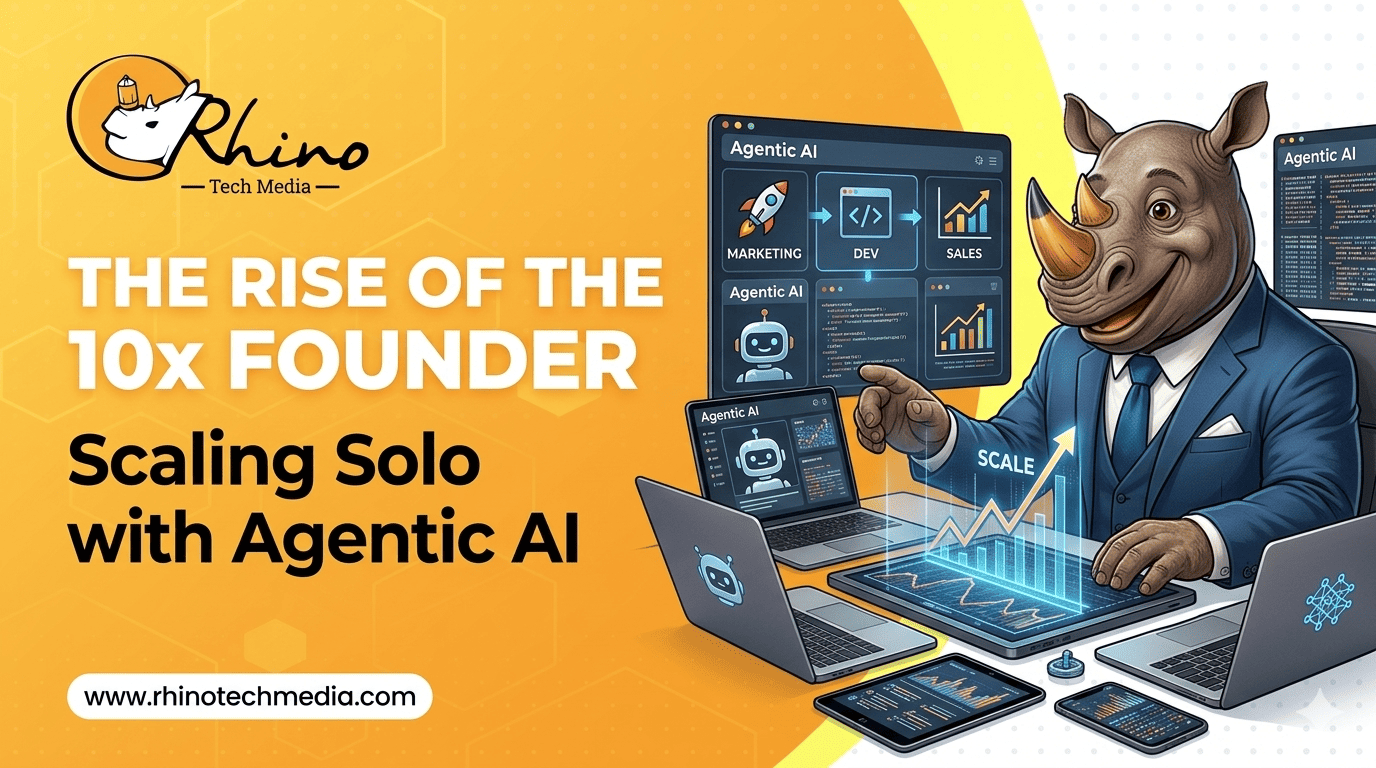
The startup landscape is undergoing a profound transformation, driven by the emergence of agentic artificial intelligence and the rise of what many are calling the “10x founder.” This new archetype represents a solo entrepreneur who leverages AI agents not just as tools, but as autonomous collaborators capable of executing complex workflows. In this paradigm, one individual can achieve the output of an entire team, redefining how businesses are built, scaled, and sustained in the digital age.
Traditionally, scaling a startup required hiring specialized teams across engineering, marketing, operations, and customer support. However, agentic AI is dismantling these constraints. Unlike earlier AI systems that responded to prompts, modern agentic systems can plan, act, iterate, and complete multi step tasks independently. This shift from assistance to autonomy is the foundation of the 10x founder phenomenon. According to recent industry insights, these systems are increasingly capable of functioning as “digital coworkers,” embedding themselves into daily workflows and executing tasks with minimal human intervention .
At the core of this transformation is the idea that AI can act as a “co founder.” From ideation to execution, AI agents now support nearly every stage of the entrepreneurial journey. They can conduct market research, generate product ideas, write code, design user interfaces, manage customer interactions, and even optimize marketing campaigns. This drastically reduces the time and cost required to launch a venture. What once took months of coordinated effort can now be achieved in days or even hours. In fact, studies show that AI augmented solo founders generate significantly higher revenue and are more likely to reach profitability compared to their non AI counterparts .
The economic implications of this shift are substantial. The cost of building and scaling a company has dropped dramatically, while the speed of execution has increased exponentially. Venture capital trends reflect this change, with billions of dollars flowing into agentic AI startups that promise autonomous business operations . At the same time, the number of solo founded startups is rising rapidly, signaling a broader shift toward lean, AI native business models . This is not just a technological evolution, but a structural change in how entrepreneurship functions.
One of the most compelling aspects of the 10x founder is the ability to scale without traditional headcount. AI agents can handle repetitive and time consuming tasks such as customer support, bookkeeping, and content creation, allowing founders to focus on strategic decision making and product innovation. This creates a new metric of efficiency, where success is measured not by team size but by output per individual. As noted in industry discussions, concepts like “revenue per employee” are being replaced by new metrics that reflect AI driven productivity .
However, this new model is not without challenges. While AI can automate execution, it does not fully replace human judgment, creativity, or strategic thinking. Founders must still define vision, validate ideas, and build meaningful relationships with customers and stakeholders. Moreover, the rapid pace of AI driven work can lead to cognitive overload, as individuals manage multiple AI systems and workflows simultaneously. Reports have highlighted concerns about mental fatigue and burnout among professionals heavily reliant on agentic AI tools .
Another critical challenge lies in differentiation. As AI tools become widely accessible, the barriers to entry for startups are lower than ever. This increases competition and makes it harder for founders to stand out. Success in the era of the 10x founder will depend on factors such as unique insights, proprietary data, strong branding, and effective distribution strategies. Simply using AI is no longer a competitive advantage, it is the baseline.
Despite these challenges, the trajectory is clear. We are moving toward a future where businesses are increasingly autonomous, and where the role of the founder is evolving from operator to orchestrator. Agentic AI enables a single individual to coordinate complex systems, manage multiple functions, and scale operations in ways that were previously unimaginable. This shift is giving rise to the concept of the “one person unicorn,” a billion dollar company built and run by a single founder with the support of AI agents .
In conclusion, the rise of the 10x founder represents a fundamental redefinition of entrepreneurship. Agentic AI is not just enhancing productivity, it is reshaping the very structure of organizations and the nature of work itself. Solo founders can now build, launch, and scale ventures with unprecedented speed and efficiency, challenging long held assumptions about team size and resource requirements. As this trend continues to evolve, the most successful founders will be those who can effectively harness AI while maintaining a clear vision, strategic focus, and human centric approach to innovation.
