
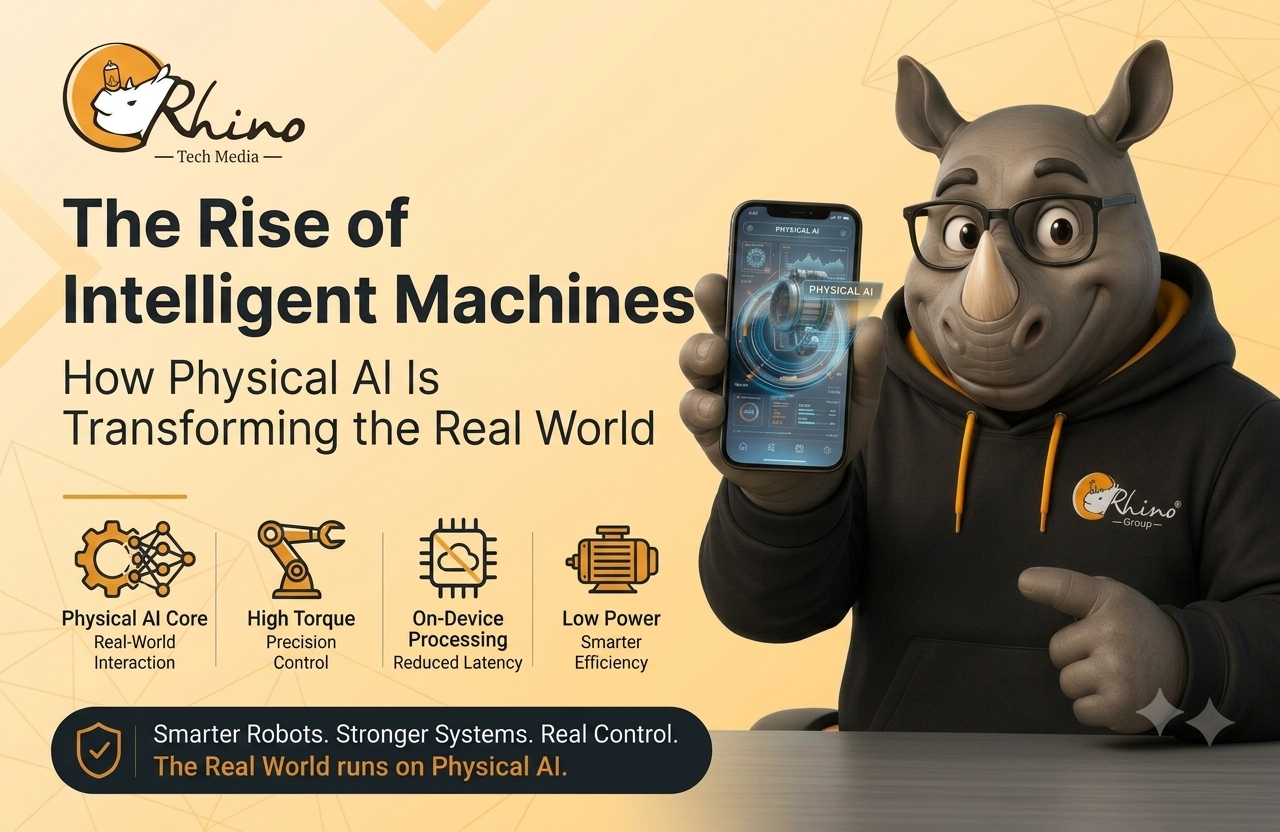
How Physical AI Is Transforming the Real World
Overview
Artificial intelligence is no longer confined to computers and digital assistants. In 2026, AI is increasingly being integrated into physical machines, giving rise to a new generation of intelligent robots capable of seeing, learning, adapting, and interacting with the world around them. This convergence of AI, robotics, advanced sensors, and edge computing—often referred to as Physical AI—is transforming industries by enabling machines to perform complex tasks with greater autonomy, precision, and efficiency.
Physical AI is driving innovation in:
- Manufacturing.
- Logistics.
- Healthcare.
- Agriculture.
- Construction.
- Retail.
- Transportation.
Unlike traditional robots that follow fixed, pre-programmed instructions, AI-powered robots can analyze their surroundings, make real-time decisions, and continuously improve through machine learning. They can:
- recognize objects.
- navigate dynamic environments.
- collaborate safely with human workers.
- adjust their behavior as conditions change.
These capabilities are making automation more flexible and practical across a wide range of industries. Beyond improving productivity, Physical AI is helping organizations address labor shortages, reduce operational costs, enhance workplace safety, and deliver higher-quality products and services. While human expertise remains essential, intelligent machines are increasingly serving as collaborative partners that augment human capabilities rather than replace them.
As the technology matures, Physical AI is expected to become one of the most significant drivers of digital transformation. Businesses that embrace intelligent robotics today will be better equipped to increase efficiency, foster innovation, and remain competitive in an increasingly automated and interconnected world.
Smarter Manufacturing
Manufacturing remains one of the largest adopters of Physical AI.
Intelligent robots are helping factories become more flexible by performing tasks such as:
- Product assembly
- Quality inspection
- Predictive maintenance
- Material handling
- Inventory movement
- Equipment monitoring
Using computer vision, AI systems can detect tiny manufacturing defects that may be invisible to the human eye. Predictive maintenance algorithms analyze machine performance and identify potential failures before they occur, reducing costly downtime and extending equipment life.
Smart factories also use autonomous mobile robots to transport materials efficiently throughout production facilities.
Revolutionizing Warehousing and Logistics
Warehouses are becoming increasingly automated with AI-powered robotics.
Modern logistics companies use intelligent robots for:
- Sorting packages
- Picking products
- Moving inventory
- Loading shipments
- Managing warehouse operations
- Inventory tracking
Autonomous mobile robots can safely navigate busy warehouses by avoiding obstacles, selecting efficient routes, and working alongside employees without requiring dedicated pathways.
These technologies help businesses fulfill orders more quickly while reducing operating costs and improving accuracy.
Transforming Healthcare
Healthcare is experiencing major advances through Physical AI.
Intelligent robotic systems now assist medical professionals by:
- Supporting minimally invasive surgeries
- Delivering medications
- Monitoring patients
- Assisting elderly individuals
- Transporting medical supplies
- Automating laboratory testing
AI-powered surgical robots provide greater precision during delicate procedures, while rehabilitation robots help patients regain mobility after injuries or strokes.
Hospitals are also using autonomous service robots to improve efficiency by handling routine logistical tasks, allowing healthcare professionals to spend more time with patients.
Precision Agriculture
Agriculture is becoming increasingly data-driven through intelligent robotics.
AI-powered farming equipment can:
- Identify weeds
- Monitor crop health
- Detect plant diseases
- Apply fertilizer precisely
- Harvest crops
- Monitor soil conditions
Drones equipped with AI analyze fields using high-resolution imagery, enabling farmers to identify problems early and optimize crop yields while reducing water usage and chemical applications.
Physical AI supports more sustainable farming by minimizing waste and improving resource management.
Construction Gets Safer and Smarter
Construction companies are adopting intelligent machines to improve safety and efficiency. The construction industry is embracing Physical AI to improve safety, productivity, and project efficiency. Traditionally, construction has relied heavily on manual labor, making it one of the most hazardous industries.
Physical AI supports:
- Autonomous surveying
- Site monitoring
- Structural inspections
- Heavy equipment assistance
- Material transportation
- Progress tracking
Today, intelligent robots, AI-powered equipment, drones, and autonomous machines are helping construction companies reduce risks, streamline operations, and complete projects faster while maintaining high quality standards.Robots can perform dangerous tasks in hazardous environments, reducing workplace accidents while helping projects stay on schedule.
Enhancing Workplace Safety
One of the greatest advantages of Physical AI is improving worker safety. Across industries such as manufacturing, construction, mining, healthcare, logistics, and energy, AI-powered machines are helping reduce workplace accidents by taking on dangerous, repetitive, and physically demanding tasks.
Intelligent robots can perform dangerous tasks including:
- Handling hazardous chemicals
- Working in extreme temperatures
- Heavy lifting
- Mining operations
- Nuclear facility inspections
- Disaster response
By taking on high-risk responsibilities, robots reduce workplace injuries while allowing employees to focus on supervision, maintenance, and higher-value activities.
Intelligent Robots in Retail
Retail businesses are increasingly deploying intelligent machines to improve customer experiences.
Applications include:
- Automated inventory scanning
- Shelf monitoring
- Store cleaning
- Customer assistance
- Smart checkout systems
- Order fulfillment
AI-powered robots can detect empty shelves, locate misplaced products, and provide real-time inventory updates, helping retailers improve operational efficiency and product availability.
Human-Robot Collaboration
Rather than replacing workers, modern intelligent robots are increasingly designed to work alongside people.
Collaborative robots, or cobots, are equipped with sensors and AI systems that allow them to detect nearby workers and adjust their movements to ensure safe interaction.
Human employees continue to provide creativity, judgment, and problem-solving skills, while robots contribute speed, precision, and endurance.
This partnership often leads to:
- Higher productivity
- Better product quality
- Reduced employee fatigue
- Increased workplace safety
- Greater operational flexibility
The future of human-robot collaboration will become even more intelligent as advances in generative AI, computer vision, and machine learning enable robots to understand natural language, recognize human intentions, and adapt to new tasks with minimal training.
Challenges Facing Physical AI
Despite rapid progress, several challenges remain.
Businesses must address issues such as:
- High implementation costs
- Workforce training
- Cybersecurity risks
- Data privacy
- Regulatory compliance
- Ethical use of AI
- System reliability
Organizations also need clear governance policies to ensure intelligent machines operate safely, transparently, and responsibly.
The Future of Intelligent Machines
The next generation of Physical AI will be even more capable, combining advances in generative AI, robotics, computer vision, and machine learning.
Future intelligent machines are expected to:
- Learn new tasks with minimal training
- Adapt to unfamiliar environments
- Collaborate with other robots
- Understand natural language more effectively
- Operate for longer periods with improved energy efficiency
- Perform increasingly complex physical tasks
As hardware becomes more affordable and AI models continue to improve, intelligent robotics will become accessible to businesses of all sizes, accelerating automation across nearly every industry.
Conclusion
Physical AI is transforming artificial intelligence from a purely digital technology into a real-world force capable of reshaping industries and everyday life. Intelligent machines are becoming smarter, more adaptable, and more collaborative, helping organizations improve efficiency, strengthen safety, reduce costs, and unlock new opportunities for innovation.
Rather than replacing human workers, the future of Physical AI lies in collaboration—where people and intelligent machines work together to solve complex challenges, boost productivity, and create more resilient businesses.
