
Overview
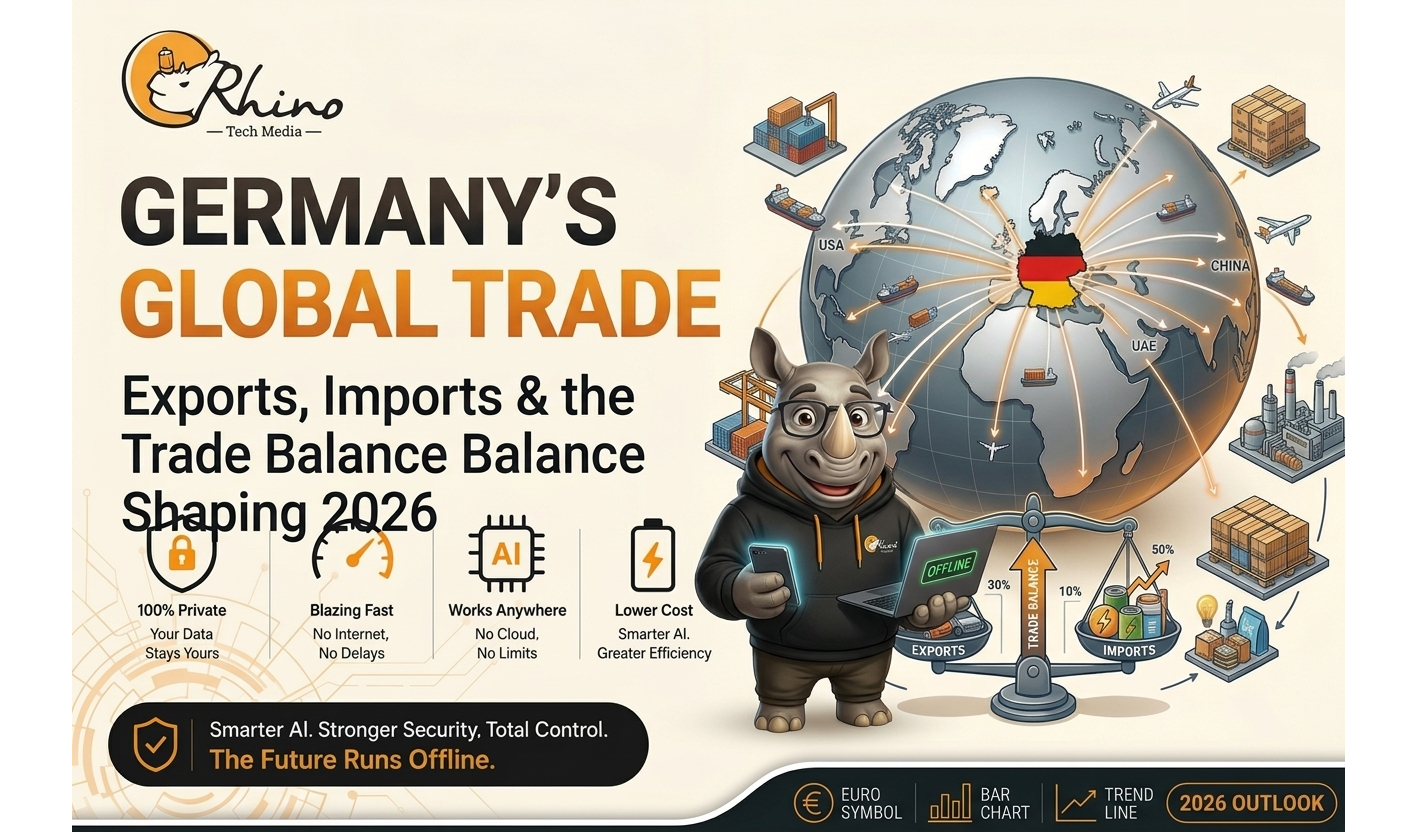
Germany remains one of the world’s leading trading economies, with exports playing a central role in its industrial strength and economic model. In 2026, however, Germany’s trade landscape is being reshaped by changing global demand, higher import costs, geopolitical tensions, supply-chain shifts and the transformation of its manufacturing base.
The country continues to generate a substantial trade surplus, but the balance between exports and imports is becoming increasingly important as German companies adapt to a more competitive and uncertain global marketplace.
Key Highlights
- l A Powerful export economy — Germany continues to rely heavily on exports of machinery, vehicles, industrial equipment, chemicals and other high-value manufactured goods.
- l Trade surplus remains significant — Germany maintains a positive trade balance, with exports exceeding imports and supporting the country’s position as a major global trading power.
- l Imports are becoming more strategically important — Germany depends on imported energy, raw materials, components, technology and consumer goods to support both industry and domestic demand.
- l China remains a major trade partner — China was Germany’s most important source of imports in the first five months of 2026, with German imports from China reaching €72.4 billion, up 6.2% from the same period in 2025.
- l Import costs are under pressure — Import prices rose 6.1% year-on-year in June 2026, driven particularly by higher prices for intermediate goods and energy.
- l Export prices are also rising — German export prices increased 3.5% in June 2026 compared with June 2025, reflecting higher prices for intermediate and capital goods.
- l Manufacturing remains at the core — Germany’s global trade strength continues to be closely linked to its industrial and manufacturing base, particularly automobiles, machinery, electrical equipment and chemicals.
- l The U.S. relationship matters — Germany’s trade surplus with the United States declined significantly in the first quarter of 2026, highlighting the impact of changing trade conditions and global demand.
- l Global supply chains are evolving — German companies are increasingly reassessing suppliers, production locations and logistics networks as geopolitical and economic risks reshape international trade.
- l 2026 is about resilience, not just volume — Germany’s future trade performance will increasingly depend on innovation, competitiveness, energy security, supply-chain diversification and access to global markets.
The Bigger Picture
Germany enters 2026 with a powerful export base, but the traditional model of “export more, manufacture more” is facing a changing global environment. The challenge is no longer simply maintaining a trade surplus — it is ensuring that German industry remains competitive while navigating higher costs, geopolitical uncertainty, changing consumer demand and the transformation toward a more digital, sustainable economy.
Germany’s trade balance therefore offers more than a snapshot of exports and imports. It is a window into the future of Europe’s largest industrial economy.
Germany’s Export Power
Exports remain one of the foundations of the German economy. German companies compete internationally in sectors where engineering expertise, technological quality and advanced manufacturing are major advantages.
Key export strengths include:
- l Automobiles and automotive components
- l Machinery and industrial equipment
- l Chemical and pharmaceutical products
- l Electrical equipment
- l Precision engineering and industrial technologies
- l Medical and scientific equipment
- l Advanced manufacturing products
The beginning of 2026 provided some positive momentum. In the first quarter, total German exports of goods and services increased by 3.3% after adjustment for prices, seasons and calendar effects. Chemicals, pharmaceuticals and metals contributed to the increase.
This suggests that Germany’s export sector is still capable of supporting economic growth despite a challenging global environment.
Imports Are Rising
Germany’s economy is also heavily dependent on imports.
German manufacturers require foreign supplies of energy, raw materials, electronic components, industrial inputs and other goods. At the same time, German consumers and businesses purchase increasingly large quantities of products manufactured abroad.
In April 2026, imports reached €122.1 billion, up 6.2% from April 2025. Imports therefore grew considerably faster than exports during the year-on-year comparison.
Major import categories include:
- l Energy and raw materials
- l Electronics and electrical equipment
- l Industrial components
- l Machinery and equipment
- l Chemicals
- l Consumer products
- l Automotive products
- l Technology-related goods
This makes imports an important indicator of both domestic demand and Germany’s industrial supply chains.
The Trade Balance Remains Positive
The difference between the value of exports and imports creates Germany’s trade balance.
When exports exceed imports, the country records a trade surplus.
Germany continued to record a substantial surplus in 2026. For example:
- l January 2026: €21.2 billion seasonally and calendar adjusted
- l February 2026: €19.8 billion
- l March 2026: €14.3 billion
- l April 2026: €14.5 billion
The pattern shows that Germany remains a strong net exporter, although the monthly surplus can fluctuate considerably.
The United States: A Critical Trade Relationship
The United States remains one of Germany’s most important export markets, particularly for high-value industrial products, vehicles, machinery, pharmaceuticals and electrical equipment.
But 2026 has brought additional pressure to this relationship.
In the first quarter of 2026, Germany’s goods exports to the United States fell 12.1% year-on-year to €36.2 billion, while imports from the U.S. increased 1.9% to €23.8 billion.
As a result, Germany’s export surplus with the United States fell to €12.4 billion, down 30.5% from €17.8 billion in the first quarter of 2025.
The automotive sector was particularly affected. German exports of cars and automotive components to the United States fell 28.4% in the first quarter compared with the previous year.
Why it matters
The U.S. market has historically been an important source of German export demand. Changes in tariffs, trade policy and consumer demand can therefore have a direct impact on German manufacturers.
China: Major Supplier, Major Market
China plays a different but equally important role in Germany’s trade structure.
Germany exports significant quantities of industrial and high-value products to China while also importing enormous volumes of manufactured goods, components and technology-related products.
In April 2026, China was Germany’s largest source of imports, with imports worth €15.6 billion on a seasonally and calendar-adjusted basis.
This creates both opportunities and challenges.
Germany benefits from:
- l Access to one of the world’s largest consumer markets
- l Chinese demand for German industrial products
- l Competitive global supply chains
- l Access to manufactured components and goods
At the same time, Germany faces:
- l Greater competition from Chinese manufacturers
- l Dependence on certain imported products
- l Supply-chain vulnerabilities
- l Increasing pressure on traditional German industrial sectors
The relationship is therefore becoming increasingly strategic rather than simply commercial.
Europe Remains Germany’s Trade Foundation
Despite the importance of the United States and China, Europe remains central to Germany’s trading system.
In April 2026, Germany exported €79.1 billion worth of goods to EU member states and imported €61.0 billion from the EU.
This highlights the importance of the European single market.
Germany’s geographic position in the center of Europe gives its companies access to a huge network of customers, suppliers and production partners.
Key advantages include:
- l Integrated European supply chains
- l Common market access
- l Shorter transportation distances
- l Shared industrial standards
- l Strong cross-border manufacturing networks
- l Access to millions of consumers
Europe therefore remains the backbone of Germany’s international trade strategy.
Manufacturing Is Still at the Core
Germany’s trade performance cannot be separated from its manufacturing sector.
For decades, the country’s economic model has been built around producing sophisticated industrial goods and selling them around the world.
The model includes:
Research → Engineering → Manufacturing → Export → Global Markets
Automobiles, machinery, chemicals, pharmaceuticals and electrical equipment have traditionally generated substantial export revenues.
But the industrial model is now undergoing a major transformation.
The next phase of German manufacturing will increasingly depend on:
- l Artificial intelligence
- l Industrial automation
- l Robotics
- l Semiconductor technology
- l Electric vehicles
- l Battery technology
- l Renewable energy
- l Digital manufacturing
- l Advanced materials
- l Smart factories
Germany’s ability to remain an export leader will increasingly depend on how successfully its manufacturers adapt.
The Automotive Challenge
The automotive industry remains one of Germany’s most recognizable export sectors, but it is undergoing major structural change.
The transition from internal-combustion vehicles toward electric and software-defined vehicles is changing global competition.
German manufacturers are facing competition from both established international companies and rapidly growing Chinese electric-vehicle producers.
The pressure is particularly visible in Germany’s U.S. trade relationship: vehicle and component exports to the United States dropped sharply in the first quarter of 2026.
The automotive industry must increasingly compete on:
- l Electric vehicles
- l Battery technology
- l Software
- l Autonomous driving
- l AI-powered systems
- l Manufacturing efficiency
- l Cost competitiveness
- l Global supply chains
The future of Germany’s automotive exports will therefore depend not simply on how many vehicles the country produces, but on what kind of vehicles it produces and how competitive they are globally.
Digitalization Could Strengthen German Exports
Digital transformation is creating another opportunity.
AI, automation, industrial software and connected manufacturing systems can help German companies produce more efficiently and develop higher-value products.
Digital trade competitiveness could come from:
- l AI-powered production
- l Predictive maintenance
- l Smart factories
- l Industrial robotics
- l Digital twins
- l Automated logistics
- l Advanced data analytics
- l Connected supply chains
Germany’s traditional industrial expertise combined with next-generation digital technologies could create a powerful new export model.
Germany’s Trade Volume Is Recovering — But Not Fully
An important distinction in Germany’s trade data is the difference between trade value and trade volume.
Nominal export and import values can rise because prices increase, even when the physical quantity of goods traded does not rise at the same rate.
Destatis reported that in April 2026, German export volume was 4.8% higher than a year earlier, while import volume was 2.8% higher.
However, the longer-term picture remains more challenging.
Germany’s 2025 export volume was 1.3% higher than in 2024, but still 6.3% below the 2019 level. Import volume was 1.6% higher than in 2024 but remained 4.2% below 2019 levels.
This indicates that Germany’s international trade is recovering in some areas, but the country’s trade structure has not simply returned to its pre-pandemic trajectory.
The Biggest Risks to Germany’s Trade Balance
Germany’s trade surplus is not guaranteed.
Several factors could put pressure on exports and imports in the coming years.
Key risks include:
- l Trade tariffs — Higher tariffs can make German products more expensive in overseas markets.
- l Weak global demand — A slowdown in major economies can reduce demand for German machinery, vehicles and industrial products.
- l Automotive disruption — The shift toward electric vehicles is intensifying competition.
- l Energy costs — High energy prices can reduce the competitiveness of energy-intensive industries.
- l Geopolitical tensions — Conflicts and political disputes can disrupt trade routes and supply chains.
- l China competition — Chinese companies are becoming increasingly competitive in sectors traditionally dominated by European manufacturers.
- l Supply-chain disruptions — Dependence on foreign components and raw materials can create vulnerabilities.
- l Currency movements — Changes in exchange rates can influence the international price competitiveness of German products.
What Could Strengthen Germany’s Export Future?
Germany still possesses major advantages that could support its position as a global trading power.
Potential growth drivers include:
- l Advanced manufacturing
- l Industrial AI
- l Robotics
- l Green technologies
- l Pharmaceuticals
- l Semiconductor production
- l Renewable-energy equipment
- l Defense technology
- l High-value machinery
- l Digital industrial services
The opportunity is to move from an economy primarily focused on selling traditional industrial products toward one increasingly focused on selling advanced technologies and high-value solutions.
Conclusion
Germany enters 2026 with its position as a global trading powerhouse largely intact, but the forces shaping its trade balance are changing rapidly. Exports continue to generate substantial value, while rising imports reflect Germany’s deep integration into global supply chains and growing dependence on international sources of energy, technology, components and raw materials.
The traditional German export model — built on automobiles, machinery, chemicals and advanced manufacturing — now faces stronger global competition, changing trade policies, higher costs and a major technological transition. At the same time, new opportunities are emerging in artificial intelligence, robotics, clean technology, advanced manufacturing, pharmaceuticals and digital industrial solutions.
The future of Germany’s trade balance will therefore depend on more than export volumes. Competitiveness, innovation, productivity, energy security and supply-chain resilience will increasingly determine Germany’s place in global commerce.
Germany still has enormous industrial strengths. The challenge for 2026 and beyond is to transform those strengths for a new era of global trade.
The German trade engine is still powerful — but its next chapter will be defined by how successfully it adapts.
