
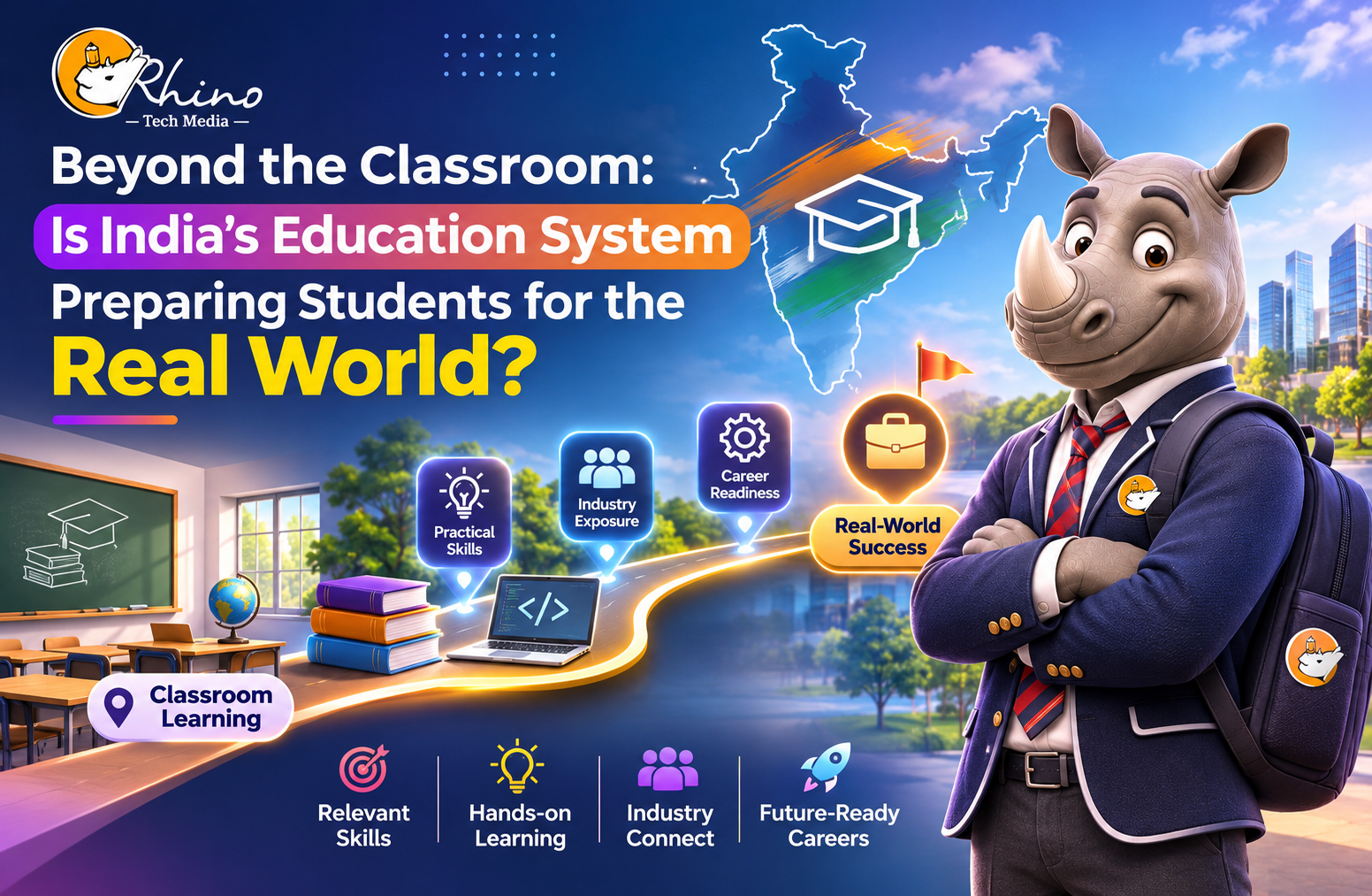
Getting good marks, earning a degree and finding a decent job. For many Indian families, this is what a successful education looks like. Parents spend years supporting their children’s studies, while students work hard to meet academic expectations. But what happens when graduation is over?
A young graduate moves to another city for work, attends their first interview or starts managing their own expenses. Suddenly, knowing textbook answers is not enough. They need to communicate confidently, make decisions, solve problems and adapt to unfamiliar situations.
This is where an important question arises: Are we teaching students how to live and work in the real world, or mainly preparing them to pass examinations?
India has made significant progress in expanding access to education. However, the growing gap between academic learning and practical abilities deserves attention, particularly as technology and workplace expectations continue to change.
1. When Good Marks Are Not Enough?
A student who scores 95% may have excellent subject knowledge but struggle to explain an idea during a presentation. Another student with average marks might confidently handle a project, work with a team and find solutions to practical challenges.
This does not mean academic performance is unimportant. Rather, it shows that marks cannot measure every ability a person needs.
According to Mercer | Mettl’s India Graduate Skill Index 2025, only 42.6% of Indian graduates who apply for jobs are considered overall employable. The assessment covered more than one million students across over 2,700 campuses.
The findings highlight the importance of developing skills alongside academic qualifications.
Students need opportunities to practise:
- Communication and presentation.
- Critical thinking and decision-making.
- Problem-solving and teamwork.
- Digital literacy and technology use.
- Adaptability and professional behaviour.
These abilities help graduates apply their knowledge instead of simply remembering it.
2. Are Examinations Taking Priority Over Actual Learning?
Ask a student about their examination preparation, and you will often hear about revision schedules, mock tests, memorised answers and marks.
For many, academic success revolves around completing the syllabus and securing a good rank. Competitive examinations and admission requirements add further pressure.
The problem is not examinations themselves. It is the excessive importance placed on them.
For example, a science student may memorise environmental concepts without participating in a local conservation project. A commerce student may understand accounting formulas but never prepare a practical household or business budget.
When learning becomes centred on examinations, students get fewer opportunities to:
- Experiment and learn from mistakes.
- Question information and develop independent opinions.
- Connect classroom lessons with everyday situations.
- Explore creative interests and different career paths.
Assessment should recognise understanding and practical application, not just the ability to reproduce information under examination conditions.
3. Why the Gap Between Colleges and Employers Matters?
Completing a degree is an achievement, but entering the workforce brings an entirely different set of expectations.
Consider an engineering graduate applying for their first job. They may understand technical concepts but have limited experience working on actual projects. Similarly, a management graduate may know business theories but struggle to communicate with clients or coordinate a team.
Employers increasingly value practical experience alongside qualifications.
Educational institutions can make the transition easier through:
- Internships with relevant organisations.
- Industry-based assignments and projects.
- Workshops led by working professionals.
- Career guidance and workplace mentoring.
- Opportunities to solve actual business or community problems.
Students do not need years of professional experience before graduation. Even a short internship or a well-designed college project can help them understand workplace responsibilities.
The World Economic Forum’s Future of Jobs Report 2025 also highlights the changing skills employers expect as industries evolve.
4. What About the Life Skills Students Rarely Learn?
Education should prepare young people for personal responsibilities as well as professional careers.
Imagine receiving your first salary. You need to pay rent, manage monthly expenses, save money and make sensible financial decisions. These responsibilities can feel overwhelming when nobody has taught you the basics.
Some essential life skills deserve greater attention in schools and colleges.
Financial literacy: Students should understand budgeting, savings, interest rates, loans and responsible spending.
Emotional intelligence: Learning to manage stress, accept feedback and handle disagreements can improve personal and professional relationships.
Communication: Speaking confidently, listening carefully and expressing opinions respectfully are useful in almost every situation.
Digital awareness: Young people should understand online privacy, misinformation, cybersecurity and responsible use of artificial intelligence.
These lessons can help students become more independent and better prepared for everyday challenges.
5. Can NEP 2020 Make Indian Education More Practical?
India has recognised the need to move beyond traditional teaching methods through the National Education Policy (NEP) 2020.
The policy promotes experiential learning, critical thinking, vocational education and greater flexibility in choosing subjects.
Some of its important recommendations include:
- Introducing vocational education from Grade 6.
- Providing practical learning and internship opportunities.
- Reducing unnecessary curriculum content.
- Encouraging creativity and independent thinking.
- Connecting academic knowledge with real-life experiences.
For instance, students could explore gardening, carpentry or pottery through hands-on activities rather than learning about occupations only through textbooks.
However, successful implementation requires trained teachers, appropriate infrastructure and sufficient resources.
Read the National Education Policy 2020 to understand India’s approach to transforming education.
6. What Can Schools, Parents and Students Do Differently?
Improving education does not depend on government policies alone. Everyday learning experiences also need to change.
Schools and colleges can:
- Introduce practical assignments and collaborative projects.
- Organise internships and industry visits.
- Encourage discussions, presentations and debates.
- Include financial and digital literacy in learning programmes.
Parents can:
- Encourage children to explore interests beyond academics.
- Teach basic money management and household responsibilities.
- Allow children to make age-appropriate decisions.
- Focus on confidence and personal development, not just marks.
Students can:
- Participate in volunteering and extracurricular activities.
- Take online courses to develop additional skills.
- Build personal projects related to their interests.
- Seek internships and practical learning opportunities.
For example, organising a college event teaches planning, communication and teamwork. Creating a small website develops digital knowledge and problem-solving abilities.
These experiences may seem simple, but they can make the transition into adult life much easier.
7. Preparing for Jobs That Do Not Yet Exist
The future workplace will not necessarily look like the one students see today.
Artificial intelligence, automation and digital transformation are changing how businesses operate. New opportunities are emerging, while some existing roles are being redesigned.
The World Economic Forum’s Future of Jobs Report 2025 estimates that 39% of workers’ existing skill sets could be transformed or become outdated between 2025 and 2030.
This makes continuous learning essential.
A marketing graduate, for example, may need to understand social media analytics, AI tools and changing consumer behaviour. An engineering professional may have to learn new software and technologies throughout their career.
Students should therefore develop the confidence to learn new things rather than depend entirely on what they studied in college.
Conclusion: Education Should Prepare Students for Life
India’s education system has an opportunity to do more than produce graduates with impressive academic records. It must help young people become confident professionals, responsible citizens and independent individuals. Academic knowledge remains important, but practical experience, financial awareness, communication and critical thinking deserve equal attention.
The National Education Policy 2020 provides a promising direction, but its success depends on meaningful changes in classrooms, teaching methods and career preparation. Schools, colleges, parents and employers must work together to make learning relevant to everyday life.
Ultimately, a student’s success should not be measured only by examination results or the degree they hold. It should also reflect how well they can use their knowledge, face challenges and adapt to change.
Let’s move beyond marks and start preparing students for the world they will actually live in. The future of India depends on what its young people know, but equally on what they can do with that knowledge.
