
Overview
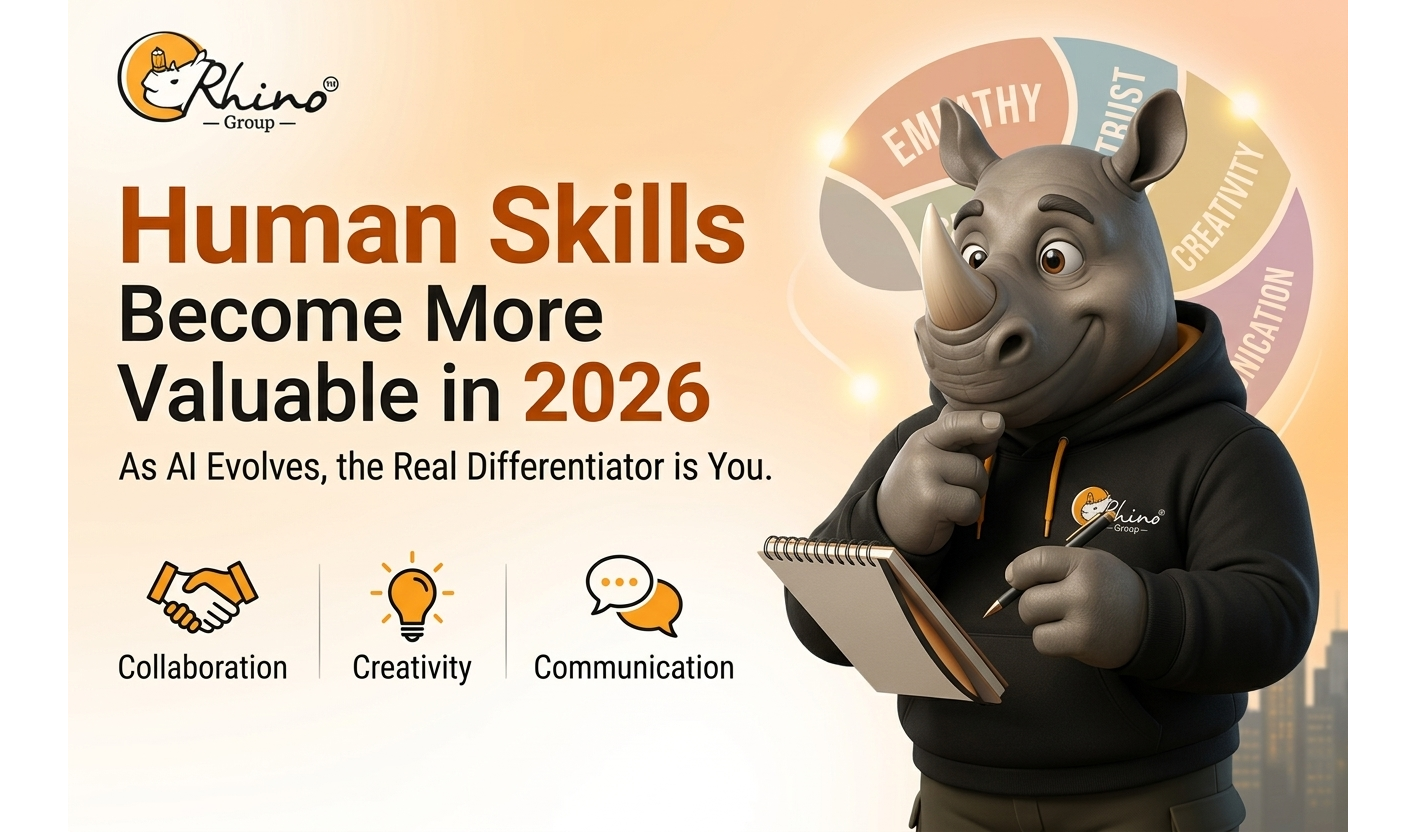
As AI takes over more routine and repetitive tasks, human capabilities are becoming a stronger source of differentiation. In 2026, businesses increasingly need people who can combine AI literacy with creativity, judgment, communication and adaptability. The World Economic Forum identifies creative thinking, resilience, flexibility, agility, leadership and analytical thinking among the skills expected to remain highly important through 2030.
- Adaptability is essential — Employees need to continuously learn, adjust to new technologies and respond to changing business environments.
- Critical thinking matters more — As AI generates information and recommendations, humans remain responsible for evaluating accuracy, context and consequences.
- Creativity becomes a competitive advantage — Original ideas, strategic thinking and innovative problem-solving are increasingly valuable as routine creative tasks become easier to automate.
- Emotional intelligence gains importance — Empathy, active listening and understanding people are difficult to replicate through automation and remain important for leadership and collaboration.
- Communication becomes more valuable — Clear communication, persuasion, negotiation and relationship-building help teams work effectively alongside AI.
- Leadership and judgment stand out — Businesses need people who can make decisions, take responsibility and guide teams when technology cannot provide a complete answer.
- Collaboration becomes human + AI — The future isn’t simply humans versus AI; successful workers will increasingly know how to combine technological tools with human expertise.
- Lifelong learning becomes the norm — With skills changing rapidly, continuous upskilling and reskilling are becoming essential for long-term employability.
- l Human agency becomes important — As AI influences more workplace decisions, maintaining human oversight, accountability and ethical judgment becomes increasingly important.
Key takeaway
In 2026, AI skills get you into the conversation—but human skills help you stand out.
The strongest professionals will be those who can use AI efficiently while thinking creatively, communicating clearly, adapting quickly and making sound human decisions.
Artificial intelligence is changing the way people work, but it is also changing what makes human contribution valuable. As AI takes over more repetitive tasks—from data processing and routine analysis to content generation and basic decision support—businesses are placing greater emphasis on capabilities that depend on human judgment, creativity, relationships and leadership.
PwC’s 2026 Global AI Jobs Barometer, based on more than one billion job advertisements across 27 countries, found that AI-exposed roles are increasingly adding tasks that depend on human-intensive skills such as empathy, judgment and creativity. These skills are being added 2.5 times faster in the most AI-exposed roles than in the least exposed roles.
The message for 2026 is clear: AI proficiency matters, but knowing how to think, lead, communicate and create value remains distinctly human.
1. Adaptability Becomes Essential
Technology and workplace expectations are changing faster than traditional career paths. Employees can no longer depend only on the skills they learned at the beginning of their careers.
- Ability to learn new tools and technologies
- Willingness to change established working methods
- Continuous upskilling and reskilling
- Ability to remain effective during uncertainty
- Openness to new responsibilities and roles
Why it matters: AI is changing the skills required for AI-exposed jobs more than twice as quickly as for less-exposed roles.
2. Creativity Becomes a Competitive Advantage
AI can generate text, images, ideas and solutions at remarkable speed. But businesses still need people who can identify which ideas are meaningful, relevant and worth pursuing.
- Original thinking
- Creative problem-solving
- Concept development
- Connecting seemingly unrelated ideasl Finding new opportunities
- Turning information into innovative solutions
Creativity is therefore moving from being a desirable quality to becoming an important source of competitive advantage.
3. Critical Thinking & Judgment Matter More
AI can provide recommendations, but humans still need to determine whether those recommendations make sense.
Employees increasingly need to:
- Question AI-generated information
- Evaluate accuracy and reliability
- Understand context
- Identify risks
- Compare different solutions
- Make complex decisions
- Take responsibility for outcomes
PwC’s 2026 research shows that AI-exposed entry-level jobs are increasingly demanding traditionally senior capabilities such as judgment, leadership and strategic thinking.
4. Emotional Intelligence Gains Importance
Technology can process information, but human relationships remain central to business.
Emotional intelligence includes:
- Empathy
- Active listening
- Understanding customer needs
- Managing conflict
- Building trust
- Reading social situations
- Supporting colleagues
As workplaces become more technologically advanced, the ability to understand and work effectively with people can become an even stronger differentiator.
5. Communication Becomes a High-Value Skill
When AI can produce information instantly, communicating that information effectively becomes increasingly important.
Strong professionals will need to:
- Explain complex ideas simplyl Persuade and influence
- Present ideas clearly
- Negotiate effectively
- Communicate across cultures and teams
- Build strong professional relationships
The value isn’t simply in having information—it is in knowing how to communicate it and what to do with it.
6. Leadership Moves Earlier in Careers
AI is changing the traditional career ladder. Junior employees may increasingly be expected to handle responsibilities that previously required years of experience.
PwC found that AI-exposed entry-level positions are seven times more likely to require traditionally senior skills such as leadership and strategic thinking. These “seniorised” entry-level roles have grown 35% since 2019.
This means future professionals may need to develop leadership capabilities much earlier.
Key leadership skills include:
- Decision-making
- Team management
- Strategic thinking
- Accountability
- Motivation
- Stakeholder management
- Managing change
7. Human + AI Collaboration Becomes the New Model
The future of work isn’t simply humans versus AI.
The stronger model is:
AI handles scale + Humans provide judgment.
AI can help employees:
- Analyze large amounts of information
- Automate repetitive work
- Generate first drafts
- Identify patterns
- Speed up research
- Improve productivity
Humans can then focus more heavily on:
- Strategy
- Creativity
- Relationships
- Decision-making
- Innovation
- Leadership
PwC’s 2026 research suggests that organizations achieving the greatest returns from AI are using it to amplify human expertise rather than simply replace human work.
8. Empathy Becomes a Business Skill
Empathy is no longer limited to personal relationships or customer service. It increasingly influences product development, management, marketing and organizational culture.
Understanding:
- What customers actually need
- Why people behave differently
- What employees are experiencing
- How different audiences respond
- What motivates people
can help companies make better decisions than data alone.
9. Lifelong Learning Becomes the New Normal
In the AI economy, expertise cannot remain static.
Professionals will increasingly need to combine:
Existing expertise + AI literacy + new human skills
This means learning becomes an ongoing process rather than something that ends with formal education.
Businesses, meanwhile, will need to rethink training, mentorship and career development as AI changes job requirements. PwC specifically recommends redesigning early-career pathways and investing in human-intensive skills alongside AI capabilities.
What This Means for Businesses in 2026
Companies should not think of AI only as an automation tool. The bigger opportunity is to redesign work around the strengths of both technology and people.
Businesses can focus on:
- Training employees to work effectively with AI
- Developing leadership and strategic thinking
- Encouraging creativity and experimentation
- Strengthening communication and collaboration
- Building continuous-learning cultures
- Giving employees access to AI tools
- Keeping human oversight in important decisions
- Redesigning jobs instead of simply eliminating tasks
The companies that benefit most may be those that understand that technology creates greater value when it amplifies human expertise.
The Bigger 2026 Trend
The workplace is moving from:
“What can AI do?”
to:
“What can humans do better because of AI?”
AI can increase speed, scale and efficiency. But creativity, judgment, empathy, leadership, adaptability and meaningful human connection remain critical sources of value.
Conclusion
In 2026, the future of work is not about choosing between humans and AI—it is about bringing the strengths of both together. As artificial intelligence takes on more routine and repetitive tasks, uniquely human abilities such as creativity, critical thinking, empathy, communication, leadership and adaptability are becoming increasingly valuable.
The professionals and businesses that thrive will be those that embrace AI while investing in people. Technology can provide speed, scale and efficiency, but humans bring context, judgment, imagination and emotional intelligence.
The competitive advantage of the future will not simply be knowing how to use AI—it will be knowing what to do with it.
official hyperlinks to the websites and reports referred to in the Human Skills Become More Valuable in 2026 topic:
1. PwC — 2026 Global AI Jobs Barometer
Read the official PwC 2026 Global AI Jobs Barometer
This was the main source for statistics and insights about judgment, creativity, leadership, AI-exposed jobs, changing skill requirements, and human-intensive skills.
2. PwC — Full 2026 Global AI Jobs Barometer Report
Download the full PwC 2026 report
3. World Economic Forum — Future of Jobs Report 2025
Read the World Economic Forum Future of Jobs Report 2025
This report supports the broader discussion around the growing importance of technological skills alongside human, cognitive and collaboration skills in the changing global workforce.
