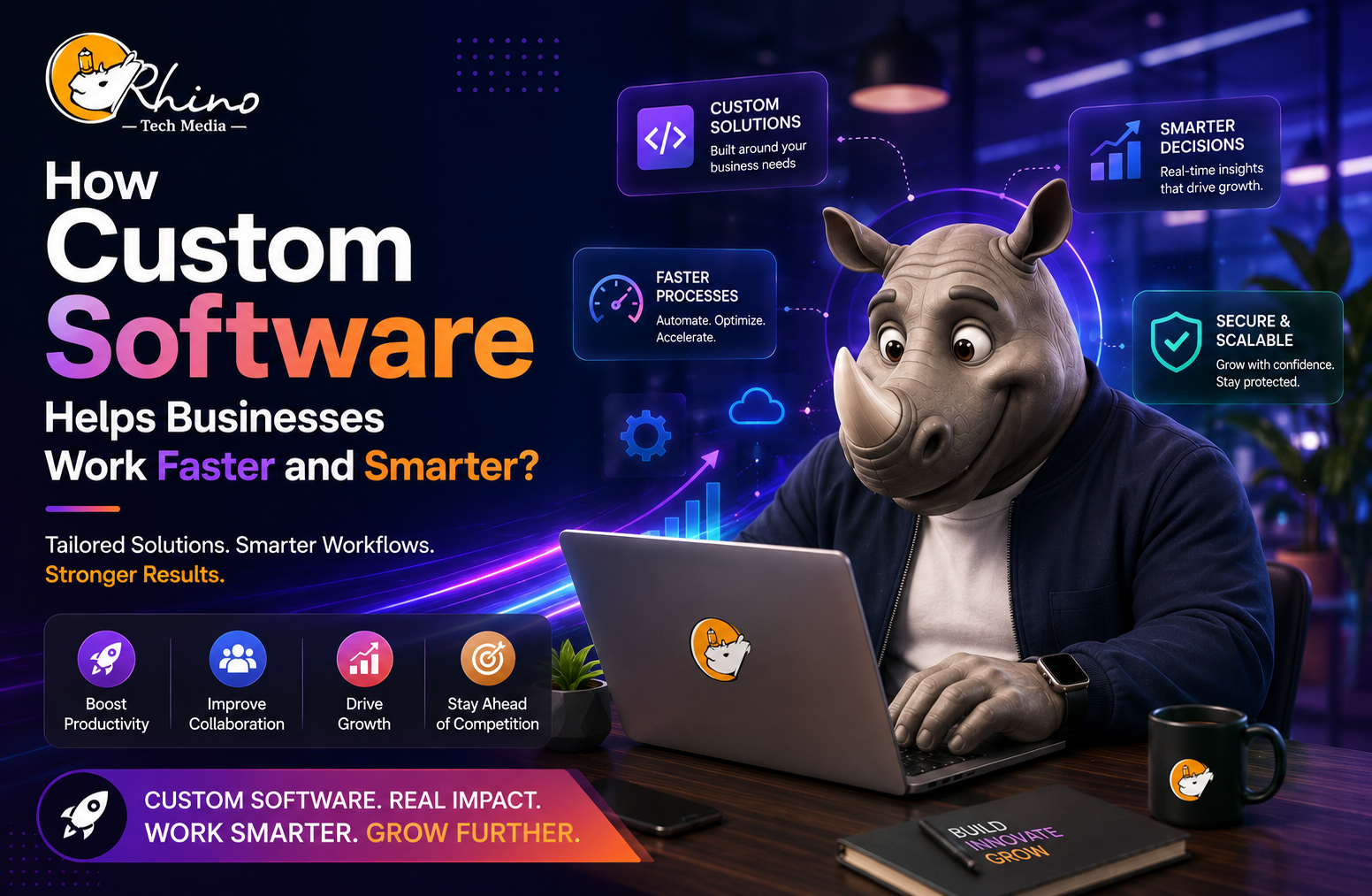
Businesses are always looking for ways to save time, improve productivity, and deliver better customer experiences. Yet many still rely on spreadsheets, emails, manual data entry, and disconnected systems.
These methods may work at first, but as a business grows, they can lead to delays, errors, and unnecessary costs.
This is where custom software development can help.
Instead of forcing a business to adapt to generic software, a custom solution is built around its workflows, employees, customers, and goals.
According to Gartner, the global custom software development services market is expected to exceed $283 billion by 2028, showing the growing demand for tailored technology solutions.
What Is Custom Software?
Custom software is an application developed specifically for a business or a particular business requirement.
Unlike off-the-shelf software, it can be designed around existing processes and adapted as the company grows.
Common examples include:
- Custom CRM systems
- Inventory management platforms
- Employee portals
- Customer dashboards
- Booking systems
- Workflow automation tools
- Business intelligence platforms
- Industry-specific applications
The goal is simple: make business operations faster, easier, and more reliable.
Why Do Businesses Need Custom Software?
Generic software can work well for standard requirements. Problems often arise when a company has specialised processes or several systems that need to work together.
Employees may spend hours:
- Entering the same information multiple times
- Searching through spreadsheets
- Preparing reports manually
- Sending repetitive emails
- Waiting for approvals
- Moving data between applications
A tailored system can reduce this manual work by connecting important processes in one place.
Key Benefits of Custom Software
1. Automate Repetitive Tasks
Automation can handle predictable tasks that previously required manual effort.
For example, when a wholesale customer places an order, a custom system could automatically update inventory, create an invoice, notify the warehouse, and send an order confirmation.
The result: faster processing, less manual work, and fewer errors.
2. Connect Business Systems
Businesses often use separate platforms for sales, accounting, inventory, customer support, and delivery.
When these systems don’t communicate properly, employees have to transfer information manually.
Custom software can connect existing applications through APIs and integrations, helping businesses:
- Reduce duplicate data entry
- Keep information consistent
- Improve workflow visibility
- Access information faster
3. Give Employees Faster Access to Information
Important information is often scattered across spreadsheets, emails, and different applications.
A custom dashboard can bring essential data into one place, including:
- Sales performance
- Inventory levels
- Customer orders
- Outstanding payments
- Project progress
- Support requests
This saves time and supports better data-driven decision-making.
4. Improve Employee Productivity
A well-designed system can remove unnecessary steps from everyday work.
For example, a service company could use custom software to automatically create support tickets, assign them to employees, set priorities, notify customers, and track progress.
Employees spend less time on administration and more time on valuable work.
According to McKinsey, high-performing IT organisations have achieved significantly stronger revenue growth and profit margins than lower-performing organisations.
This doesn’t mean custom software automatically increases profits, but it highlights the importance of technology as a strategic business investment.
5. Improve Customer Experience
Customers expect quick and convenient service.
Custom applications can provide features such as:
- Order tracking
- Customer portals
- Online payments
- Service request tracking
- Invoice downloads
- Automated notifications
For example, a customer portal can allow users to check their order status without contacting support.
This improves convenience while reducing repetitive enquiries.
6. Build Around Your Business
Every company operates differently.
A logistics company has different requirements from a retailer, manufacturer, or professional services firm.
Custom software can be designed around:
- Business workflows
- Employee roles
- Customer needs
- Industry requirements
- Existing applications
- Future growth
This makes the technology more relevant to the people using it.
7. Support Business Growth
As a company grows, so does its data, workforce, customer base, and operational complexity.
A scalable software solution can grow with the business by adding:
- New users
- Additional locations
- More integrations
- Advanced reporting
- New workflows
- Automation features
Businesses don’t need to build everything at once. Starting with the biggest problem and expanding gradually is often a better approach.
Custom Software and AI
Artificial intelligence is creating new possibilities for business applications.
AI can be integrated into software for practical uses such as:
- Automated document processing
- Intelligent search
- Customer support assistants
- Predictive analytics
- Automated reporting
- Data classification
This is particularly relevant in India. According to Deloitte’s 2026 India findings, 40% of surveyed Indian organisations reported significant or full AI usage, compared with approximately 28% globally.
The key is to use AI where it solves a genuine business problem rather than adopting it simply because it is trending.
Is Custom Software Right for Your Business?
Custom development may be worth considering if:
- Your team relies heavily on spreadsheets
- Employees repeatedly enter the same data
- Existing systems don’t integrate properly
- Manual processes are slowing operations
- Managers lack timely business information
- Customers frequently request updates
- Standard software doesn’t meet your requirements
- Your company is preparing for significant growth
However, custom software isn’t always the answer. Start by identifying the actual business problem.
How to Start a Custom Software Project?
1. Identify the Bottleneck
Find the processes that consume the most time or cause frequent errors.
2. Define the Goal
Decide what you want to improve, such as processing time, accuracy, costs, or customer response speed.
3. Prioritise Features
Start with the features that solve the biggest problems. Avoid unnecessary complexity.
4. Plan Security and Integration
Consider user permissions, data protection, backups, APIs, compliance, and third-party integrations from the beginning.
5. Measure the Results
Track processing time, error rates, employee adoption, customer response time, costs, and satisfaction after launch.
Conclusion
Custom software can help businesses replace manual work and disconnected systems with more efficient digital processes.
From automating repetitive tasks to connecting applications, improving access to information, and creating better customer experiences, the right solution can make everyday operations easier and more scalable.
The key is to start with a business problem, not technology for its own sake. Identify the biggest bottlenecks, set measurable goals, and build the features that deliver real value.
With automation, analytics, and AI continuing to evolve, custom software can become an important part of a business’s long-term growth strategy.
If inefficient workflows are slowing your team down, speak with an experienced custom software development partner to explore a practical solution built around your business needs.
