
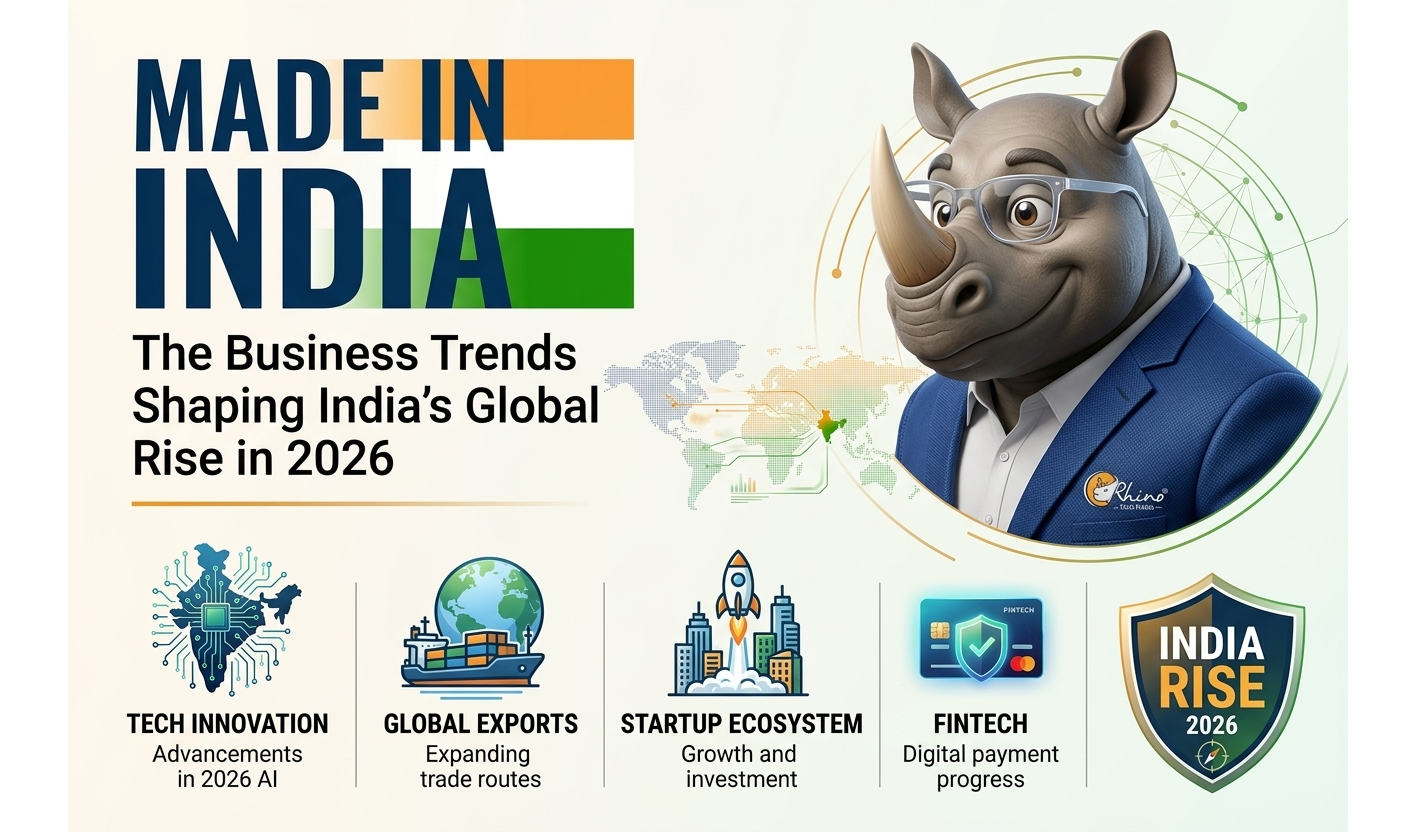
The Business Trends Shaping India’s Global Rise in 2026
Overview
India is entering 2026 with a business landscape increasingly shaped by technology, manufacturing, innovation and global integration. The country is moving beyond its traditional strength in IT and services toward a broader economic model that combines digital infrastructure, advanced manufacturing, artificial intelligence, semiconductors, startups and expanding global supply chains.
The Economic Survey 2025–26 highlights structural transformation, industry, infrastructure, services and AI as important drivers of India’s next phase of growth. Manufacturing recorded strong momentum, while continued investment in infrastructure is supporting greater capacity and competitiveness.
At the same time, India is positioning itself as a more important player in global technology and manufacturing. Government initiatives around AI, semiconductors, electronics, logistics and exports are designed to attract investment, strengthen domestic capabilities and connect Indian businesses more deeply with international markets.
Key Business Trends Shaping India in 2026
- l AI Becomes a Business Growth Engine
Artificial intelligence is moving rapidly from experimentation to practical business applications. India’s AI ecosystem is expanding across startups, enterprises, manufacturing, financial services, healthcare and public-sector applications. The IndiaAI Mission is supporting computing infrastructure, AI development, startups and skills. - l India Builds a Semiconductor Industry
Semiconductors are becoming a strategic priority as India seeks to move from being a major technology consumer to an important producer and supplier. In July 2026, the government approved Semicon 2.0, with a reported outlay of ₹1.275 trillion, covering chip design, fabrication, packaging, materials, equipment and ecosystem development. - l Manufacturing Moves Up the Value Chain
“Make in India” is increasingly about producing higher-value goods, components and technologies rather than simply expanding basic manufacturing. Electronics, automobiles, pharmaceuticals, engineering, defense and advanced industrial products are among the areas attracting attention. - l Electronics Become a Global Export Opportunity
India’s electronics manufacturing ecosystem continues to expand, supported by production-linked incentives and integration with global supply chains. Government data indicates electronics has emerged as one of India’s largest export categories, while the sector supports millions of jobs. - l Digital India Powers Business Transformation
India’s digital public infrastructure—including UPI, digital identity and broadband connectivity—is creating a foundation for new businesses and services. UPI processed 24,162 crore transactions in FY2025–26, according to the government, demonstrating the enormous scale of India’s digital economy. - l Startups Shift Toward Deep Tech
India’s startup ecosystem is evolving beyond consumer apps and fintech toward AI, semiconductors, robotics, climate technology, biotechnology and other deep-tech industries. More than 55,200 entities were certified under DPIIT in FY2025–26, according to the government. - l Global Supply Chains Create New Opportunities
Companies seeking to diversify production are increasingly looking at India as part of their global manufacturing strategies. Infrastructure investment, manufacturing incentives and policy reforms are designed to make Indian businesses more competitive in international value chains. - l Infrastructure Becomes a Competitive Advantage
Roads, railways, ports, logistics networks, industrial corridors and digital infrastructure remain central to India’s business expansion. Better connectivity can reduce logistics costs, improve supply-chain efficiency and make new industrial locations more attractive. - l MSMEs Become Critical Growth Partners
Small and medium-sized businesses are increasingly being integrated into larger domestic and international supply chains. The 2026 budget included a ₹10,000 crore SME Growth Fund aimed at improving access to capital and supporting MSME expansion and exports. - l Green Growth and Energy Transition Accelerate
India’s expanding economy is creating greater demand for reliable and cleaner energy. Renewable power, electric mobility, energy storage, green technologies and more efficient industrial systems are becoming increasingly important areas for investment and innovation. - l India’s Global Business Role Is Expanding
Perhaps the biggest trend is the broader transformation of India’s position in the global economy. The country is increasingly combining its advantages in technology, talent, manufacturing, digital infrastructure and domestic demand to compete for a larger role in international business.
The Bigger Picture
India’s 2026 business story is no longer simply about growth—it is about transformation. The country is building an economy that aims to combine digital leadership with industrial capability, turning India from a major global market into an increasingly important global producer, technology hub and innovation ecosystem.
AI Becomes a Major Business Growth Engine
Artificial intelligence is moving from an experimental technology to a practical business tool across the Indian economy.
Companies are using AI to improve customer service, automate repetitive processes, analyze data, optimize supply chains, develop products and support decision-making. Manufacturing, financial services, healthcare, retail and IT services are among the sectors being reshaped.
India has also been building national AI infrastructure and capabilities through the IndiaAI Mission, while businesses are increasingly looking beyond basic automation toward AI-powered products and services.
Key developments:
- l AI-powered business operations
- l Generative AI and enterprise applications
- l AI-driven customer service
- l Predictive analytics
- l AI in manufacturing and logistics
- l Growth of Indian AI startups
- l Increasing demand for AI-skilled workers
The opportunity: Indian companies that successfully combine AI with local knowledge, talent and massive domestic demand could create products capable of competing internationally.
India’s Semiconductor Ambition Takes Center Stage
One of the biggest changes in India’s industrial strategy is the push into semiconductors.
Chips are essential for smartphones, automobiles, telecommunications, defense, data centers, AI systems and almost every modern electronic product. India has traditionally been stronger in semiconductor design and engineering than manufacturing, but the country is now attempting to develop a much more complete ecosystem.
In July 2026, the government approved Semicon 2.0, with a total outlay of ₹1.275 trillion, aimed at strengthening semiconductor design and manufacturing capabilities.
Key developments:
- l Semiconductor fabrication
- l Chip design and intellectual property
- l Assembly, testing and packaging
- l Semiconductor equipment and materials
- l R&D and training centers
- l Expansion of domestic chip startups
- l Integration into global semiconductor supply chains
India already has a significant semiconductor design workforce, giving the country an important foundation for moving further up the value chain.
Electronics Manufacturing Moves to the Next Level
India’s electronics sector is becoming one of the country’s most important manufacturing growth stories.
The strategy is evolving from simply assembling finished products toward developing a complete domestic ecosystem that includes components, sub-assemblies, materials, machinery and advanced manufacturing capabilities.
Government data shows electronics production has increased several-fold over the past decade, while exports have also grown sharply.
Key trends include:
- l Smartphone manufacturing
- l Electronics components
- l Consumer electronics
- l Industrial electronics
- l Wearables and connected devices
- l Semiconductor packaging
- l Electronics exports
The result is a gradual shift from “assembled in India” toward “designed, manufactured and increasingly developed in India.”
Global Supply Chains Are Looking Toward India
Global companies are increasingly looking to diversify their manufacturing and sourcing strategies.
Geopolitical tensions, trade restrictions and supply-chain disruptions have encouraged multinational companies to reduce excessive dependence on individual countries. India is attempting to position itself as an alternative manufacturing and supply-chain destination.
This creates opportunities across electronics, automobiles, pharmaceuticals, textiles, chemicals, engineering and renewable-energy equipment.
Why India is attractive:
- l Large domestic market
- l Expanding infrastructure
- l Skilled engineering workforce
- l Growing manufacturing capabilities
- l Government production incentives
- l Large pool of entrepreneurs
- l Strategic geographic position
However, India still faces challenges involving logistics, regulation, infrastructure and import dependence, meaning the transition will require continued investment and reform.
The Rise of Advanced Manufacturing
India’s manufacturing ambitions are moving beyond low-cost production.
The next phase is increasingly focused on automation, robotics, AI, precision engineering and high-value industrial products.
Factories are becoming more connected, using sensors, software and real-time data to improve productivity and quality. AI is also beginning to influence product design, production planning and predictive maintenance.
Emerging areas include:
- l Smart factories
- l Industrial robotics
- l Automotive technology
- l Aerospace
- l Defense manufacturing
- l Precision engineering
- l Advanced materials
- l AI-enabled production
The convergence of software and manufacturing could become one of India’s most important competitive advantages.
Digital India Creates a New Business Infrastructure
India’s digital transformation is one of the foundations of its modern economy.
Digital public infrastructure has enabled businesses and consumers to interact, pay, verify identities and access services at enormous scale. Systems such as UPI have become particularly important in creating a highly digital consumer economy.
Business opportunities are expanding around:
- l Digital payments
- l Fintech
- l E-commerce
- l Cloud computing
- l Cybersecurity
- l Digital identity
- l Online financial services
- l Digital government services
This infrastructure lowers barriers for startups and enables even relatively small companies to reach huge numbers of customers.
India’s Startup Economy Enters a New Phase
India has developed one of the world’s largest startup ecosystems.
The next stage, however, may be less about simply creating more consumer apps and more about building deep-tech and globally scalable companies.
AI, semiconductors, biotechnology, robotics, space technology, climate technology and advanced manufacturing are attracting increasing attention.
The next generation of Indian startups is likely to focus on:
- l Artificial intelligence
- l Deep tech
- l Semiconductor design
- l Robotics
- l Space technology
- l Biotechnology
- l Climate technology
- l Cybersecurity
- l Industrial software
This represents an important shift from digital consumption to technological creation.
MSMEs Become More Important to India’s Global Ambitions
India’s small and medium-sized businesses are critical to the country’s employment, manufacturing and export ambitions.
As large corporations expand their supply chains, thousands of smaller companies can become suppliers of components, services, materials and specialized products.
The challenge is helping these businesses gain access to:
- l Financing
- l Technology
- l Skilled workers
- l Export markets
- l Digital tools
- l Modern manufacturing equipment
Greater integration between MSMEs and multinational companies could help India build deeper domestic supply chains.
Green Energy and the Industrial Transition
India’s enormous energy requirements are creating a major market for clean-energy technologies.
Solar power, wind energy, batteries, electric vehicles, energy storage and grid modernization are becoming increasingly important to the country’s long-term economic strategy.
The opportunity extends beyond electricity generation.
India is also developing markets around:
- l Battery manufacturing
- l Electric mobility
- l Green hydrogen
- l Energy storage
- l Solar manufacturing
- l Smart grids
- l Energy-efficient factories
For businesses, the energy transition represents both an environmental challenge and a major new industrial opportunity.
India Moves Toward Greater Technological Self-Reliance
Strategic independence is becoming increasingly important in India’s economic policy.
The country wants to reduce vulnerability in critical technologies and strengthen domestic capabilities in areas such as semiconductors, electronics, defense, telecommunications and energy.
But self-reliance does not necessarily mean isolation.
The broader goal is to build enough domestic capability to become a stronger participant in global value chains.
This is reflected in India’s semiconductor strategy, which aims to develop capabilities across design, fabrication, packaging, materials and equipment.
What This Means for Global Business
India’s transformation creates opportunities far beyond Indian companies.
For international businesses, India increasingly represents three things at once:
- l A Huge consumer market.
More consumers are entering the digital economy and demanding sophisticated products and services. - l A Manufacturing destination.
Companies are looking for new production and supply-chain locations. - l A Technology and talent hub.
India possesses a large technology workforce and an expanding ecosystem of startups, engineers and researchers. - l The combination is unusual: scale + talent + technology + manufacturing potential.
The Challenges India Must Overcome
India’s growth story is powerful, but it is not without obstacles.
Key challenges include:
- l Closing infrastructure gaps
- l Improving logistics efficiency
- l Developing advanced technical talent
- l Increasing R&D investment
- l Reducing import dependence in critical industries
- l Creating enough high-quality jobs
- l Supporting MSMEs through technological transformation
- l Managing AI-driven workforce disruption
- l Maintaining regulatory predictability
- l Expanding domestic semiconductor capabilities
India’s ability to address these challenges will determine how successfully it can convert its enormous potential into sustainable global competitiveness.
Conclusion: India’s Global Business Moment
India’s 2026 business story is about much more than economic growth. It is about a fundamental transformation in how India creates, builds, innovates and competes on the global stage.
From artificial intelligence and semiconductors to advanced manufacturing, digital infrastructure, clean energy and startups, India is developing the capabilities needed to move higher up the global value chain. Its enormous domestic market provides scale, while its technology talent, entrepreneurial ecosystem and expanding industrial base create opportunities for international growth.
The road ahead will not be without challenges. Infrastructure gaps, skills shortages, regulatory complexity, geopolitical uncertainty and the disruption caused by AI will require continued investment and reform. But India’s direction is increasingly clear.
“Made in India” is becoming more than a label—it is becoming a global business strategy.
