
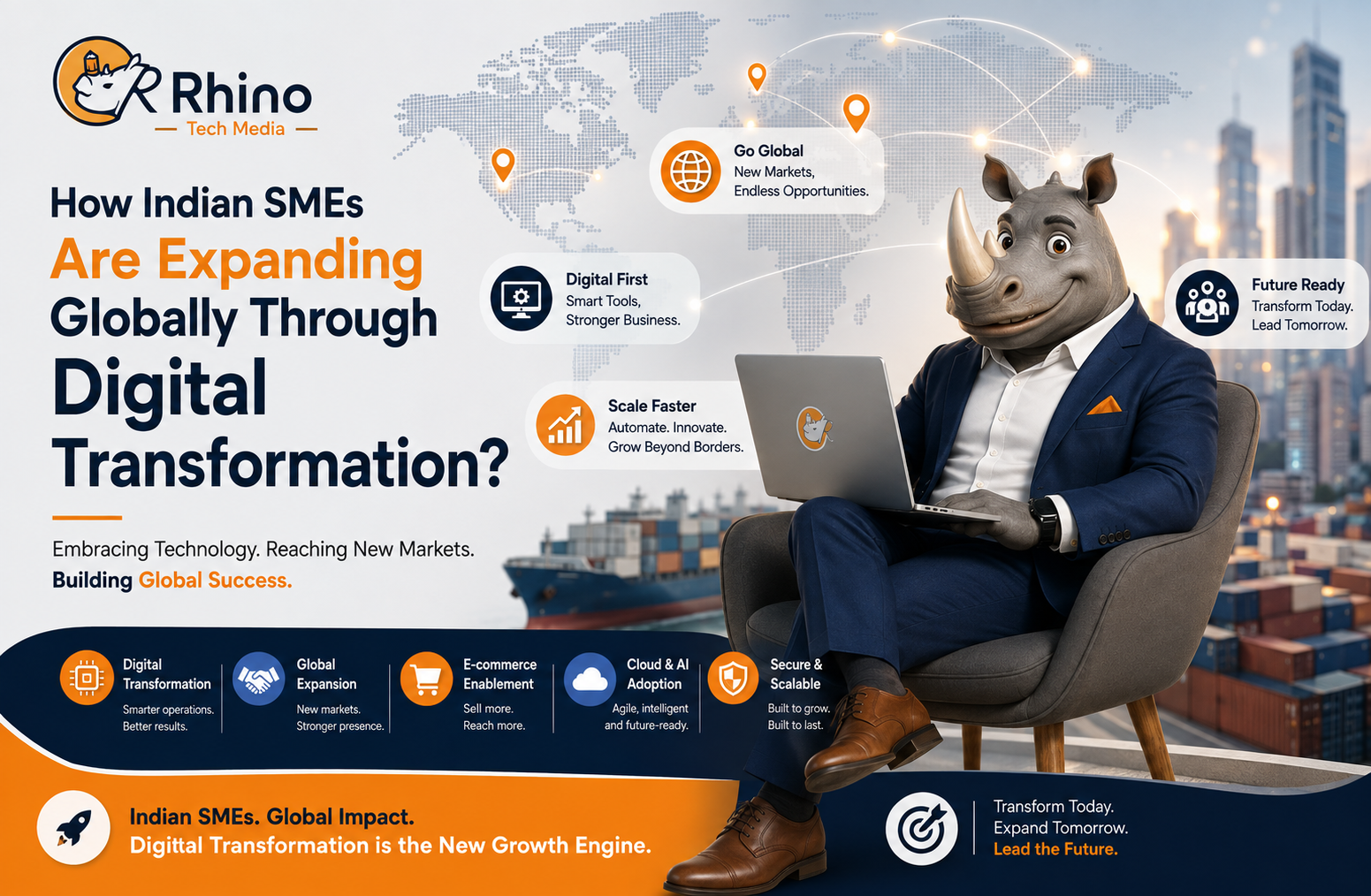
Going global once meant Indian small and medium-sized enterprises (SMEs) had to invest heavily in overseas offices, distributors, sales teams, and physical infrastructure. Digital transformation is changing that model.
Today, Indian businesses can find international buyers through search engines, showcase products on digital marketplaces, manage customers through cloud platforms, accept digital payments, and provide support across time zones without maintaining a physical presence in every country.
The opportunity is already significant. According to India’s Ministry of Micro, Small and Medium Enterprises, the MSME sector contributes over 45% of India’s exports. Government data also shows that MSME exports increased from ₹3.95 lakh crore in 2020-21 to ₹12.39 lakh crore in 2024-25, while the number of exporting MSMEs rose from 52,849 to 1,73,350 during the same period.
Digital transformation is helping more of these businesses compete internationally by improving market access, reducing operational friction, and making global customer engagement more affordable.
Why Digital Transformation Matters for Indian SMEs?
International expansion is not simply about finding customers abroad. Businesses need to understand local demand, establish credibility, manage enquiries, handle payments, meet regulatory requirements, coordinate logistics, and maintain consistent customer service.
Technology can connect many of these activities.
For an Indian SME, digital transformation can help:
- Reach international customers through SEO and digital advertising
- Build credibility with professional websites and online content
- Sell through international B2B and e-commerce platforms
- Manage leads and customer relationships through CRM systems
- Automate repetitive administrative processes
- Analyse customer and sales data
- Coordinate international orders and inventory
- Provide faster and more consistent customer support
India’s growing digital user base also supports this transition. According to the latest World Bank data, 70% of India’s population used the internet in 2025.
How Indian SMEs Are Expanding Into Global Markets?
1. Using Digital Marketing to Reach International Buyers
SEO, LinkedIn, email marketing, social media, and digital advertising help SMEs reach customers in specific countries.
For example, an Indian manufacturer entering Germany can create SEO-friendly pages highlighting its products, certifications, industries served, and export capabilities. This allows international buyers to discover the business before contacting the sales team.
2. E-Commerce Makes International Sales Easier
SMEs can reach overseas customers through their websites and digital marketplaces, particularly in sectors such as:
- Textiles and apparel
- Handicrafts and home décor
- Specialty foods
- Beauty products
- Engineering components
- Consumer products
Clear product information, certifications, shipping details, secure payments, and responsive customer support can help build trust with international buyers.
A strong digital storefront can therefore become more than a sales channel. It can also strengthen a company’s credibility in new markets.
3. Cloud Technology Simplifies Global Operations
Cloud-based CRM, accounting, inventory, and project management tools help SMEs manage international customers and operations from one place.
For example, a business serving customers in the UAE, Singapore, and the UK can use a cloud CRM to track enquiries, follow-ups, and customer information across markets.
The goal is not to adopt every available tool. It is to create a connected technology system that supports the company’s actual workflow.
4. AI Helps SMEs Work Smarter
AI can help SMEs with:
- Market research
- Customer support
- Translation and localisation
- Document processing
- Sales follow-ups
- Data analysis
- Demand forecasting
- Internal knowledge management
For example, an Indian software company entering the European market could use AI to organise customer enquiries, identify common questions, prepare initial responses, and analyse customer feedback.
AI should support employees rather than replace human judgment, particularly when dealing with customer communication, financial decisions, legal information, and sensitive business data.
5. Digital Payments Support Cross-Border Trade
Digital payment solutions can simplify international invoicing, currency conversion, payment tracking, and transactions.
Before selecting a provider, SMEs should consider:
- Transaction and foreign-exchange fees
- Supported currencies
- Settlement times
- Security and fraud protection
- Regulatory requirements
- Refund processes
- Accounting integration
A reliable digital payment process can make international transactions faster and more convenient for businesses and customers.
Digital Transformation Is More Than Buying Software
One of the biggest mistakes SMEs can make is assuming that purchasing technology automatically means the business has transformed.
It does not.
A company can have expensive software and still face inefficient processes, poor data quality, and low employee adoption.
A Practical Digital Transformation Roadmap
1. Identify the biggest bottleneck
Start with a specific business problem. It could be losing leads, spending too much time on manual reporting, struggling with inventory, or responding slowly to customers.
2. Choose technology around the problem
Select tools that directly address the challenge instead of adopting technology simply because it is popular.
3. Start with a focused pilot
Test the solution with one department, product category, or target market before expanding it across the business.
4. Train employees
Successful adoption depends on people. Employees need clear processes, training, and time to become comfortable with new systems.
5. Measure business outcomes
Track metrics such as international leads, conversion rates, customer acquisition costs, order-processing time, response times, repeat purchases, and export revenue.
This keeps digital transformation connected to business performance rather than technology spending.
Challenges Indian SMEs Need to Consider
Global digital expansion also introduces new risks.
Cybersecurity is one of the most important. As businesses move customer records, financial information, intellectual property, and operational data online, protecting these assets becomes essential.
SMEs should consider basic safeguards such as:
- Multi-factor authentication
- Strong password policies
- Regular software updates
- Secure backups
- Employee cybersecurity training
- Role-based access to sensitive information
- Regular reviews of third-party software
Businesses must also understand country-specific requirements related to taxation, customs, product standards, data protection, intellectual property, payments, and consumer protection.
Technology can simplify international operations, but it does not remove the need for local market knowledge and regulatory compliance.
India’s MSME Ecosystem Is Becoming More Globally Connected
Digital transformation is developing alongside broader changes in India’s MSME ecosystem.
The Ministry of MSME’s 2024-25 Annual Report highlights the importance of technology, digitalisation, market access, finance, and skills in supporting MSME growth. The sector contributes around 30% of India’s GDP and more than 45% of exports.
Government data also shows strong growth in the number of MSMEs participating in exports in recent years.
These developments show that international participation is no longer limited to India’s largest companies. Smaller businesses are increasingly becoming part of global supply chains and markets.
Digital tools can accelerate this transition by making international discovery, communication, operations, and customer management more accessible.
What Indian SMEs Should Do Next?
Businesses do not need to digitise everything at once. A practical starting point is to focus on capabilities that directly support international growth:
- Build a global-ready website: Clearly explain products, services, certifications, industries, and export capabilities.
- Invest in SEO: Create useful content that answers the questions international buyers are searching for.
- Strengthen digital sales: Use CRM systems to organise leads and follow-ups.
- Automate repetitive tasks: Reduce manual work in reporting, documentation, communication, and administration.
- Use data effectively: Track which countries, products, channels, and campaigns generate the best opportunities.
- Adopt AI carefully: Start with low-risk, measurable use cases and maintain human oversight.
- Prioritise cybersecurity: Protect customer information, financial systems, and intellectual property.
- Research target markets: Understand regulations, customer expectations, competition, pricing, and logistics before entering a new country.
The most digitally mature SME will not necessarily be the one using the most technology. It will be the one using technology to solve the right problems.
Conclusion
Digital transformation is helping Indian SMEs reach global markets without needing a physical presence overseas. With SEO, e-commerce, cloud tools, digital payments, automation, and AI, businesses can reach customers, streamline operations, and compete internationally.
MSME exports reached ₹12.39 lakh crore in 2024-25, with 1,73,350 MSMEs exporting.
The key is to adopt technology that solves real business challenges. Start small, measure the results, and scale what works.
Ready to take your business beyond India? Start by turning one business challenge into a digital opportunity.
