
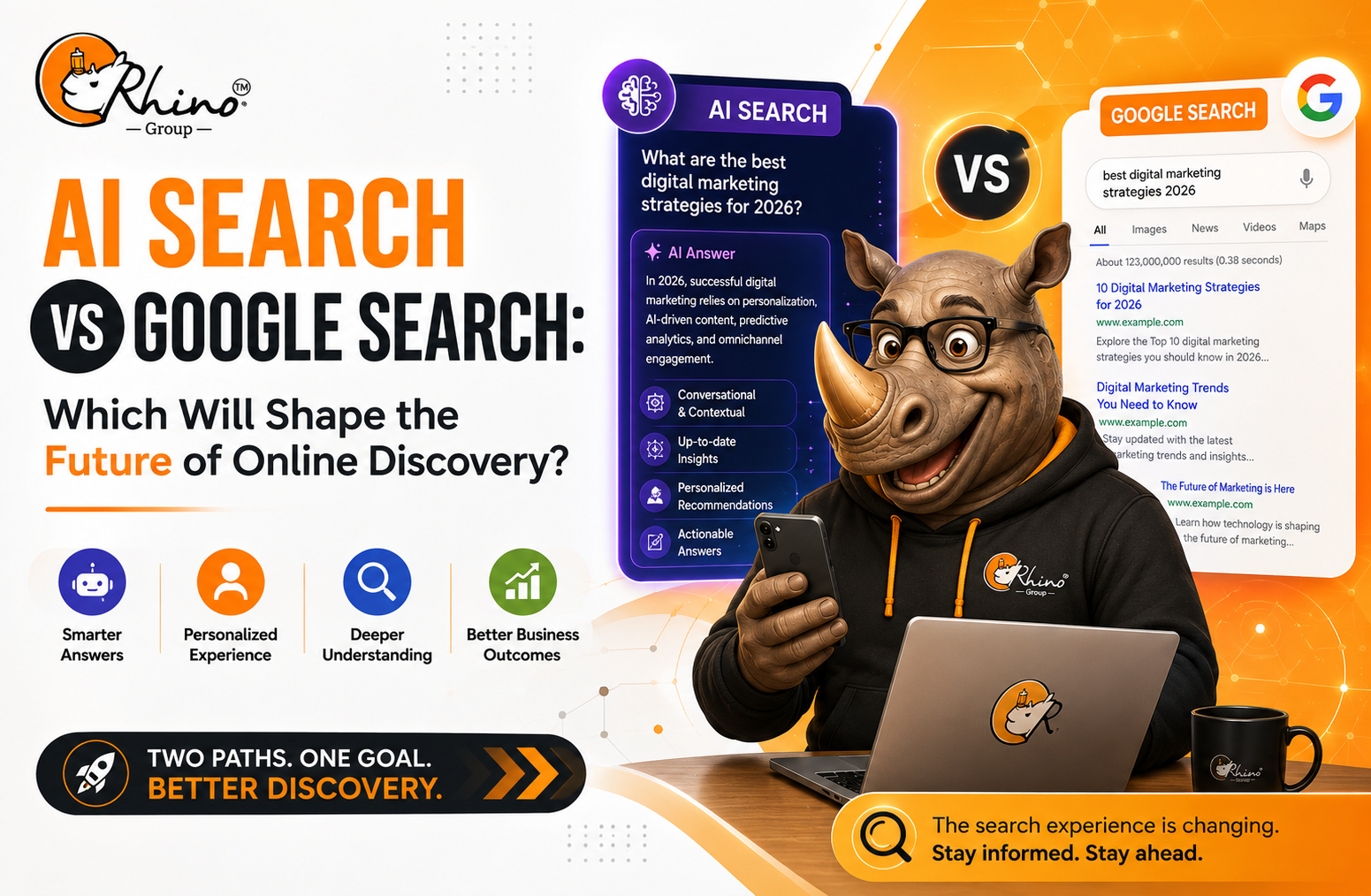
For more than two decades, Google Search has been the gateway to the internet. Whenever people wanted to learn something, compare products, find solutions, or discover new services, Google helped them access information from millions of websites.
But the way people search online is changing.
Today, users are not only typing short keywords into search engines. They are asking complete questions and expecting meaningful answers instantly. Instead of opening multiple websites and comparing information, many people now prefer AI-powered tools that provide quick, personalized responses.
This shift has sparked an important discussion: AI Search vs Google Search. Which technology will define the future of online discovery?
The answer is not about one replacing the other. AI Search and Google Search are evolving together, creating a smarter, faster, and more efficient way for people to find and understand information.
What Is AI Search and Why Is It Growing?
AI Search uses artificial intelligence (AI), machine learning (ML), and natural language processing (NLP) to understand what users actually need instead of simply matching keywords. Learn more about NLP and machine learning here:
- Natural Language Processing: https://en.wikipedia.org/wiki/Natural_language_processing
- Machine Learning: https://en.wikipedia.org/wiki/Machine_learning
Traditional search engines mainly focus on finding webpages based on search terms. AI Search goes further by understanding context, user intent, and the purpose behind a question.
For example, instead of searching:
“Best laptops for students 2026”
A user may ask:
“I am a college student studying design. I need a laptop for editing, gaming, and online classes within my budget. What should I buy?”
AI Search can understand the user’s situation and provide a more personalized response.
Key Benefits of AI Search
- Provides direct and conversational answers
- Understands complex questions
- Reduces research time
- Summarizes information from multiple sources
- Helps users make faster decisions
- Creates a more personalized search experience
This is why AI-powered search tools like ChatGPT and Google’s AI-powered search experiences are becoming increasingly popular among students, professionals, businesses, and everyday users.
Why Google Search Still Remains Powerful?
Although AI Search is growing quickly, Google Search continues to play an important role in online discovery.
Over the years, Google has built one of the world’s largest information systems, helping users find websites, businesses, products, news, videos, maps, and research content. Learn more about how Google Search works:
https://www.google.com/search/howsearchworks/
Google’s biggest strength is its ability to connect users with original sources. This allows people to explore different viewpoints and verify information directly.
Why People Still Use Google Search?
- Access to billions of webpages
- Reliable search rankings
- Local business discovery
- Real-time news updates
- Product comparisons
- Maps and location-based information
For example, someone searching for a nearby restaurant, checking customer reviews, or finding an official company website may still prefer Google because it provides access to multiple trusted sources.
AI Search vs Google Search: Understanding the Difference
1. Finding Information vs Getting Answers
The biggest difference between AI Search and Google Search is how information is delivered.
Google helps users discover information by showing a list of relevant websites.
AI Search focuses on understanding the question and generating a direct answer.
Both approaches have advantages.
A student learning a new topic may prefer an AI-generated explanation, while a business professional researching market trends may want to explore different trusted sources through Google.
2. Speed and Convenience
Modern internet users value speed.
People want solutions quickly without spending too much time searching through multiple pages.
AI Search helps users by:
- Explaining complicated topics
- Creating summaries
- Comparing different options
- Providing step-by-step guidance
However, convenience should always be balanced with accuracy. For important decisions involving finance, healthcare, legal matters, or business strategy, users should always verify information from trusted and authoritative sources such as the World Health Organization (https://www.who.int/) or official government and industry websites.
How AI Search Is Changing the Future of SEO?
The growth of AI Search is changing how businesses approach digital marketing and SEO.
In the past, many businesses focused mainly on keywords and rankings. Today, search engines are becoming smarter at understanding content quality, user experience, and credibility.
Future SEO success will depend on creating content that genuinely helps people.
Businesses should focus on:
- Answering real customer questions
- Creating valuable and original content
- Sharing practical experiences
- Building online authority
- Improving website experience
- Keeping information updated
Google has also emphasized creating people-first content through its Helpful Content guidance:
https://developers.google.com/search/docs/fundamentals/creating-helpful-content
Similarly, Google’s SEO Starter Guide explains the importance of creating useful, high-quality content instead of optimizing only for search algorithms:
https://developers.google.com/search/docs/fundamentals/seo-starter-guide
Search engines are moving away from content created only for algorithms. They are rewarding content created for real users.
The Future of Search: AI and Google Working Together
The future of search is not about AI replacing Google. Instead, AI is becoming an important part of how people interact with information.
Search technology is moving from:
“Find information yourself”
to
“Get help understanding information.”
This change means businesses need to create content that is useful, trustworthy, and easy for both humans and AI systems to understand.
What Businesses Should Do to Prepare?
The changing search landscape creates both challenges and opportunities.
Businesses should focus on building a strong digital presence through:
1. High-Quality Content
Content should solve customer problems and provide genuine value.
2. Brand Trust
Reliable brands with expertise and authority are more likely to gain visibility. Google’s E-E-A-T (Experience, Expertise, Authoritativeness, and Trustworthiness) principles continue to play an important role in evaluating content quality.
Learn more:
https://developers.google.com/search/blog/2022/12/google-raters-guidelines-e-e-a-t
3. Human-Centered Experiences
Real examples, insights, and practical solutions make content more valuable.
4. Multiple Digital Channels
Businesses should invest in websites, social media, videos, newsletters, and other platforms to reach their audiences.
Will AI Search Replace Google Search in the Future?
The answer is unlikely.
AI Search and Google Search serve different purposes.
AI Search is useful for:
- Learning concepts
- Quick explanations
- Brainstorming ideas
- Summarizing information
Google Search remains valuable for:
- Finding original sources
- Checking updated information
- Comparing products
- Discovering local businesses
- Exploring different opinions
The future will not be about choosing between AI and Google. It will be about using both technologies effectively.
Conclusion: The Future of Online Discovery Is Smarter and More Human
The future of online discovery will not be about AI Search replacing Google Search. Instead, both technologies will work together to create faster, smarter, and more personalized experiences.
AI will help users understand information better, while Google will continue connecting people with trusted sources and original content.
For businesses, the key focus should be creating valuable, authentic, and user-focused content. As search technology continues to evolve, quality information, credibility, and strong digital experiences will remain the foundation of long-term online success.
