
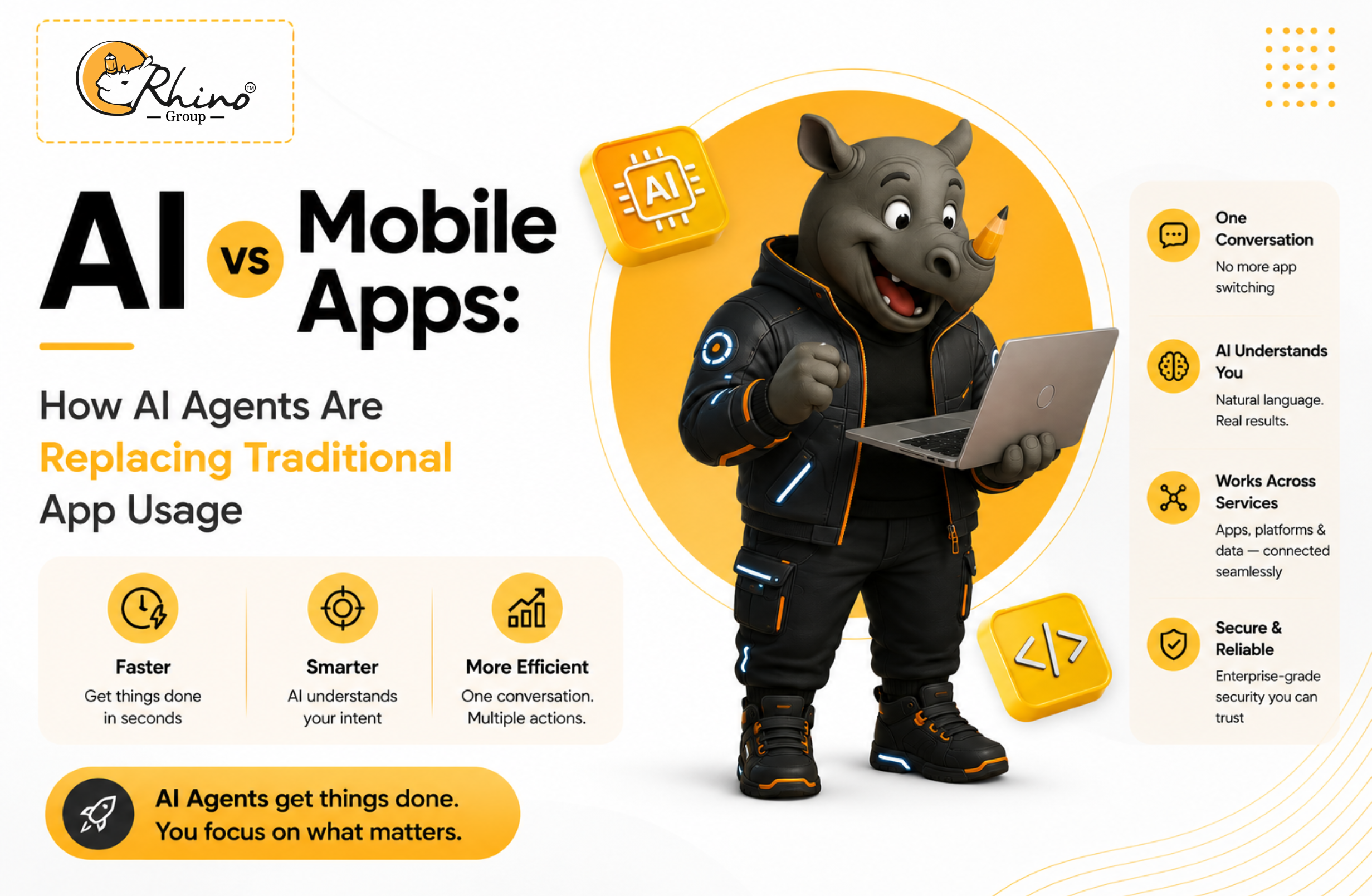
AI Agents Are Transforming Mobile App Usage
For more than a decade, mobile apps have defined how users interact with digital services. Activities such as booking transport, ordering food, shopping, payments, and travel have all been handled through separate mobile applications.
While this app-based model improved digital access, it also created fragmentation. Users switch between multiple apps, repeat similar workflows, and manage different interfaces to complete everyday tasks.
In 2026, a clear shift in the future of mobile apps is emerging. Instead of manually navigating applications, users are increasingly using AI agents that understand intent and coordinate actions across multiple services. This marks the rise of intent-based AI systems, where the focus shifts from apps to outcomes.
Mobile apps are not disappearing, but their role in digital interaction is changing significantly.
Why Mobile Apps Are Losing Efficiency?
The traditional mobile app ecosystem is becoming less efficient due to structural limitations.
The first challenge is app fragmentation. Most users have dozens of apps installed, but only a few are used regularly. This creates unnecessary complexity in device usage without improving productivity.
The second challenge is repetitive workflows. Even simple actions require multiple steps such as opening an app, searching, entering details, and confirming requests. This increases time spent on navigation instead of task completion.
The third challenge is limited discovery. App store rankings and advertising heavily influence visibility, which means useful applications are often underutilized while heavily promoted apps dominate attention.
These limitations highlight a growing gap between user intent and task execution in the mobile app ecosystem.
Rise of AI Agents and Intent-Based AI Systems
A major shift is taking place in how users interact with technology. Instead of opening multiple apps, users are moving toward expressing needs in natural language through AI-powered assistants.
This is known as intent-based computing, where the system understands what the user wants and completes the task across connected platforms. In this model, AI does not replace services. Instead, it acts as an intelligent layer that interprets requests, accesses relevant systems, and delivers outcomes with minimal user effort.
As AI agents replacing mobile apps becomes a growing trend, the focus of digital interaction shifts from navigation to execution.
AI Agents as the New Digital Coordination Layer
The future of digital ecosystems is not a single “super app,” but a coordination layer powered by AI agents.
AI agents operate above existing mobile apps and digital services. They:
- understand user intent and context
- connect to multiple platforms using APIs
- break tasks into structured steps
- execute workflows across systems
- reduce manual interaction and switching
In this model, mobile apps continue to exist but function as backend infrastructure. The primary user interaction happens through AI systems rather than individual applications.
This represents a fundamental change in how digital services are accessed and delivered.
Key Technologies Driving AI vs Mobile Apps Shift
The transition from mobile apps to AI-driven systems is enabled by three core technologies.
First, the rise of API-first platforms allows digital services to be accessed programmatically. This enables AI systems to interact with multiple services in real time.
Second, advancements in context-aware AI allow systems to understand user preferences, history, and behavior. This reduces repetitive input and improves personalization in AI-driven workflows.
Third, secure authentication frameworks such as token-based access systems ensure that AI agents can perform actions safely without exposing sensitive user data. Together, these technologies form the foundation of modern AI vs mobile apps transformation
Impact of AI Agents on Users, Developers, and Businesses
For users, the experience becomes more seamless. Instead of switching between multiple apps, they interact with a single AI interface that reduces effort, navigation, and decision fatigue.
For developers, priorities shift from designing mobile app interfaces to building scalable APIs, structured data systems, and AI-compatible infrastructure that can integrate with intelligent agents.
For businesses, discoverability is changing. In an AI-first ecosystem, visibility depends on whether services are machine-readable and accessible to AI systems. Platforms that fail to integrate APIs risk reduced exposure in AI-driven discovery models.
Evolution of App Stores in an AI-First Ecosystem
App stores are not becoming obsolete, but their role is evolving.
Instead of being the primary destination for downloading mobile apps, app stores are gradually shifting toward becoming service distribution and integration platforms.
In the future of mobile apps, app stores may function more as backend marketplaces where services connect to AI systems rather than being manually installed by users.
This reflects a shift from “download and use” to “connect and execute” models.
Challenges in AI-Driven Mobile App Transformation
Despite rapid progress in AI agents replacing mobile apps, several challenges remain.
Trust is a major concern, as users must rely on AI systems to make accurate decisions and complete tasks correctly. Privacy and data security are critical, especially as AI systems gain access to personal and sensitive information.
Accountability is another challenge when automated actions produce unexpected outcomes or errors. Finally, lack of standardization across platforms slows down full adoption of AI-driven ecosystems.
Because of these factors, both mobile apps and AI systems will coexist during the transition period.
Conclusion
The evolution from mobile apps to AI-driven systems represents a major transformation in digital interaction. However, this shift is not about eliminating mobile apps but redefining their role in the ecosystem.
For years, users have interacted with rigid mobile app structures that require manual navigation, repeated steps, and frequent switching between applications. While functional, this model places effort on the user rather than the system.
With the rise of AI agents and intent-based AI systems, digital interaction is becoming more intuitive. Users increasingly express what they want, and AI systems handle how it is executed across platforms.
Mobile apps will continue to exist but will gradually transition into backend systems supporting AI-driven workflows. The future of mobile apps is not app-centric but intent-centric, where AI becomes the primary interface for digital experiences. This shift leads to faster, simpler, and more efficient interaction between humans and technology.
