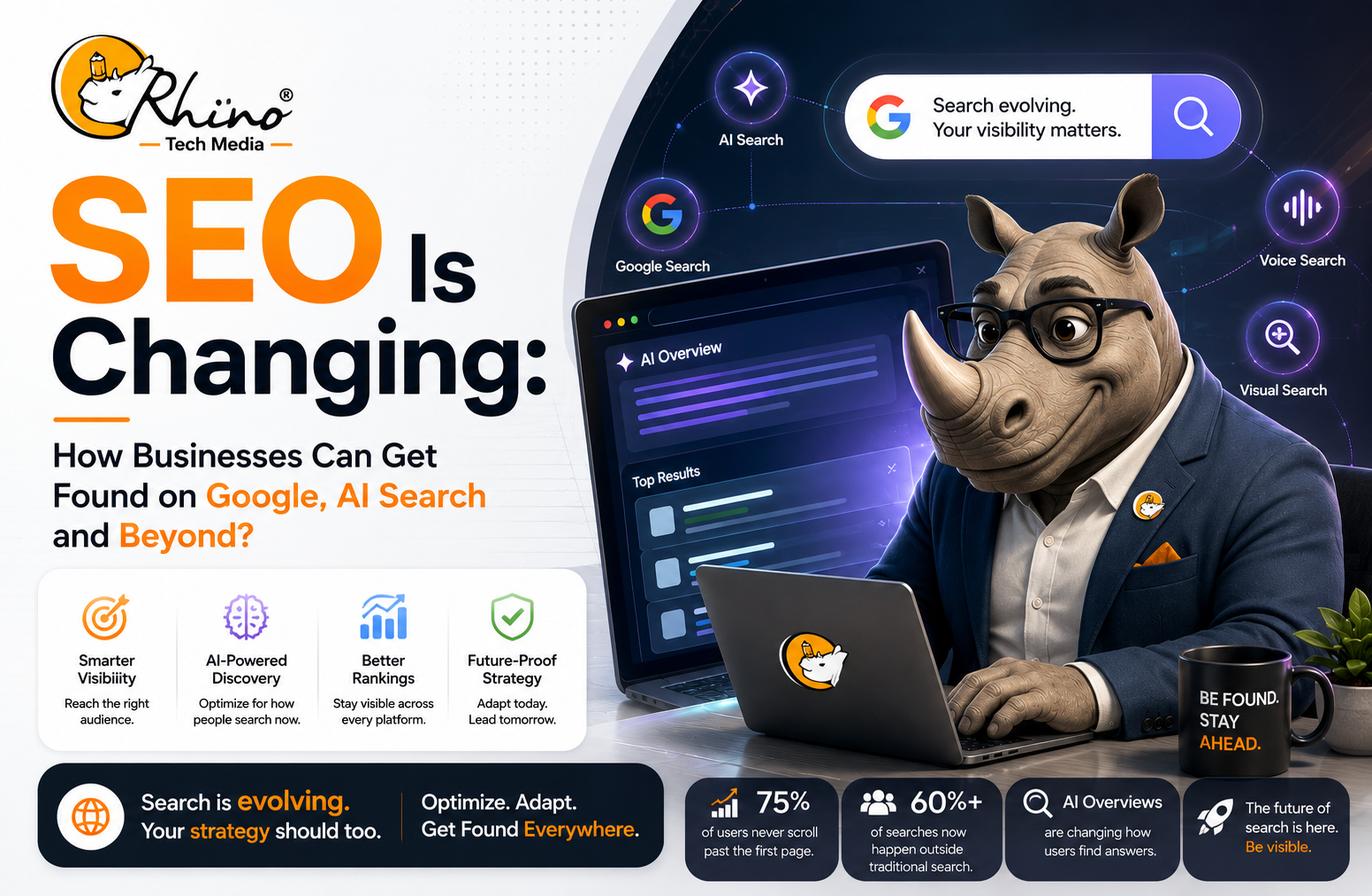
Search is changing fast.
People are no longer using Google only to type short keywords and scan blue links. They are asking longer questions, comparing businesses with AI, and expecting quick, useful answers.
For businesses, this means SEO is no longer just about rankings.
It is about being discoverable wherever customers search.
Google says its core SEO practices still apply to AI Overviews and AI Mode. There is no secret “AI SEO trick.” Businesses should focus on useful content, technical SEO, and satisfying search intent.
Key Takeaway: SEO isn’t disappearing. Search is expanding.
Search Is Becoming More Conversational
A traditional search might be:
“Digital marketing agency Chennai”
A modern search could be:
“Which digital marketing agency is best for a small B2B company looking for qualified leads?”
The second query reveals the customer’s real intent.
Search Intent Includes:
- Informational: What is technical SEO?
- Commercial: Best SEO agency for startups
- Transactional: SEO services pricing
- Navigational: Rhino TechMedia SEO services
- Conversational: Which SEO strategy should a B2B company use?
The goal is to answer the need behind the search, not simply repeat keywords.
AI Search Is Creating a New Discovery Layer
Google AI Overviews and AI Mode can provide synthesized answers using information from multiple sources.
This means your website may not only compete for a traditional ranking. It can also become a source supporting an AI-generated answer.
Important Numbers
48%
BrightEdge reported AI Overviews appeared on approximately 48% of its tracked queries in early 2026.
18%
Pew Research Center found that 18% of Google searches in its March 2025 analysis produced an AI summary.
8% vs. 15%
Users clicked traditional search results on 8% of visits when an AI summary appeared, compared with 15% when one did not.
The lesson is simple:
Rankings still matter, but visibility is becoming broader than rankings.
How Businesses Can Adapt?
1. Create Content Worth Referencing
Generic content is everywhere.
Give readers something more valuable through:
- Original research
- First-hand experience
- Case studies
- Industry insights
- Expert commentary
- Real examples
- Comparisons
- Practical recommendations
Instead of:
“What Is SEO?”
Try:
“How AI Search Is Changing SEO for B2B Companies in 2026.”
The second topic gives you an opportunity to provide original information and experience.
Key Takeaway: Focus on creating content that adds value, not simply more content.
2. Demonstrate E-E-A-T
E-E-A-T stands for:
Experience, Expertise, Authoritativeness, and Trustworthiness.
Google emphasizes trust as the most important aspect.
Strengthen credibility with:
- Author names and bios
- Relevant experience
- Reliable sources
- Original examples
- Updated information
- Accurate company details
- Strong About and Contact pages
Readers should know who created the content and why they should trust it.
3. Answer Real Customer Questions
Don’t create dozens of thin pages for similar keywords.
Build useful resources around customer problems.
For example:
- How does SEO generate leads?
- How long does SEO take?
- What is technical SEO?
- How does local SEO work?
- How is AI changing search?
- What should businesses measure?
Connect related content with internal links to create a stronger topic structure.
4. Keep Technical SEO Strong
AI search doesn’t replace technical SEO.
Make sure your website:
- Is crawlable
- Has indexable content
- Uses logical internal links
- Provides important information in text
- Works well on mobile
- Uses HTTPS
- Has accessible XML sitemaps
- Monitors Core Web Vitals
A strong content strategy cannot compensate for a technically weak website.
5. Build Your Digital Presence
Your website is only one part of your online identity.
Customers may discover your business through:
- Reviews
- Industry publications
- Business profiles
- Social platforms
- Expert contributions
- Partnerships
- Relevant third-party websites
Your digital presence should clearly communicate:
Who you are. What you offer. Who you help. Why customers should trust you.
6. Use Structured Data and Visuals
Structured data can help search engines understand pages such as:
- Articles
- Organizations
- Products
- Local businesses
- Breadcrumbs
- Profiles
Use it accurately and only where it represents visible content.
For long-form content, visuals can also improve engagement.
Useful Graphics
- Traditional Search vs. AI Search
- 2026 AI Search Statistics
- Modern SEO Framework
- Search Query → AI Answer → Source → Brand
What Should Businesses Measure?
Rankings and traffic still matter, but business results matter more.
Track:
- Organic impressions
- Organic clicks
- Non-brand visibility
- Qualified leads
- Conversions
- Branded searches
- Engagement
- Assisted conversions
- AI visibility where measurable
Google also introduced Search Generative AI performance reports in Search Console in June 2026, providing dedicated visibility data for generative AI features such as AI Overviews and AI Mode, initially for a subset of sites.
This makes AI search performance easier to monitor.
What About AEO and GEO?
You may hear terms like:
AEO: Answer Engine Optimization
GEO: Generative Engine Optimization
These describe efforts to improve visibility in AI-generated answers.
But they shouldn’t be treated as replacements for SEO.
The fundamentals remain:
Be crawlable.
Be useful.
Be original.
Be trustworthy.
Be easy to understand.
Don’t Turn AI Into a Content Factory
AI can help with:
- Research
- Brainstorming
- Outlining
- Editing
- Content organization
But publishing large amounts of generic AI content without adding real value is not a sustainable strategy.
Use AI for efficiency. Use human expertise for value.
Your experience, research, judgment, and original insights are what make content valuable.
A Practical SEO Strategy for 2026
Focus on six areas:
01. Technical SEO
Make your website accessible and easy to understand.
02. Helpful Content
Answer real questions with useful information.
03. Expertise
Show who created the content and why they are qualified.
04. Topic Authority
Build connected resources around important subjects.
05. Brand Authority
Maintain a credible presence across relevant platforms.
06. Measurement
Connect search visibility with leads, conversions, and business growth.
Key Takeaway: Don’t create a separate strategy for every new search feature. Build one strong digital presence that works across traditional and AI-powered search.
Key Takeaways
- Search is becoming more conversational.
- Search intent matters more than keyword repetition.
- AI is creating another discovery layer.
- Traditional SEO remains essential.
- Original experience strengthens content.
- Trust needs to be demonstrated.
- Technical SEO remains the foundation.
- Brand visibility extends beyond your website.
- Measure business outcomes, not rankings alone.
Use AI to support your workflow, not replace expertise.
Conclusion: The Future of SEO Is About Being Useful
SEO isn’t disappearing.
Search is simply becoming more sophisticated.
Customers may discover your business through a Google result, an AI-generated answer, a review, or a branded search.
So don’t ask only:
“How do we rank number one?”
Ask:
“How can we become one of the most useful and trustworthy sources for our customers?”
Build a technically strong website. Create genuinely helpful content. Demonstrate expertise. Strengthen your brand. Connect related topics. Measure what contributes to real business growth.
The businesses that succeed won’t necessarily publish the most content.
They will create content worth finding, reading, trusting, and sharing.
In the next era of search, being useful isn’t just good marketing. It is the foundation of being found.
