
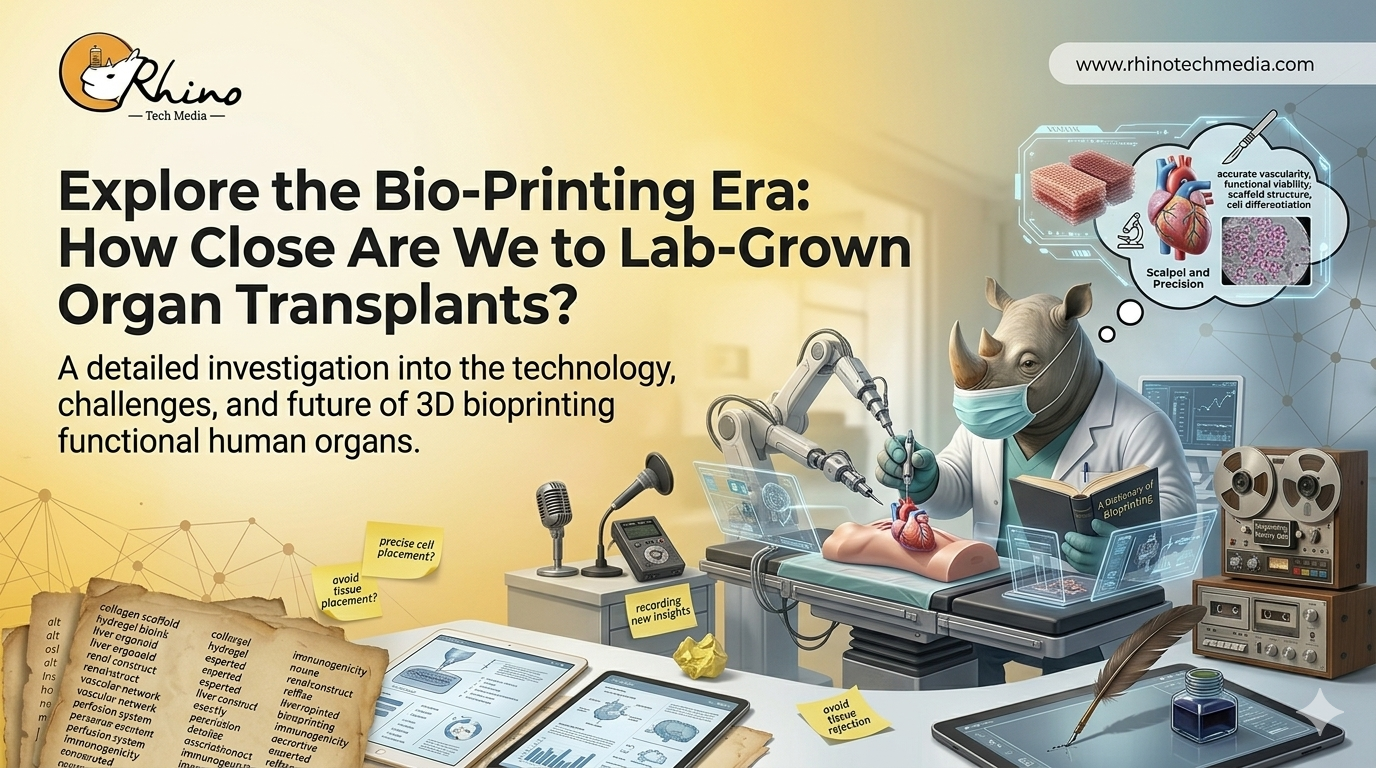
Bio-Printing: How Close Are Lab-Grown Organ Transplants?
The idea of printing human organs in a lab once belonged purely to science fiction. Today, however, bio-printing,also known as 3D bioprinting,has emerged as one of the most promising frontiers in modern medicine. With thousands of patients worldwide waiting for life-saving transplants and donor shortages worsening every year, scientists are racing to develop lab-grown organs. But how close are we to making this a clinical reality?
What is Bio-Printing?
Bio-printing is an advanced form of 3D printing that uses “bioinks”,a mixture of living cells and biomaterials,to build tissue layer by layer. Unlike traditional manufacturing, this process aims to replicate the complex architecture of human tissues, including multiple cell types, extracellular matrices, and structural organization.
The ultimate goal is to produce fully functional organs such as kidneys, hearts, and livers that can be transplanted into patients without the risk of rejection. In theory, organs could even be created using a patient’s own cells, eliminating the need for immunosuppressive drugs.
Current Achievements in Bio-Printing
While fully functional organs are still out of reach, significant progress has been made in simpler tissues. Scientists have successfully bioprinted:
- Skin for burn victims
- Cartilage for reconstructive surgery
- Bone and vascular tissues
- Miniature organ models (organoids) for research
These advancements are already being used in drug testing, disease modeling, and regenerative medicine.
Recent breakthroughs have also improved printing precision and speed. For instance, new techniques allow better control over how cells are deposited, helping replicate the intricate structures found in natural tissues.
However, these successes represent early milestones rather than the final destination.
The Biggest Scientific Challenges
Despite rapid progress, creating a fully functional, transplantable organ remains extremely difficult. The main challenges include:
1. Vascularization (Blood Supply)
One of the biggest hurdles is building a network of blood vessels within the printed organ. Without proper vascularization, cells cannot receive oxygen and nutrients, causing the tissue to die. This is widely considered the primary barrier to organ-scale bioprinting.
2. Structural Complexity
Human organs are incredibly complex, containing multiple cell types arranged in precise patterns. Replicating this level of detail is far more challenging than printing simple tissues.
3. Functional Integration
Even if an organ is successfully printed, it must function correctly inside the human body—interacting with nerves, blood flow, and biochemical signals.
4. Mechanical Strength and Longevity
Printed organs must be strong enough to withstand physiological stress while maintaining long-term stability.
Are We Close to Transplantable Organs?
Despite optimistic headlines, the reality is more cautious. As of 2025, no fully functional, lab-grown solid organ has been successfully transplanted into a human and sustained life.
That said, progress is accelerating. Researchers have developed:
- Functional tissue patches for repairing damaged organs
- Bioprinted structures with early-stage blood vessel networks
- Preclinical models that survive in animal testing
These developments suggest that while complete organs are not yet available, the foundational technologies are steadily advancing.
Timeline: When Could It Happen?
Experts generally estimate that:
- Short term (5–10 years): More widespread use of bioprinted tissues and partial organ replacements
- Medium term (10–20 years): Early-stage transplant trials for simpler organs or hybrid bioengineered constructs
- Long term (20+ years): Fully functional, lab-grown organs for routine transplantation
However, timelines remain uncertain due to the complexity of the science and regulatory hurdles.
Ethical and Economic Implications
The success of bio-printing could transform healthcare in profound ways:
- Eliminating organ shortages: No more waiting lists
- Personalized medicine: Organs tailored to individual patients
- Reduced animal testing: Lab-grown tissues for drug trials
At the same time, ethical questions arise around accessibility, cost, and the potential commercialization of human biology.
The Future of Bio-Printing
The future of bio-printing lies in integrating multiple technologies, including artificial intelligence, stem cell research, and advanced biomaterials. AI, for example, is already being used to optimize printing patterns and simulate organ structures before fabrication.
Global collaborations and increased funding are also accelerating progress, indicating strong confidence in the field’s long-term potential.
Conclusion
Bio-printing represents a revolutionary step toward solving one of medicine’s greatest challenges: the shortage of transplantable organs. While we are not yet at the stage where fully functional lab-grown organs can replace human donors, the gap is steadily closing.
In essence, bio-printing is no longer science fiction,but it is not yet everyday clinical reality either. The coming decades will likely determine whether this technology fulfills its promise of saving millions of lives and reshaping the future of healthcare.
