
Introduction
On November 8, 2016, the Indian government made a momentous decision: the demonetisation of the ₹ 500 and ₹ 1,000 notes, which together accounted for roughly 86% of the currency in circulation. The stated objectives included battling black money, curbing counterfeit currency, encouraging digital payments, and formalising the economy.
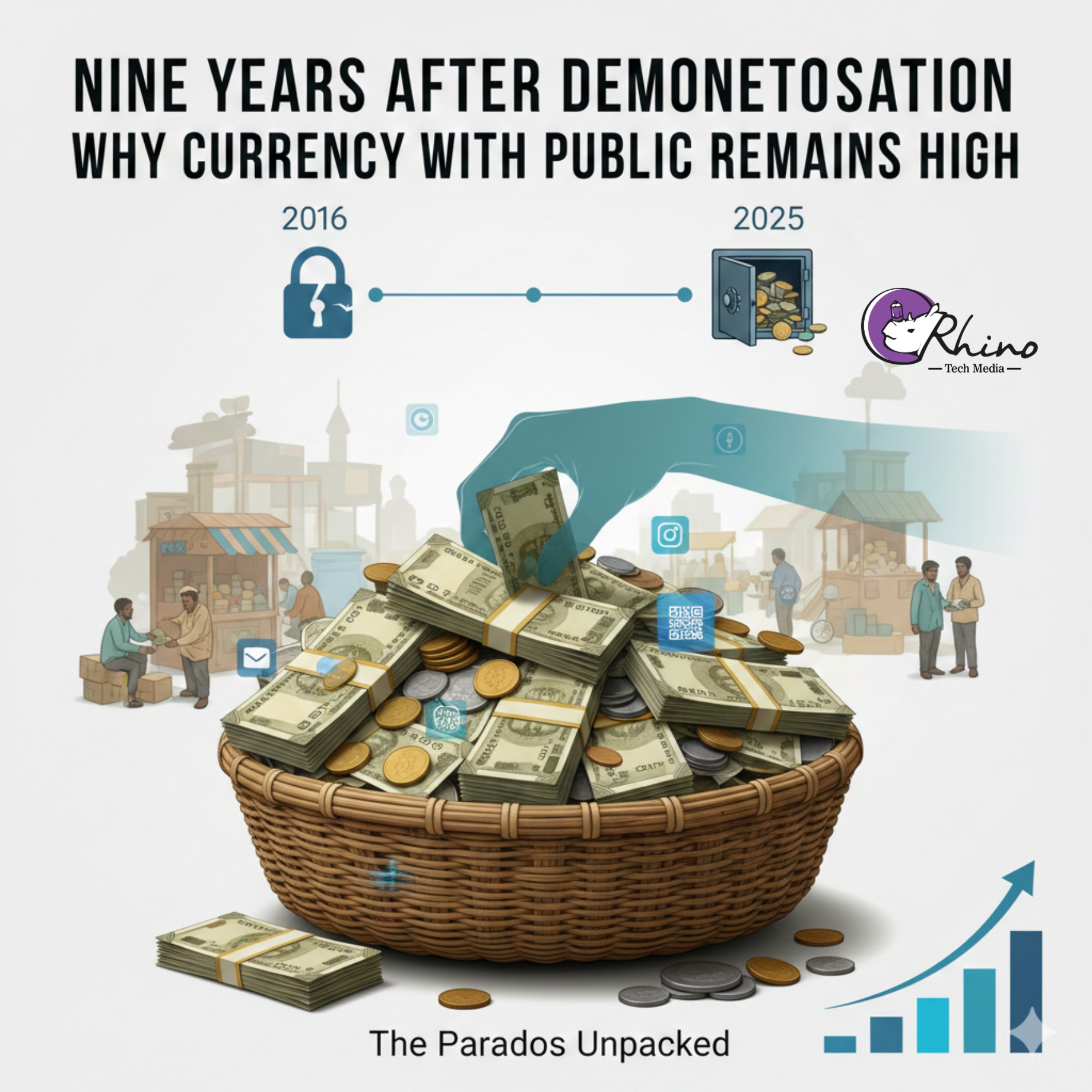
Fast forward nine years: contrary to expectations, cash has not only regained its ground — the amount of currency with the public has more than doubled. As of mid-October 2025, this figure stands at approximately ₹ 37.29 lakh crore, up from ₹ 17.97 lakh crore just before demonetisation.
This phenomenon raises a crucial question: why has cash remained so dominant in an age of digital payments and financial formalisation? The answer lies in a combination of economic realities, behavioural preferences, structural features of India’s informal economy, and external shocks.
Historical Trend and Context
Currency Growth Since Demonetisation
- Immediately after demonetisation, currency with the public plummeted: by January 2017, it fell to about ₹ 7.8 lakh crore.
- However, it rebounded strongly. By October 2025, it had more than doubled compared to November 2016.
- Over the years, currency in circulation (CIC) has risen significantly: reports show an increase of ~83% since 2016.
Currency-to-GDP Ratio
- A critical contextual metric is the ratio of currency in circulation to GDP.
- While absolute currency has surged, strong economic growth has kept this ratio in check. As of 2025, it is around 11.11%.
- For reference, this was 8.7% in 2016–17, rose to a pandemic-era peak of 14.5% in 2020–21, and has since come down.
- Though it has moderated, India’s ratio remains higher than many developed economies (e.g., U.S. ~8%, Eurozone ~8–10%, China ~9.5%).
Reasons for Persistently High Currency with Public
- Strong Informal Economy
A large portion of the Indian economy operates informally — small traders, daily-wage workers, unregistered enterprises — where cash remains the most trusted and practical medium of exchange. Digital penetration is still uneven, and many small-scale transactions rely heavily on cash. - Cultural Preference and Trust in Cash
Cash carries a deep-rooted cultural value. Many people prefer tangible, physical money. For certain demographics — especially in rural or less-banked regions — cash feels more reliable than digital payments. Even with the rise of UPI and other digital systems, behavioral inertia persists. - Precautionary Motives and Hoarding
- During external shocks (e.g., the COVID-19 pandemic), people tend to hoard cash. After demonetisation, especially during the pandemic, many withdrew money as a precaution.
- There is also a component of “savings in cash”: for some, holding physical currency remains a way to store value or have liquidity immediately available.
- Limited Substitution by Digital Payments
- Although digital payments have grown phenomenally (UPI, for instance), they have not completely replaced cash for all segments.
- Some transactions simply favor cash: informal trade, small shops (“kiranas”), rural markets, cash-on-delivery in e-commerce, etc.
- There are infrastructural challenges: not everyone has access to smartphones, reliable internet, or bank accounts.
- Reserve Bank of India (RBI) Policy and Currency Printing
- The RBI has continued to issue currency. Over time, fresh notes (in lower denominations) have been introduced and circulated.
- Even though high-denomination ₹ 2,000 notes were later phased out, the supply of other denominations has supported the growth of cash holdings.
- Psychological Factors & Liquidity Preference
In uncertain times, people prefer liquidity, and cash offers immediate usability without reliance on infrastructure. For many, having cash at hand is a psychological comfort.
Implications
- Monetary Policy Transmission: A high cash-to-GDP ratio may weaken the effectiveness of monetary policy. When people hoard cash, changes in interest rates or liquidity operations may not transmit as efficiently through formal banking channels.
- Inflation Control: Persistent high cash circulation could complicate inflation management, especially if cash demand surges during economic stress.
- Financial Inclusion & Formalisation: While demonetisation aimed to formalise the economy, the continued dominance of cash suggests that formalisation is incomplete. Policymakers may need to rethink strategies for financial inclusion.
- Digital-Rural Divide: The persistence of cash underlines the digital divide. Policy efforts must continue to bridge the infrastructure and trust gap in digital payments.
Conclusion
Nine years after demonetisation, the fact that currency with the public remains so high reveals a deeper reality: cash is not merely a fallback, but a cornerstone of India’s economic and social fabric. The surge in digital payments has not translated into a proportional decline in cash usage. Instead, economic growth, cultural preferences, informal sector dynamics, and precautionary behavior have combined to keep cash alive and thriving.
Demonetisation may have been ambitious in its goals, but it underestimated the resilience of cash. As India continues its journey toward a more formal and digital economy, policymakers will need to reckon with this cash paradox — designing strategies that acknowledge and address the enduring appeal of currency in hand.
