
Introduction
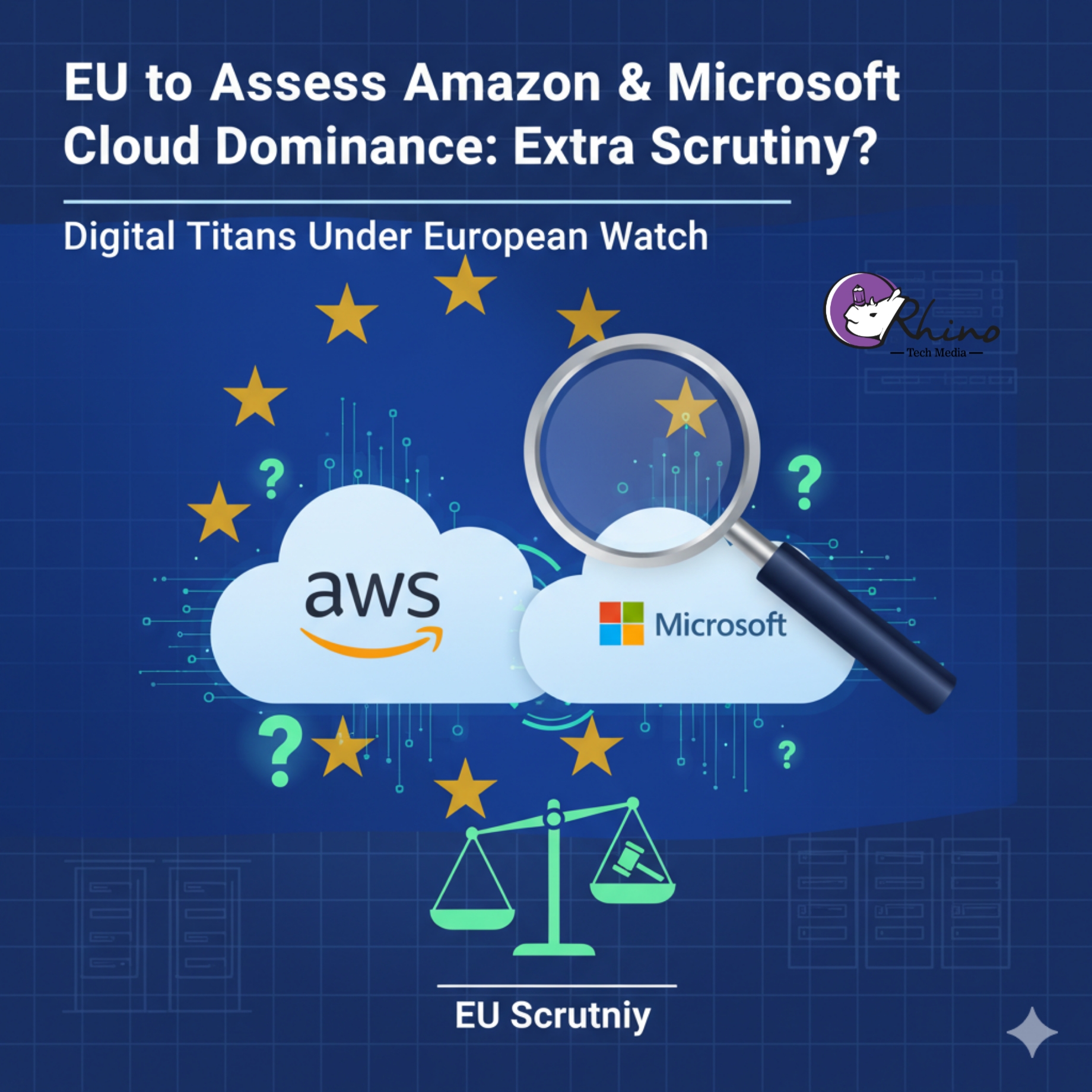
The European Union is currently evaluating whether the cloud computing operations of Amazon Web Services (AWS) and Microsoft Azure warrant additional regulatory scrutiny under its Digital Markets Act (DMA). This development reflects growing concern in Brussels over the dominant role that these hyper scalers play in Europe’s cloud infrastructure, especially as cloud services become increasingly vital for businesses, public institutions, and emerging technologies like artificial intelligence (AI).
Background & Context
- Cloud’s Strategic Importance
Cloud computing has become a backbone of the modern digital economy. Companies rely on cloud platforms to scale infrastructure, deploy AI, store data, and manage critical workloads. The EU recognizes that control over cloud infrastructure is not just a commercial issue, but one with implications for innovation, resilience, and sovereignty. Moreover, a report suggests that U.S.-based hyperscalers — especially AWS, Azure, and Google Cloud — dominate the European cloud market. This has raised alarm in Brussels over dependency on non-European providers. - Regulatory Framework: The DMA
The Digital Markets Act (DMA) is the EU’s flagship tool for reining in powerful tech platforms (“gatekeepers”). However, its current thresholds and definitions make it hard to apply directly to cloud services: gatekeeper designation typically depends on users, but in infrastructure-as-a-service (IaaS) or platform-as-a-service (PaaS), “users” are often businesses, not typical end-consumers. The European Commission is exploring whether AWS and Azure, despite not meeting standard DMA thresholds, should nonetheless be classified as “gatekeepers” due to their market influence. - Precedent & Competitive Concerns
There is existing scrutiny from other European authorities:- France’s Autorité de la concurrence has studied cloud competition and flagged potential anti-competitive practices by Amazon and Microsoft, including “egress fees” (costs to move data out of cloud) and barriers to customer switching.
- Google has made a formal antitrust complaint to the European Commission, accusing Microsoft of using licensing practices to lock in customers to Azure.
- Trade association CISPE (Cloud Infrastructure Services Providers in Europe) — which includes many European cloud players — previously filed a complaint against Microsoft, alleging discrimination and bundling that favors Azure over rival clouds.
- External Pressure & Voices
Some MEPs (Members of European Parliament) argue that it is urgent to bring cloud (and even AI) under DMA regulation before market concentration becomes too entrenched. At the same time, some tech players warn that over-regulation could hamper innovation or raise costs for European businesses relying on U.S. cloud providers.
Key Issues & Risks That Motivate the EU’s Assessment
Here are the principal arguments and risks driving the EU to consider extra scrutiny for AWS and Azure:
- Market Dominance and Lock-in
- Switching costs / customer lock-in: There are concerns that once businesses commit to a cloud provider, switching is technically difficult and expensive. The EU is evaluating whether cloud providers act as “important gateways” between businesses and consumers.
- Licensing practices: Microsoft’s licensing of core software (e.g., Windows Server) is under fire — competitors argue customers face financial disincentives when running Microsoft software on rival clouds.
- Egress fees: Costs to move data out (“egress”) may serve as a barrier to exit.
- Sustainable Returns & Scale
The UK’s Competition and Markets Authority (CMA), in its own cloud market study, noted that AWS and Microsoft have sustained “very strong returns” above their cost of capital, which may hint at entrenched market power. Large-scale investments by these cloud plaighyers create economies of scale that may deter new entrants, reinforcing their dominance. - Strategic Gatekeeper Role
Even if AWS and Azure do not meet traditional DMA user thresholds, their function as infrastructure providers to critical digital services makes them strategically important. The Commission is evaluating whether such “indirect gatekeeping” justifies DMA designation. - Digital Sovereignty & European Cloud Capacity
- The EU has voiced concerns about over-reliance on U.S. hyperscalers, particularly for sensitive or critical data workloads.
- There is a recognized gap in Europe’s own cloud capacity. According to consultations, there is “a lack of a competitive EU-based offer … at sufficient scale” for high-security or high-stakes use-cases (e.g., public sector, AI).
- Calls for strengthening data sovereignty are mounting, though there is tension: some analysis warns that overly protectionist rules might exclude non-EU providers and increase costs.
- Precedent of Service Disruption
Recent outages (e.g., AWS outage) underscore how dependent many European services are on these cloud providers. This highlights systemic risk: if dominant cloud providers falter, a large portion of the EU digital economy could be affected.
Counterarguments & Challenges
While the case for extra scrutiny is strong, there are also significant counterpoints and challenges:
- Innovation Risk
- Cloud is a highly dynamic, innovation-driven sector. Over-regulation might stifle the very benefits (scale, efficiency, R&D) that large cloud providers deliver. Indeed, Amazon has argued that designating AWS as a gatekeeper could “raise costs for European companies” and hurt innovation.
- New cloud features (especially in AI) are rapidly evolving; rigid regulation might lag behind technological changes.
- Definition & Threshold Problems
- The DMA was not originally designed with IaaS/PaaS in mind; applying it to cloud providers raises conceptual challenges about how to define “gatekeeper” in this space.
- Metrics like “number of users” are harder to interpret for cloud infrastructure, which serves corporate clients rather than individual users.
- Economic Cost & Competitiveness
- Some EU companies and associations warn that strict rules could “edge foreign providers out” or make European entities less competitive globally.
- Data migration costs, compliance burdens, or forced architecture changes could increase costs for businesses — especially SMEs — and reduce flexibility.
- Sovereignty vs Global Integration
- While digital sovereignty is a valid goal, the EU currently lacks cloud providers of comparable scale. Attempts like Gaia-X have made progress but haven’t (yet) matched hyperscaler scale.
- There’s a fine line between promoting European cloud capacity and creating protectionist policies that undermine choice.
- Regulatory Overlap and Complexity
- Cloud providers are already subject to multiple EU regulations (e.g., GDPR, NIS Directive, cybersecurity frameworks). Adding DMA obligations may complicate governance.
- Ensuring that any new obligations are proportionate and effective (without being redundant or burdensome) will be challenging.
Strategic Implications for the EU
If the EU concludes that AWS and Azure should be regulated more strictly, several long-term implications follow:
- Accelerated European Cloud Development
Stricter rules could incentivize investment in European cloud alternatives (public and private), pushing projects like Gaia-X or native EU hyperscalers. This could help reduce dependence on U.S giants, promoting a more sovereign and resilient digital infrastructure. - Enhanced Digital Competition
Regulations could lower entry barriers, reduce lock-in, and make switching between cloud providers cheaper and easier. That could foster innovation, diversity, and fairer pricing in Europe’s cloud market. - Regulatory Precedent
Classifying cloud infrastructure as a “gatekeeper” under the DMA would set a powerful precedent — not just for cloud, but for any infrastructure digital “core platform” where dominance is not just about users but control over critical digital intermediaries. - Risk Mitigation
Given the systemic role of cloud in Europe’s digital economy, regulating major players could reduce systemic risk. Clearer obligations around reliability, interoperability, and porting could make the European cloud landscape more stable. - Tensions with Global Firms & Trade
There is a risk that overly stringent regulation could spur pushback from U.S. firms or even trigger trade tensions. Balancing regulatory sovereignty with global integration will be difficult.
Conclusion
The EU’s assessment of AWS and Microsoft’s cloud businesses is a significant moment in digital policy — one that could reshape how infrastructure power is regulated in Europe. While the DMA was not initially tailored to cloud providers, the European Commission now faces a compelling case: the dominance of hyperscalers, lock-in risks, and systemic importance of cloud make a strong argument for extra scrutiny.
However, any regulatory move must be carefully calibrated. Overreach could stifle innovation, raise costs, or hinder Europe’s integration into the global digital economy. Conversely, too little intervention risks deepening dependency on non-European infrastructure and undermining competition.
Ultimately, the stakes go beyond antitrust. This is about Europe’s digital future — its capacity to build sovereign, resilient cloud infrastructure, foster a competitive ecosystem, and safeguard its interests in an increasingly cloud-dependent world.
