
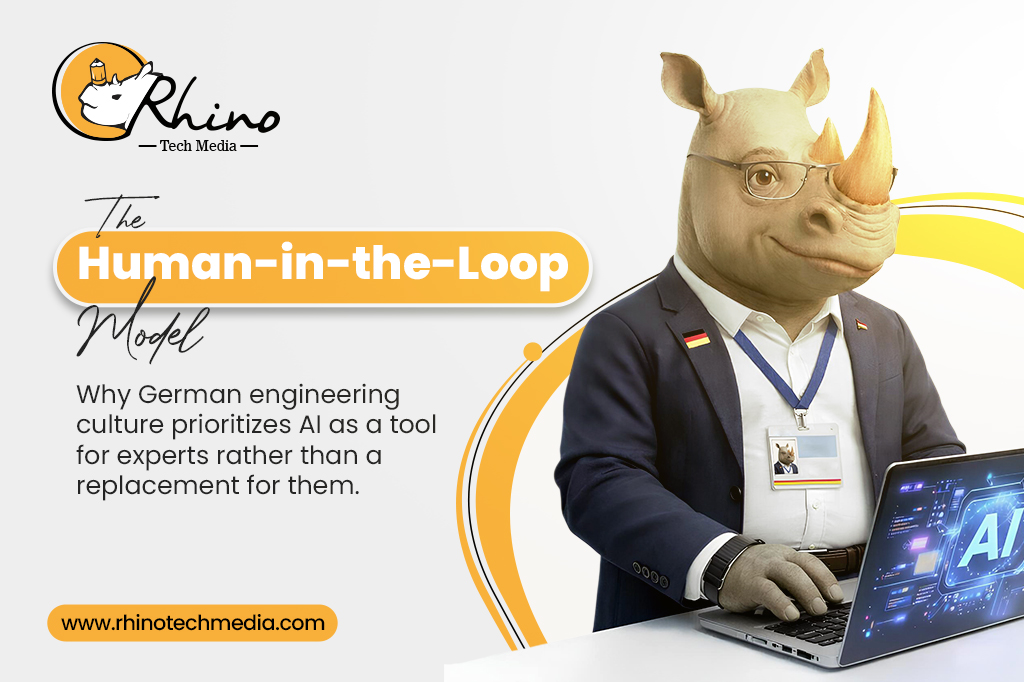
In the global race to adopt artificial intelligence, narratives often swing between extremes,AI as a silver bullet that replaces human labor, or AI as an existential threat to skilled professions. Germany, however, has taken a distinctly different path. Rooted in its engineering culture, industrial history, and regulatory philosophy, the German approach to AI emphasizes the “human-in-the-loop” model, where artificial intelligence augments expert judgment rather than replacing it. This perspective reflects not technological conservatism, but a deliberate strategy to preserve quality, accountability, and trust in complex systems.
At its core, the human-in-the-loop model ensures that AI systems operate under continuous human oversight. Decisions,especially those that are safety-critical, ethically sensitive, or economically significant,are not fully automated. Instead, AI provides analysis, predictions, and recommendations, while trained professionals retain final authority. In Germany, this is less a design choice and more a cultural principle.
German engineering has long been defined by precision, reliability, and responsibility. From automotive manufacturing to industrial automation, systems are expected to perform flawlessly under real-world conditions. This expectation has shaped attitudes toward AI. German engineers view intelligence not as something to be abstracted away into black-box algorithms, but as a collaborative process between humans and machines. AI is valued for its ability to process vast datasets, identify patterns, and optimize processes,but it is not trusted to operate autonomously without human reasoning and domain expertise.
The concept of Ingenieurwesen,engineering as a disciplined, ethical profession,plays a central role here. Engineers in Germany are trained to take personal responsibility for the systems they design and deploy. Fully autonomous AI challenges this accountability. If a machine makes an unsupervised decision that leads to failure or harm, responsibility becomes diffuse. The human-in-the-loop model resolves this tension by maintaining a clear chain of accountability, ensuring that experts remain answerable for outcomes, even when AI is involved.
This philosophy is particularly visible in Germany’s flagship industries. In automotive manufacturing, AI is extensively used for predictive maintenance, quality inspection, and driver-assistance systems. Yet fully autonomous decision-making is approached cautiously. Advanced driver-assistance systems are designed to support drivers, not replace them, with constant reminders that human attention is required. Similarly, in Industry 4.0 environments, AI optimizes production lines and detects anomalies, but human engineers oversee adjustments, validate decisions, and intervene when systems behave unexpectedly.
Germany’s regulatory environment reinforces this mindset. Strong data protection laws, rigorous safety standards, and evolving AI regulations emphasize transparency, explainability, and human oversight. Rather than seeing regulation as an obstacle to innovation, German policymakers and companies treat it as a framework for sustainable technological progress. The human-in-the-loop model aligns naturally with these values, ensuring that AI systems remain interpretable and controllable.
There is also a deep social dimension to this approach. Germany’s workforce is highly skilled, with strong vocational training and apprenticeship systems. AI is therefore framed not as a threat to jobs, but as a productivity multiplier for experts. By augmenting human capabilities, AI helps engineers, technicians, and analysts make better decisions faster,without eroding professional identity or expertise. This reduces resistance to adoption and builds long-term trust between workers and technology.
Critically, the German model challenges the dominant Silicon Valley narrative that equates progress with full automation. It suggests that intelligence embedded in systems does not have to eliminate human judgment to be effective. In fact, in complex, high-stakes environments, the combination of machine efficiency and human intuition often produces superior results. Errors can be caught, edge cases can be handled thoughtfully, and ethical considerations can be addressed in real time.
As AI systems grow more powerful, the German human-in-the-loop philosophy offers an important counterbalance. It demonstrates that technological leadership does not require surrendering control to algorithms. Instead, it calls for designing AI that respects human expertise, preserves accountability, and enhances,rather than replaces,the role of professionals.
In a future increasingly shaped by intelligent machines, Germany’s approach reminds us that the most resilient and trusted systems are not those that remove humans from the loop, but those that keep them firmly at the center of it.