
Artificial intelligence has become an essential part of modern business operations. From software development and customer support to content creation, research, and data analysis, organizations are increasingly integrating large language models (LLMs) into their daily workflows. AI is helping businesses improve productivity, automate repetitive processes, and make faster decisions.
However, as AI adoption moves from small experiments to large-scale enterprise deployments, a new challenge is emerging: rapidly increasing AI costs. Many organizations that started with limited AI initiatives in 2025 are now expanding usage across multiple departments in 2026. As a result, spending on AI APIs, premium models, autonomous agents, retrieval systems, and supporting infrastructure is increasing significantly.
While AI delivers measurable business value, uncontrolled adoption can create unnecessary expenses. Companies may end up paying for excessive token usage, inefficient workflows, duplicate tools, and advanced models being used for simple tasks.
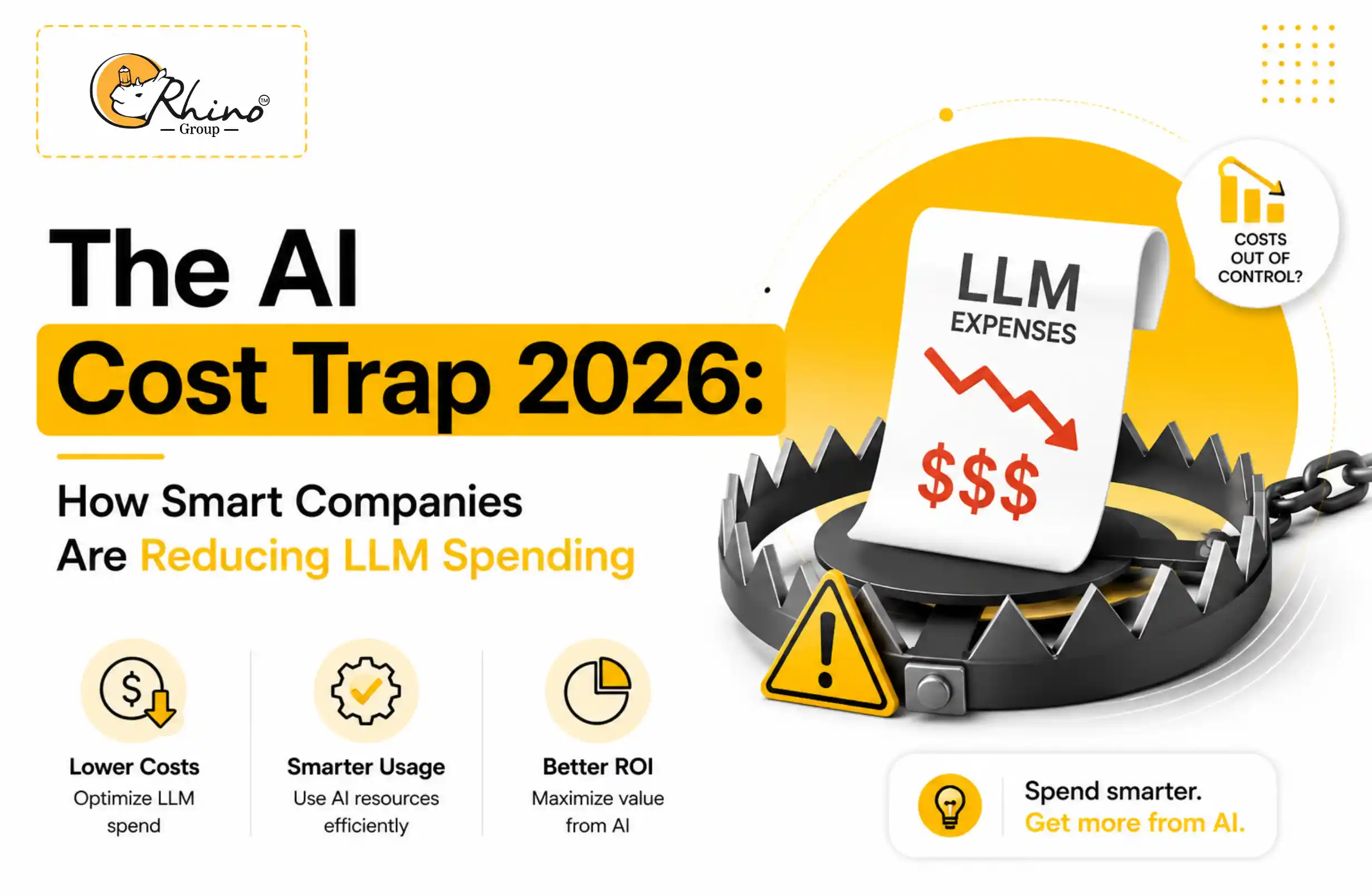
This growing challenge is known as the AI Cost Trap. Without proper monitoring, optimization strategies, and governance, businesses may struggle to balance innovation with financial efficiency.
What Is the AI Cost Trap?
The AI Cost Trap occurs when organizations rapidly increase AI usage without establishing proper controls around spending, model selection, workflow design, and governance.
During the early stages of AI adoption, companies often focus on experimentation and productivity improvements. However, as more teams begin using AI tools independently, costs can become difficult to track and manage.
Common warning signs of an AI Cost Trap include:
- Increasing monthly AI expenses
- Limited visibility into AI usage patterns
- Multiple teams using separate AI platforms
- Premium models being used for basic tasks
- Large context windows consuming unnecessary tokens
- Lack of centralized AI management
As AI becomes deeply integrated into business processes, these inefficiencies can affect overall profitability and reduce the return on investment from AI initiatives.
Why AI Costs Are Increasing in 2026?
Premium Models Cost More
Advanced AI models provide stronger reasoning, coding capabilities, and analytical performance. These models are valuable for complex business challenges, but they also come with higher operating costs.
A common mistake organization make is using premium models for everyday activities that do not require advanced capabilities. Tasks such as simple content drafting, summarization, and routine customer responses can often be completed using smaller and more affordable models without affecting quality.
Choosing the right model based on task complexity is becoming an important part of enterprise AI cost management.
Excessive Context Usage
Modern AI systems can process large amounts of information, but providing unnecessary data increases costs. Employees may submit lengthy documents, complete conversation histories, or large code repositories when only a limited amount of information is required.
Every additional piece of context increases token consumption, which directly impacts AI expenses. Optimizing input size, improving data retrieval methods, and providing only relevant information can significantly reduce unnecessary spending.
Autonomous AI Agents
AI agents are transforming business workflows by automating research, customer support, operations, and decision-making tasks. However, these systems often involve multiple behind-the-scenes processes, including data retrieval, tool usage, and repeated model interactions.
Without proper monitoring, a single automated workflow can generate a large number of AI requests, increasing operational costs over time.
Fragmented AI Adoption
Many organizations allow different teams to adopt AI tools independently. While this encourages innovation, it can also create challenges such as duplicate subscriptions, overlapping solutions, and inconsistent usage practices.
Without a centralized approach, businesses may lose visibility into where money is being spent and whether different AI solutions are delivering measurable value.
Where Businesses Waste AI Budget?
Poor Prompt Design
Inefficient prompts are one of the most common causes of unnecessary AI spending. Poorly structured instructions often require additional requests, longer outputs, and repeated interactions.
Examples include:
- Repeating the same instructions in every request
- Adding unnecessary background information
- Requesting excessive formatting details
- Including large datasets that are not required
Well-designed prompts help AI systems provide accurate results with fewer interactions, reducing both time and cost.
Incorrect Model Selection
Not every business task requires the most powerful AI model available. Using expensive models for simple activities can quickly increase operational expenses.
Tasks such as:
- Email drafting
- Meeting summaries
- Basic customer support responses
- FAQ generation
- Routine document processing
can often be handled effectively using smaller and more cost-efficient models.
A strategic approach to model selection ensures businesses get the right balance between performance and affordability.
Hidden Infrastructure Costs
AI expenses extend beyond model usage. Many organizations overlook supporting infrastructure costs involved in building AI-powered systems.
These may include:
- Embedding generation
- Vector databases
- Data retrieval systems
- External integrations
- Cloud infrastructure
- Monitoring tools
Understanding the complete AI technology stack helps businesses identify the real cost of AI adoption.
Duplicate Requests
Without proper optimization, organizations may repeatedly process identical or similar AI requests. This creates unnecessary spending and increases system workload.
Implementing solutions such as caching, reusable workflows, and knowledge management systems can help reduce repeated processing and improve efficiency.
The 4-Step Framework for AI Cost Optimization
1. Audit AI Usage
The first step toward reducing AI expenses is understanding current usage patterns. Organizations should analyze spending based on:
- Teams
- AI models
- Business use cases
- Token consumption
- Workflow frequency
A detailed audit helps identify expensive processes, unnecessary usage, and opportunities for optimization.
2. Match the Model to the Task
Selecting the appropriate AI model for each business requirement is essential. Lightweight models should handle routine tasks, while advanced models should be reserved for complex reasoning, strategic analysis, and specialized applications.
This approach allows businesses to maintain performance while controlling costs.
3. Optimize AI Workflows
Efficient workflows can significantly reduce unnecessary AI spending. Businesses can improve efficiency by:
- Reducing unnecessary context
- Creating better prompts
- Using structured outputs
- Implementing caching systems
- Removing repetitive AI requests
Small workflow improvements can create substantial savings when applied across large organizations.
4. Establish AI Governance
A strong AI governance framework helps organizations manage growth responsibly. It should include:
- Budget monitoring
- Usage tracking
- Access control
- Vendor management
- Performance reporting
Governance ensures that AI adoption remains aligned with business goals while maintaining financial control.
Conclusion
Artificial intelligence will continue to play a major role in shaping how businesses operate, innovate, and compete. However, successful AI adoption is not determined by the number of tools an organization uses or the most advanced models it can access. It depends on how effectively AI resources are managed and aligned with business objectives.
The AI Cost Trap highlights the importance of building a sustainable approach to enterprise AI adoption. Organizations that understand their usage patterns, optimize workflows, and create responsible AI strategies can achieve greater value without unnecessary expenses.
As AI becomes a long-term business investment, cost efficiency will become just as important as innovation. Companies that develop strong AI management practices today will be better prepared to scale their technology, improve productivity, and maintain a competitive advantage in the future.
