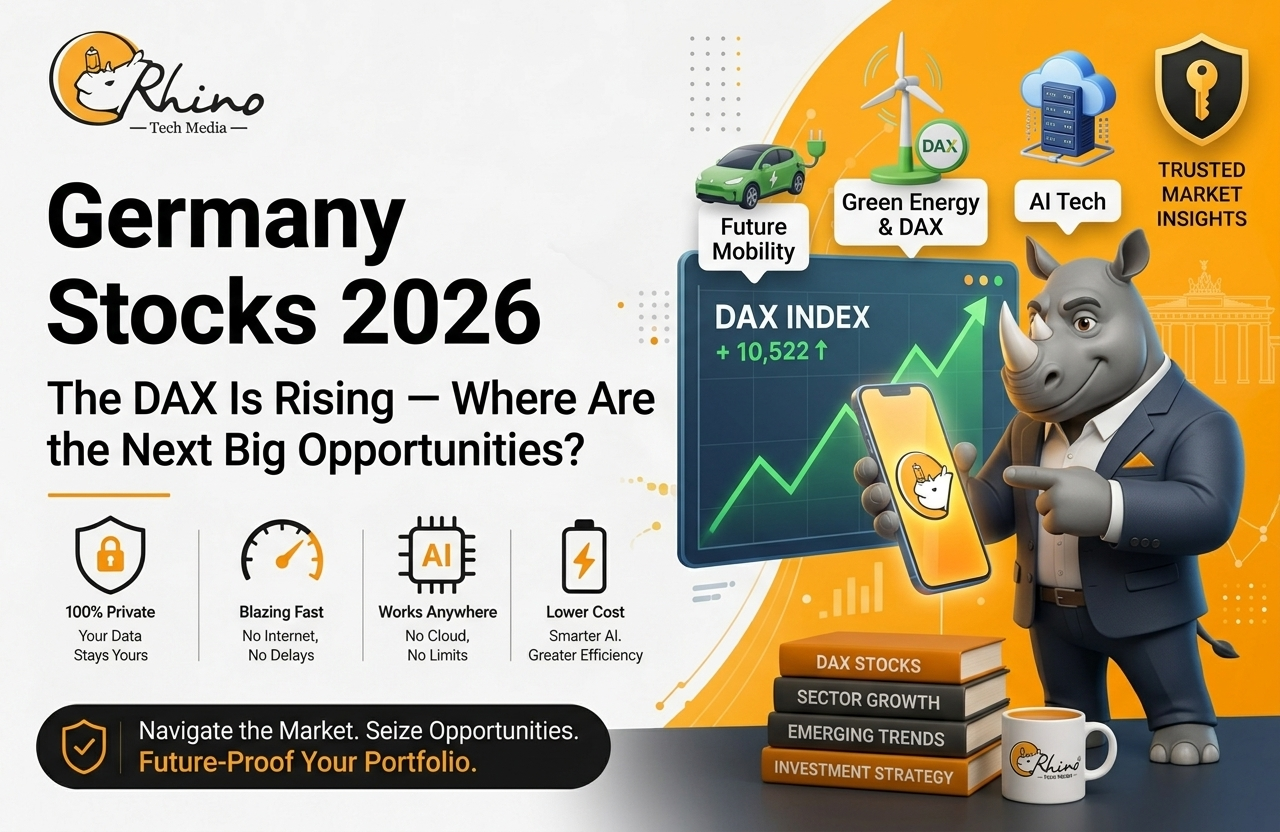
The DAX Is Rising — Where Are the Next Big Opportunities?
Overview
Germany’s stock market is entering 2026 with renewed investor attention. The DAX has reached record levels, while improving expectations around European growth, interest rates, corporate earnings, infrastructure spending, and industrial investment are creating new opportunities across the German market.
Rather than relying solely on the biggest names in the index, investors are increasingly looking across sectors that could benefit from Germany’s economic transformation. Key themes include: AI and digitalization, defense, industrial automation, infrastructure, financial services, healthcare, and energy technology.
Key Opportunities in Germany’s Stock Market:
- l AI & Technology Growth
Companies benefiting from AI adoption, cloud infrastructure, automation, software, and advanced computing are attracting increasing investor interest. SAP remains one of the market’s major technology leaders. - l Defense & Aerospace Expansion
Higher European defense spending is creating a powerful structural theme for German defense and aerospace companies. Rheinmetall, MTU Aero Engines, and Airbus are among the companies positioned within this sector. - l Industrial Automation & Manufacturing
Germany’s industrial strength remains an important investment theme. Companies involved in automation, electrification, smart factories, and industrial technology could benefit as manufacturers modernize their operations. - l Infrastructure Investment
Increased spending on transportation, construction, energy networks, and digital infrastructure could create opportunities for engineering and infrastructure companies. Data-center and defense-related construction are also emerging areas of interest. - l Financial Services
Banks and insurers could benefit from stronger economic activity and changing interest-rate conditions. Germany’s financial sector remains an important component of the broader DAX investment story. - l Energy & Electrification
Germany’s transition toward a more modern and resilient energy system is supporting interest in electricity networks, renewable energy, energy technology, and industrial electrification. - l Healthcare & Medical Technology
An aging population, healthcare innovation, diagnostics, and medical technology provide long-term growth opportunities beyond traditional cyclical industries. - l Automotive Transformation
Germany’s automotive giants continue to face challenges from EV competition and changing global demand, but the transition toward electric vehicles, software-defined cars, and advanced mobility could create new opportunities for companies successfully adapting to the shift. - l Diversification Beyond the DAX Leaders
While major companies such as SAP and Siemens remain central to the German market, investors are increasingly examining mid-cap industrial, technology, infrastructure, and specialized companies for additional growth potential.
What Investors Should Watch
The German market still faces risks, including geopolitical tensions, energy costs, global trade uncertainty, economic weakness, and elevated valuations in some high-growth stocks. The strong performance of European equities also means investors need to distinguish between companies with sustainable earnings growth and stocks driven primarily by market momentum.
The big question for 2026 is no longer simply whether the DAX can rise — it is which sectors and companies can deliver the earnings needed to justify the next stage of the rally.
Industrial Stocks Could Make a Comeback
Germany’s industrial sector remains one of the most important pillars of its stock market. Companies involved in engineering, automation, machinery, electrical equipment, and industrial technology could benefit as businesses modernize production and governments increase investment.
The combination of infrastructure spending, defense investment, digitalization, and automation is creating new demand for industrial capabilities. German industrial companies also have significant international exposure, allowing them to benefit from global investment cycles.
Key themes include:
- l Industrial automation
- l Smart manufacturing
- l Robotics
- l Electrical equipment
- l Engineering and construction
- l Factory modernization
- l Industrial software
Defense Stocks Remain a Major Investment Theme
One of the strongest structural themes for German equities in 2026 is defense.
Germany is significantly increasing defense spending, while European governments are seeking greater strategic independence and expanding domestic defense capabilities. The German government’s economic report highlights substantially higher future defense spending and the potential for investment to support industrial production and technological development.
This creates opportunities across traditional defense as well as newer areas such as drones, sensors, cybersecurity, satellites, and AI-enabled military technologies.
Areas attracting attention include:
- l Defense systems
- l Military vehicles
- l Aerospace
- l Drones and autonomous systems
- l Radar and sensors
- l Defense electronics
- l Military software and cybersecurity
Recent developments underline the strength of this theme: German naval company TKMS raised its 2026 sales-growth outlook to 10–12%, citing stronger demand for warships and advanced technologies.
Infrastructure Spending Could Create New Winners
Germany has been increasing its focus on infrastructure investment after years of underinvestment. Roads, railways, energy networks, construction, digital infrastructure, and data centers are all potential beneficiaries.
This creates an important opportunity beyond traditional DAX technology and industrial companies.
Potential growth areas include:
- l Transportation infrastructure
- l Construction
- l Engineering
- l Power grids
- l Renewable-energy infrastructure
- l Data centers
- l Telecommunications infrastructure
- l Digital networks
German M&A activity in engineering and construction increased during the first half of 2026, while government spending on defense and infrastructure continued to support transformation across industrial sectors.
AI and Technology Are Becoming More Important
Germany may not have the same concentration of mega-cap technology companies as the United States, but AI is still becoming an important driver of German corporate investment.
The opportunity extends beyond companies developing AI directly. German businesses can benefit by providing the software, automation, machinery, chips, sensors, cloud infrastructure, and industrial systems required to deploy AI.
Important themes include:
- l Enterprise AI
- l Industrial AI
- l Automation
- l Cloud computing
- l Semiconductor technology
- l Data centers
- l Cybersecurity
- l Digital transformation
Technology is also becoming increasingly connected to Germany’s traditional industrial strength. This combination of software + engineering + automation could become one of the country’s most distinctive competitive advantages.
Automotive Stocks Face Transformation
The automotive industry remains central to Germany’s economy and stock market, but it is also one of its biggest challenges.
German automakers face intense competition in electric vehicles, software, batteries, and pricing. Chinese manufacturers are becoming increasingly competitive, while consumers are demanding more technologically advanced vehicles.
However, transformation can also create opportunities.
Investors are watching:
- l Electric vehicles
- l Battery technology
- l Vehicle software
- l Autonomous driving
- l Premium vehicles
- l EV charging infrastructure
- l Automotive components
- l Digital mobility services
The winners are likely to be companies that can adapt quickly rather than simply rely on Germany’s traditional automotive strengths.
Energy and Electrification Offer Long-Term Potential
Germany’s energy transformation is another important investment theme. The country needs significant investment in electricity networks, renewable generation, storage, grid modernization, and industrial electrification.
This could benefit companies providing the infrastructure required to move toward a more efficient and flexible energy system.
Key areas include:
- l Renewable energy
- l Power-grid technology
- l Energy storage
- l Electrification
- l Energy efficiency
- l Industrial power systems
- l Smart-grid technology
Energy investment can also complement Germany’s industrial transformation by helping manufacturers reduce costs and improve energy security.
Healthcare and Pharmaceuticals Add Defensive Growth
Healthcare offers investors a different opportunity from highly cyclical industrial and automotive stocks.
Germany has an aging population, while demand for medical technology, diagnostics, pharmaceuticals, biotechnology, and specialized healthcare services continues to grow.
Potential opportunities include:
- l Medical technology
- l Diagnostics
- l Pharmaceuticals
- l Biotechnology
- l Healthcare equipment
- l Digital health
- l Specialized treatments
Healthcare can provide portfolio diversification because its performance is generally less dependent on industrial production and consumer cycles.
Earnings Will Be the Key Market Driver
A rising index ultimately needs rising corporate profits to justify higher valuations.
This makes earnings growth one of the most important factors to watch in 2026. DZ Bank expects broad-based profit growth among DAX companies, with particularly strong contributions from industry, technology, and financials.
Investors should therefore look beyond share-price momentum and examine:
- l Revenue growth
- l Earnings growth
- l Profit margins
- l Order books
- l Free cash flow
- l Dividend sustainability
- l Debt levels
- l Management guidance
Risks Investors Should Not Ignore
Despite the positive opportunities, Germany’s stock market still faces significant risks.
Major risks include:
- l Geopolitical uncertainty — conflicts and international tensions can quickly affect markets.
- l Trade tensions — Germany remains highly exposed to global trade and exports.
- l Energy costs — expensive energy can pressure industrial competitiveness.
- l Automotive disruption — Chinese competition and the EV transition remain major challenges.
- l High valuations — some stocks may already reflect significant future growth.
- l Economic weakness — a slower-than-expected German recovery could hurt cyclical companies.
- l Interest-rate changes — monetary policy can influence valuations and borrowing costs.
- l Sector concentration — strong performance from a few major companies can mask weakness elsewhere.
What Could Drive Germany Stocks in the Rest of 2026?
The German market increasingly reflects a combination of structural investment and corporate transformation rather than a simple economic recovery story.
The most important themes to monitor are:
- l Defense spending and European rearmament
- l Infrastructure investment
- l Industrial modernization
- l AI and digital transformation
- l Automation and robotics
- l Energy and electrification
- l Financial-sector earnings
- l Automotive restructuring
- l Global demand for German industrial products
- l Corporate earnings growth
Conclusion
Germany’s stock market in 2026 is becoming more than a bet on the traditional German economy. The next phase of opportunity could come from the transformation of that economy.
Defense spending is creating new demand, infrastructure investment is opening opportunities for construction and engineering companies, AI is accelerating industrial digitalization, and financial companies could benefit from stronger investment activity. Meanwhile, Germany’s automotive and energy sectors are undergoing major structural changes.
For investors, the opportunity may therefore lie beyond simply following the DAX. The most interesting companies could be those positioned at the intersection of Germany’s traditional strengths—engineering, manufacturing, finance, and industrial expertise—and its new priorities in AI, defense, infrastructure, electrification, and digital transformation.
The DAX may continue to attract attention, but the bigger story for 2026 is which companies can turn Germany’s massive investment cycle into sustainable earnings growth.
