
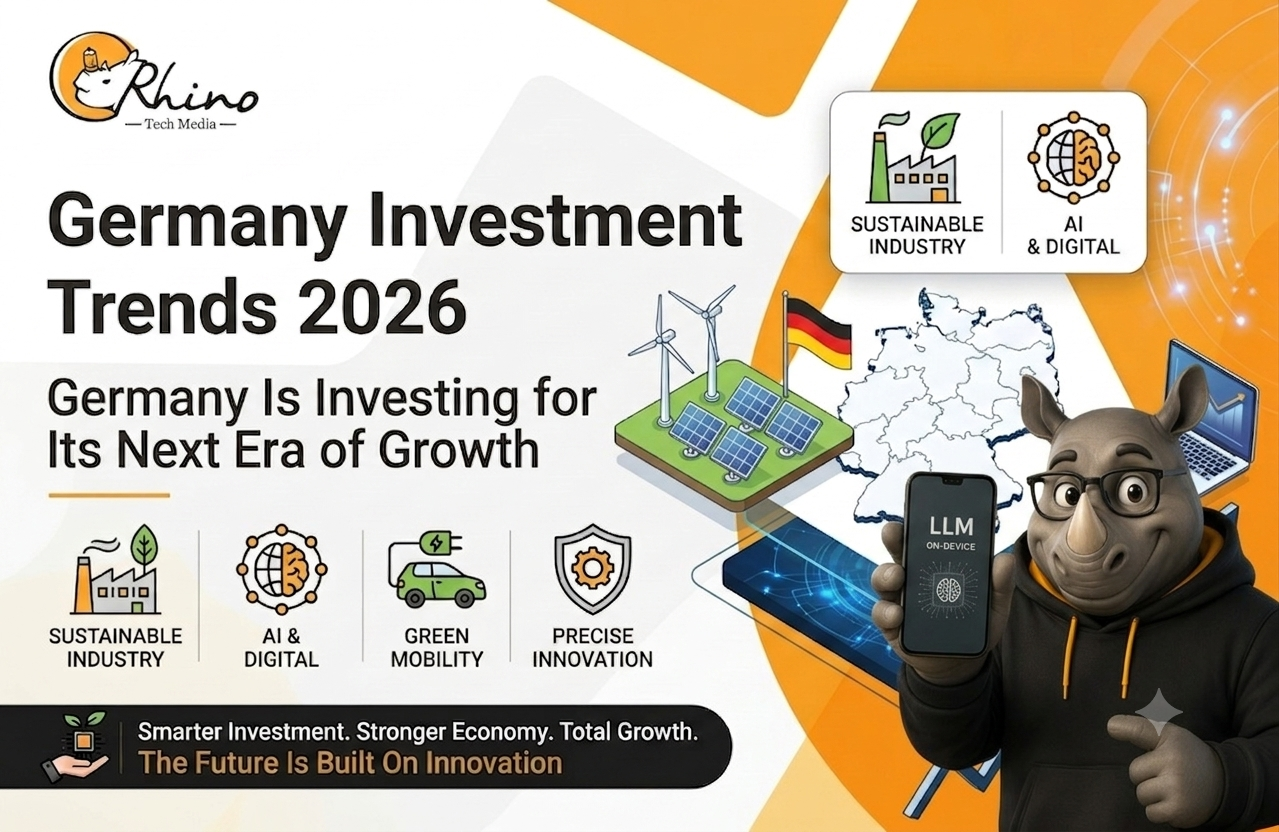
Germany Is Investing for Its Next Era of Growth
Overview
Germany is entering 2026 with a major investment push focused on infrastructure modernization, artificial intelligence, energy security, advanced manufacturing, defense, and digital transformation. A €500 billion Special Fund for Infrastructure and Climate Neutrality is creating a long-term investment framework, while the government plans more than €120 billion in public investment in 2026.
At the same time, Germany remains attractive to international investors despite economic and geopolitical challenges. In 2025, Germany recorded 1,564 foreign investment projects, a 9.3% decline from the previous year, but the decline was less severe than the global and EU averages.
Top investment Areas to Watch:
- l Artificial Intelligence & Industrial AI
- l Infrastructure & Construction
- l Renewable Energy & Power Infrastructure
- l Advanced Manufacturing & Robotics
- l Defense & Cybersecurity
- l Data Centers & Digital Infrastructure
- l Healthcare & Biotechnology
- l Climate Technology & Green Hydrogen
- l Electric Mobility & Batteries
- l Semiconductors & High-Tech Manufacturing
Germany’s 2026 investment story is increasingly about modernizing the industrial economy while building the infrastructure for its next generation of growth. The combination of large-scale public investment, industrial expertise and growing demand for AI and energy infrastructure could create substantial opportunities for both domestic and international investors.
The central investment story for Germany in 2026 is transformation. Capital is increasingly moving toward sectors that can modernize the country’s industrial base, strengthen energy and digital infrastructure, and improve long-term competitiveness.
Infrastructure Investment Takes Center Stage
Infrastructure is emerging as one of Germany’s most important investment themes in 2026. After years of underinvestment and growing pressure to modernize aging infrastructure, Germany is increasing public spending on transportation, digital networks, energy systems, healthcare facilities, and public infrastructure.
The government’s large-scale infrastructure investment plans are expected to create opportunities for both domestic businesses and international investors. Beyond stimulating economic activity, these investments are designed to improve Germany’s long-term productivity and competitiveness.
Key Investment Areas:
- l Railway Modernization: Upgrading rail networks, stations, signaling systems, and high-speed connections.
- l Roads & Bridges: Modernizing highways, bridges, tunnels, and transportation infrastructure.
- l Digital Infrastructure: Expanding fiber-optic networks, 5G connectivity, cloud infrastructure, and data centers.
- l Energy Infrastructure: Developing electricity grids, renewable-energy connections, storage systems, and hydrogen infrastructure.
- l Smart Cities: Investing in intelligent transportation, connected public services, energy-efficient buildings, and urban technologies.
- l Healthcare Infrastructure: Modernizing hospitals, medical facilities, laboratories, and digital healthcare systems.
- l Construction & Engineering: Rising infrastructure spending is supporting demand for construction companies, engineering firms, machinery, materials, and specialized technologies.
Why It Matters for Investors
Germany’s infrastructure push represents more than short-term government spending. It could create a multi-year investment cycle across construction, technology, energy, transportation, and industrial services.
For investors, the biggest opportunity lies in companies and technologies capable of helping Germany modernize its infrastructure, improve efficiency, and build a more connected and sustainable economy.
Healthcare, Biotechnology and Life Sciences
Germany’s healthcare, biotechnology, and life sciences sectors are becoming increasingly important investment areas in 2026. The country combines a strong healthcare system with world-class research institutions, established pharmaceutical companies, biotechnology startups, and advanced medical-technology manufacturers. Growing demand for innovative treatments, diagnostics, personalized medicine, and digital healthcare is creating new opportunities for both domestic and international investors.
Key Investment Opportunities:
- l Biotechnology Innovation — Investment is increasing in biotechnology companies developing new therapies, vaccines, diagnostics, and advanced biological technologies.
- l Pharmaceuticals — Germany remains an important pharmaceutical market, with opportunities across drug development, manufacturing, clinical research, and specialized medicines.
- l Medical Research & R&D — Strong universities and research institutions support innovation in areas such as genetics, oncology, immunology, and regenerative medicine.
- l Medical Technology — Demand for advanced medical devices, diagnostic equipment, surgical technologies, and laboratory solutions continues to create attractive investment opportunities.
- l AI in Healthcare — Artificial intelligence is increasingly being used for medical imaging, diagnostics, drug discovery, patient monitoring, and healthcare administration.
- l Diagnostics & Personalized Medicine — Advances in genomics, molecular diagnostics, and precision medicine are creating opportunities for companies developing more targeted approaches to disease prevention and treatment.
- l Digital Health — Telemedicine, health platforms, electronic health records, and digital patient-management solutions are helping modernize healthcare delivery.
Investment Outlook
Germany’s life sciences sector offers investors a combination of strong research capabilities, established industrial expertise, and growing demand for healthcare innovation. As technology becomes increasingly integrated into medicine, opportunities are expected to expand across biotechnology, digital health, diagnostics, pharmaceuticals, and medical technology.
Electric Mobility and Battery Technology
Germany’s automotive industry is undergoing a major transformation as electric vehicles, battery technology, software, and intelligent mobility become increasingly important. As one of the world’s leading automotive manufacturing centers, Germany is investing heavily in the transition from traditional internal-combustion vehicles toward electric, connected, and increasingly autonomous transportation.
This transformation is creating investment opportunities across the entire mobility ecosystem—from battery production and charging infrastructure to automotive software and advanced vehicle components.
Key Investment Opportunities:
- l Electric Vehicle Manufacturing — Automakers are expanding their electric vehicle portfolios and upgrading production facilities to support next-generation EV manufacturing.
- l Battery Production — Battery cells, battery-management systems, energy storage, and battery recycling are becoming strategically important areas for investment.
- l Charging Infrastructure — The expansion of public and private charging networks is creating opportunities in fast-charging stations, charging software, and energy-management systems.
- l Automotive Software — Modern vehicles increasingly depend on software for connectivity, navigation, driver assistance, cybersecurity, and vehicle management.
- l Autonomous Driving — Investment in sensors, artificial intelligence, advanced driver-assistance systems, and autonomous-driving technologies is supporting the development of smarter vehicles.
- l EV Supply Chains — Manufacturers of electric motors, power electronics, semiconductors, lightweight materials, and other EV components are becoming increasingly important.
- l Battery Recycling & Circular Economy — Recycling and recovering valuable materials such as lithium, nickel, and cobalt can strengthen supply chains while reducing environmental impact.
Investment Outlook
Germany’s transition toward electric mobility presents both significant opportunities and major competitive challenges. Companies that can combine Germany’s engineering expertise with competitive battery technology, software, AI, and efficient manufacturing could benefit from the long-term transformation of the automotive industry.
Foreign Direct Investment and Global Capital
Foreign Direct Investment (FDI) remains an important pillar of Germany’s investment landscape in 2026. As Europe’s largest economy, Germany offers international investors access to a large consumer market, highly developed infrastructure, advanced manufacturing capabilities, skilled talent, and the broader European Union market.
However, global investment patterns are changing. International companies are becoming more selective, focusing capital on strategic sectors such as AI, semiconductors, renewable energy, advanced manufacturing, healthcare, digital infrastructure, and mobility.
Key Investment Opportunities:
- l Strategic Market Access — Germany provides international companies with a strong base for accessing the wider European market and its integrated supply chains.
- l Technology & AI — Global investors are increasingly interested in Germany’s AI ecosystem, industrial technology, automation, software, and digital infrastructure.
- l Advanced Manufacturing — Germany’s established industrial base creates opportunities for foreign companies in machinery, robotics, electronics, automotive technologies, and high-tech manufacturing.
- l Energy & Renewables — International capital is supporting renewable energy, energy storage, hydrogen, electricity infrastructure, and industrial decarbonization.
- l Digital Infrastructure — Data centers, cloud computing, telecommunications, cybersecurity, and fiber networks are becoming increasingly attractive investment areas.
- l Healthcare & Life Sciences — Germany’s research institutions, pharmaceutical industry, biotechnology ecosystem, and medical-technology sector offer opportunities for international partnerships and investment.
- l Automotive Transformation — Foreign investors are participating in Germany’s transition toward electric vehicles, batteries, autonomous driving, and automotive software.
Challenges for Global Investors
Despite its advantages, Germany faces several factors that international investors must consider:
- l High energy and operating costs
- l Skilled-labor shortages
- l Regulatory complexity
- l Demographic pressures
- l Global trade uncertainty
- l Geopolitical risks
- l Increasing international competition
These challenges are encouraging investors to focus on productivity, automation, strategic technologies, and resilient supply chains.
Conclusion
Germany’s investment landscape in 2026 reflects a country undergoing a significant economic transformation. From infrastructure and artificial intelligence to renewable energy, advanced manufacturing, electric mobility, healthcare, and global capital, new investment opportunities are emerging across both established and rapidly growing industries.
Large-scale infrastructure development, technological innovation, the energy transition, and industrial modernization are creating a stronger foundation for long-term growth. At the same time, challenges such as high operating costs, labor shortages, regulatory complexity, and global economic uncertainty require investors to take a selective and strategic approach.
