
Introduction
Amazon has revealed a wearable technology innovation aimed at its delivery workforce: AI-enabled smart glasses, internally dubbed the “Amelia” glasses. The glasses employ computer vision, artificial intelligence (AI) and a heads-up display (HUD) to assist delivery associates through scanning, navigation and proof-of-delivery tasks. This report outlines their features, intended benefits, potential challenges and broader implications.
What the Smart Glasses Are
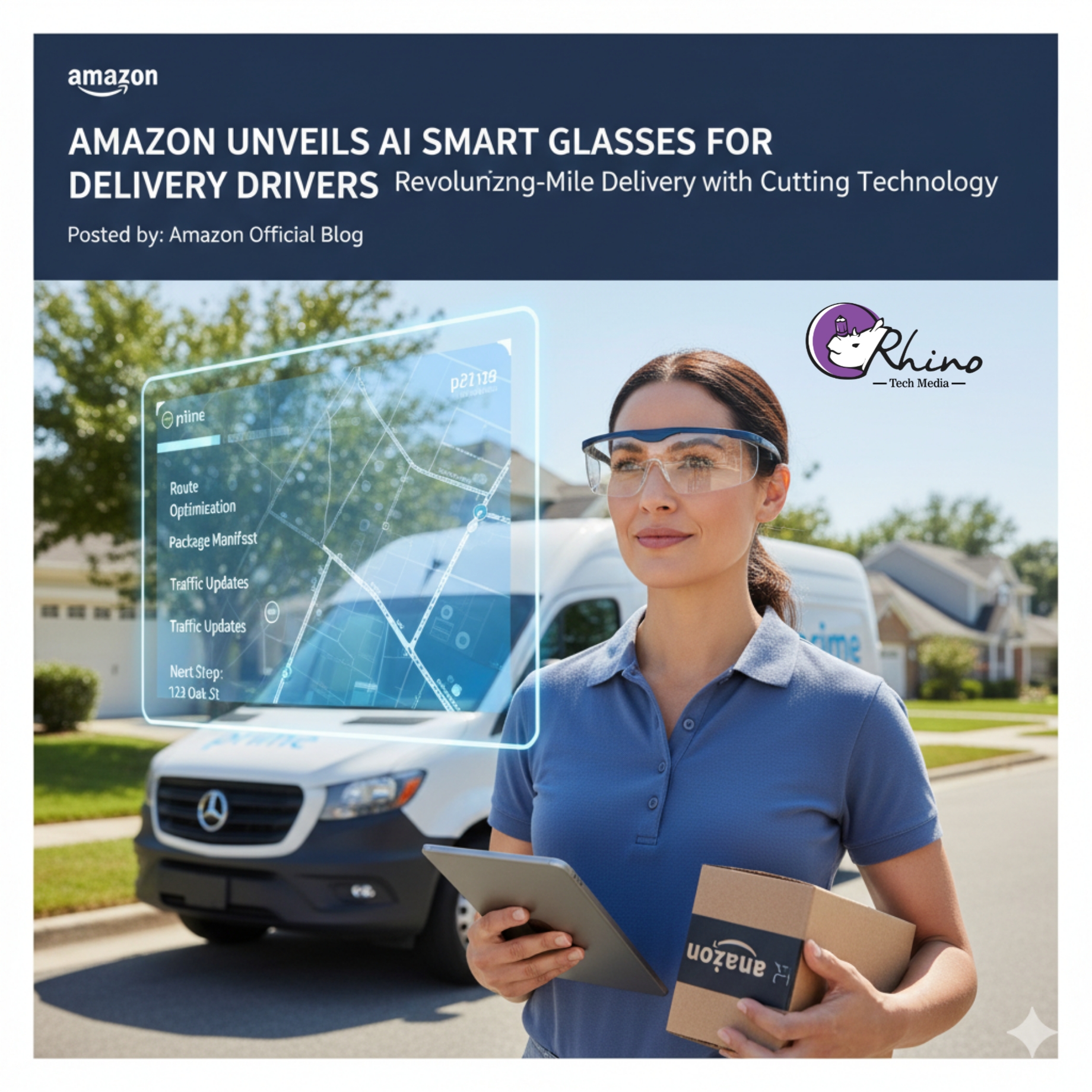
According to Amazon’s announcement, the glasses are designed specifically for its delivery network: the company’s “Delivery Associates” (DAs). Key technological elements include:
- A small heads-up display visible in the driver’s field of view, showing delivery-details, package-matching cues, navigational prompts and hazard alerts.
- Embedded cameras and computer-vision / AI sensing, enabling scanning of packages and the environment.
- A vest-mounted controller (worn on the driver’s delivery vest) which contains a swappable battery and a physical button (for e.g., capturing proof of delivery photos).
- The system is configured to activate after the driver has parked the van (i.e., when walking to the delivery point) rather than while driving, in order to reduce safety/distraction risks.
- Design considerations for all-day wear: supporting prescription lenses, transitional lenses (light-adjusting) and driver comfort.
The primary workflow appears to be: the delivery vehicle parks → the glasses activate → packages relevant to that stop are highlighted/identified → the driver receives walking directions to the door, plus hazard alerts if needed → at the doorstep a photo is taken via the vest button for proof of delivery.
Intended Benefits and Use-Cases
Efficiency Gains
Amazon claims that these glasses can reduce the time that drivers spend shifting their attention between phone screens, packages, labels and their surroundings—thus simplifying the delivery process. It is reported that the system could save “up to 30 minutes” in an 8 to 10 hour shift by reducing repetitive tasks and streamlining workflows.
Safety and situational awareness
By keeping drivers’ eyes more forward, and reducing the need to look repeatedly at a phone or handheld device, Amazon argues that the glasses improve situational safety (e.g., being aware of hazards like pets, steps, obstacles) in the last-mile walking portion of a delivery. The ability to flag hazards and guide drivers visually is a key benefit.
Deliveries in complex environments
Amazon emphasises the benefit of these glasses in complex delivery environments — gated communities, multi-unit apartment buildings, lobbies and so on. Here, locating the correct package and unit, finding the right door, navigating walkways and stairs can add time; the HUD navigation is designed to assist in those scenarios.
Digital transformation of logistics
These glasses fit into Amazon’s broader push to infuse AI, machine-vision and automation into its logistics operations (including robotics and data-driven operations). The wearable is one piece of that larger transformation.
Development Status & Deployment Plans
As of the announcement, Amazon indicates that the prototype is in testing with “hundreds” of delivery drivers in North America. The company has not yet given a firm global rollout date, but depending on results and refinement, a broader deployment could follow. The name “Amelia” has been used in various reports to refer to the glasses.
Potential Challenges and Considerations
Worker privacy & monitoring concerns
Wearable devices with cameras and sensors bring questions about monitoring of employees and privacy of customers. Article commentary has noted the “dystopian” potential of HUDs and wearables in a workplace context. Amazon’s design attempts to mitigate distraction (e.g., disabling while driving), but broader concerns remain about how the data will be used.
Adoption, ergonomics & battery life
Driving/walking delivery routes for hours under various conditions (heat, cold, rain) demands wearables that are comfortable, durable and battery-reliable. Amazon mentions support for prescription lenses and light adjustment, but wide-scale deployment will test durability, comfort and maintenance. Battery swaps, vest integration and physical controls must perform reliably.
Reaction & morale of delivery workforce
While the glasses are pitched as tools to assist and make the job safer/more seamless, there may be concerns from delivery associates about increased tracking, pressure to perform faster, or the use of the technology to monitor productivity. Ensuring that the workforce views the devices as assistance—not surveillance—will be critical for adoption.
Cost, scale and rollout logistics
Deploying a wearable to thousands of drivers globally, ensuring training, maintenance, software updates, and integration with existing delivery workflows and infrastructure is a non-trivial operation. Amazon will need to scale supply, support and logistics around the wearables themselves.
Broader Implications
For Amazon’s logistics network
If successful, the glasses could optimise the “last-mile” segment of delivery more than before, reducing delays, errors (wrong address/package), and improving safety of walking segments. That may enhance Amazon’s overall delivery efficiency, reduce cost per delivery, and improve customer experience.
For the wearable/AR market
While Amazon’s glasses are focused on internal use (rather than consumer market), the move signals how companies are adopting AR/AI-wearables for enterprise/logistics use-cases. It may accelerate broader acceptance of wearable HUDs beyond consumer novelty into industrial and operational roles.
For labour, automation and workforce dynamics
The introduction of such wearable assistive devices raises questions about the evolving role of humans in logistics. Will the glasses simply assist, or eventually increase delivery quotas? Will they integrate with further automation (drones, robots) to reduce reliance on human labour? These are strategic questions.
For competition and future consumer products
Some reports suggest Amazon is also developing AR glasses for consumers (codenamed “Jayhawk”) which would leverage similar display and vision tech. The delivery-glasses initiative may thus serve as a technological stepping stone for broader wearable products in Amazon’s roadmap.
Conclusion
Amazon’s introduction of prototype AI smart glasses for delivery drivers represents a noteworthy step in embedding cutting-edge wearable and computer-vision technologies into the logistics chain. By equipping delivery associates with heads-up displays, scanning and navigation capabilities, Amazon seeks to improve efficiency, safety and accuracy in the final leg of delivery. At the same time, the initiative raises important questions around workforce adoption, privacy, ergonomics and the cost/benefit tradeoffs of large-scale wearable deployment.
While still in testing, the glasses have the potential to reshape how last-mile delivery is performed — shifting the driver’s focus from handheld devices to heads-up, real-time guidance. The success of this venture will depend on how seamlessly Amazon integrates the hardware into driver workflows, how drivers respond to the technology, and how the company manages the change process.
In sum, this project is an exemplar of Amazon’s broader push to harness AI and automation across its operations — and could signal a new frontier in wearable-augmented logistics.
