
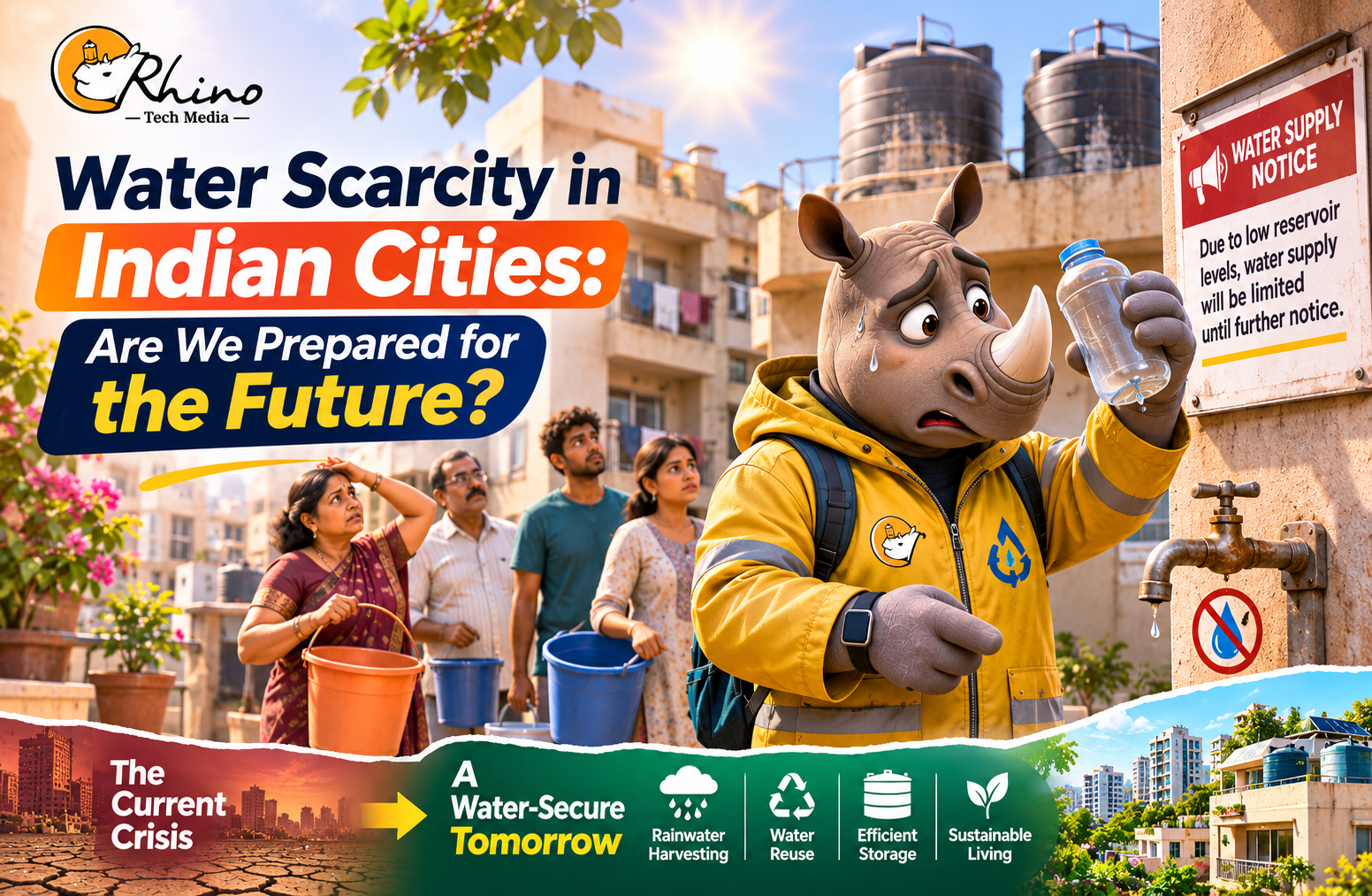
Imagine waking up one morning, turning on the kitchen tap and finding no water. You check the bathroom, look at the overhead tank and realise that your household supply has run out. Suddenly, preparing breakfast, getting children ready for school and getting to work become difficult.
For thousands of Indian families, this is not an imaginary situation. It is a reality, particularly during the summer months.
From Bengaluru’s tanker-dependent neighbourhoods to Chennai’s memories of the 2019 water crisis, urban water shortages are becoming an increasingly serious concern. The problem affects more than household routines. It puts pressure on public health, businesses, household budgets and the environment.
The recent Bisleri controversy has also raised questions about drinking water safety. When regular supplies become unreliable, bottled water often seems like an easy alternative. But can consumers always feel confident about the quality of the water they purchase?
As India’s cities continue to expand, an important question deserves attention: Are we preparing today to ensure future generations have access to clean and affordable water?
Why Is Water Scarcity Becoming a Serious Concern in India?
India receives substantial rainfall during the monsoon, yet many cities struggle with water shortages throughout the year. The challenge is not simply how much rain falls, but how effectively it is collected, stored and distributed.
According to the Ministry of Jal Shakti’s 2025 groundwater assessment, India’s annual groundwater extraction reached 247.22 billion cubic metres, with the national stage of groundwater extraction at 60.63%.
This figure highlights the country’s dependence on groundwater, although the situation varies considerably between regions.
Consider a residential area with hundreds of families. When municipal supplies are insufficient, residents turn to borewells and private tankers. As more buildings follow the same approach, pressure on underground water reserves increases.
This is why managing existing resources is just as important as finding new sources.
5 Major Reasons Behind Water Scarcity in Indian Cities
1. Rapid Urbanisation and Population Growth
Cities attract people looking for employment, education and better opportunities. As populations increase, demand for housing, drinking water, sanitation and industrial facilities grows.
However, water infrastructure does not always expand at the same pace. New residential developments can quickly put pressure on existing supply systems.
2. Excessive Groundwater Extraction
When municipal water does not reach homes regularly, borewells become an alternative.
However, groundwater needs sufficient time and rainfall to recharge. Excessive extraction can lower underground water levels and eventually make borewells unreliable.
The Central Ground Water Board regularly assesses groundwater availability and extraction to help identify areas requiring better management.
3. Disappearing Lakes and Water Bodies
Lakes, ponds and wetlands play an important role in urban water management. They collect rainwater, support groundwater recharge and help maintain local ecosystems.
Unfortunately, encroachment, construction and pollution have damaged many urban water bodies. When these natural storage systems disappear, cities become more vulnerable to both water shortages and flooding.
4. Ageing Infrastructure and Water Leakage
Imagine treating thousands of litres of water only to lose a significant portion through damaged pipelines before it reaches households.
Leaking connections, outdated distribution networks and poor maintenance contribute to unnecessary wastage. Repairing existing infrastructure should therefore be a priority for city authorities.
5. Unpredictable Rainfall
Changing rainfall patterns, longer dry spells and periods of intense rainfall make water planning more difficult.
Heavy rainfall over a few days does not guarantee sufficient supplies throughout the year, especially when cities lack adequate storage facilities and rainwater harvesting systems.
Indian Cities Already Feeling the Pressure
Water scarcity affects different cities in different ways, but the consequences are visible in everyday life.
- Bengaluru: During the 2024 water crisis, several neighbourhoods faced serious supply difficulties. Apartment residents increasingly depended on private tankers, while some households had to reduce their daily consumption.
- Chennai: The 2019 crisis, when the city’s four main reservoirs nearly ran dry, remains a reminder of how vulnerable urban water supplies can become during prolonged drought.
- Delhi: Unequal distribution means some neighbourhoods receive regular municipal supplies while others depend on tankers and alternative arrangements.
These experiences also reveal an economic divide. While some families can afford private water deliveries, others struggle with the additional expense.
Access to clean water should never depend on how much a household can afford to pay.
The Bisleri Controversy: Can Consumers Trust Packaged Drinking Water?
For many Indian households, bottled water has become a convenient option when regular supplies are unavailable or uncertain. However, a recent development involving Bisleri has brought packaged drinking water quality into the spotlight.
In November 2026, the Food Safety and Standards Authority of India (FSSAI) sanctioned prosecution against Bisleri International following laboratory findings involving a packaged drinking water sample from its Goa facility.
The initial test reported bromate at 12 micrograms per litre, above the prescribed limit of 10 micrograms per litre. Following an appeal, the referral laboratory reported bromate below the permissible limit but also flagged polycyclic aromatic hydrocarbons (PAHs).
On November 23, FSSAI clarified that its sale prohibition applied specifically to Batch GO 270, manufactured in September 2025, rather than all Bisleri products.
Bisleri disputed aspects of the findings, maintained that the affected batch was no longer available in the market and said it would cooperate with the regulator. The company also stated that subsequent production samples met applicable standards.
The regulatory proceedings should not be confused with a final court conviction.
For further details, see Reuters’ coverage of the FSSAI action and Bisleri’s response reported by Moneycontrol.
What Should Consumers Remember?
The controversy is a reminder that drinking water safety requires consistent quality checks, not just brand recognition.
Consumers should:
- Check manufacturing dates, batch details and FSSAI licence information.
- Make sure bottle caps and seals are intact.
- Avoid damaged or poorly stored packaging.
- Follow official safety advisories concerning specific products.
Ultimately, bottled water should not become a permanent substitute for reliable municipal drinking water.
6 Practical Solutions to Prevent Future Water Shortages
Preparing for the future requires action from governments, businesses, communities and individual households.
1. Make Rainwater Harvesting a Priority
Apartments, offices, schools and commercial buildings should install and maintain rainwater harvesting systems. Rooftop rainwater can be collected in storage tanks or directed towards groundwater recharge structures.
2. Restore Lakes and Ponds
Authorities must prevent encroachment, control sewage discharge and maintain natural drainage channels. Government initiatives such as Mission Amrit Sarovar highlight the importance of developing and rejuvenating local water bodies.
3. Reuse Treated Wastewater
Fresh drinking water should not be used for every activity. Properly treated wastewater can support industrial operations, gardening, construction and cleaning public spaces.
4. Improve Water Distribution Systems
Regular pipeline inspections, smart meters and leak detection technology can help cities reduce water losses and improve supply management.
5. Monitor Groundwater Extraction
Apartment associations, industries and local authorities should monitor borewell consumption and support groundwater recharge, particularly in areas facing declining water levels.
6. Encourage Responsible Household Consumption
Simple habits can make a difference:
- Repair leaking taps immediately.
- Turn off taps while brushing.
- Use buckets instead of unnecessarily long showers.
- Reuse suitable household water for gardening.
- Avoid washing vehicles with running hoses.
These actions may seem small, but they become meaningful when entire communities participate.
Can Technology Help India Become Water-Secure?
Technology offers new ways to manage water more efficiently. Smart meters can monitor household consumption, while AI-powered systems can identify unusual usage patterns and possible pipeline leaks.
Advanced wastewater treatment, groundwater monitoring, smart irrigation and desalination can also support urban water management.
However, technology alone cannot solve the crisis. It must be supported by reliable infrastructure, effective policies and responsible public participation.
Conclusion: India’s Water Future Depends on Every Drop
Water scarcity in Indian cities is no longer a distant environmental concern. It affects families trying to manage without regular supplies, businesses facing interruptions and communities paying more for basic necessities. The Bisleri controversy also reminds us that having access to drinking water means ensuring its safety.
India has the knowledge and resources to improve its water security, but action cannot wait until another summer crisis. Governments must protect lakes and modernise pipelines, industries must reuse water, and households must avoid unnecessary wastage.
We cannot control when or how much it rains, but we can change how wisely we manage the water available to us.
Saving water should not be an occasional response to a shortage. It should be part of how we live every day. The future of India’s cities depends on the decisions we make today.
