
A cancer diagnosis brings more than medical concerns. For patients and their families, it often means difficult treatment decisions, repeated hospital visits, financial pressure and uncertainty about what comes next.
Chemotherapy has helped millions of people, but it can also damage healthy cells, leading to side effects that make treatment challenging. This is why researchers are working towards more targeted ways of fighting cancer.
One technology attracting growing attention is Antibody-Drug Conjugates (ADCs).
Think of an ADC as a delivery system designed to carry powerful cancer-killing medicine towards specific targets on cancer cells. The aim is to make treatment more selective while limiting unnecessary damage to healthy tissues.
What’s particularly interesting is China’s growing role in this field.
Chinese biotechnology companies are no longer just participating in pharmaceutical manufacturing. They are developing innovative cancer medicines, entering international partnerships and competing in clinical research.
From RemeGen’s approved ADC medicine to DualityBio’s collaboration with BioNTech, China’s progress is becoming increasingly difficult for the global pharmaceutical industry to ignore.
So, what is driving this growth, and could it change the future of cancer care?
Let’s take a closer look.
What Makes Antibody-Drug Conjugates Different?
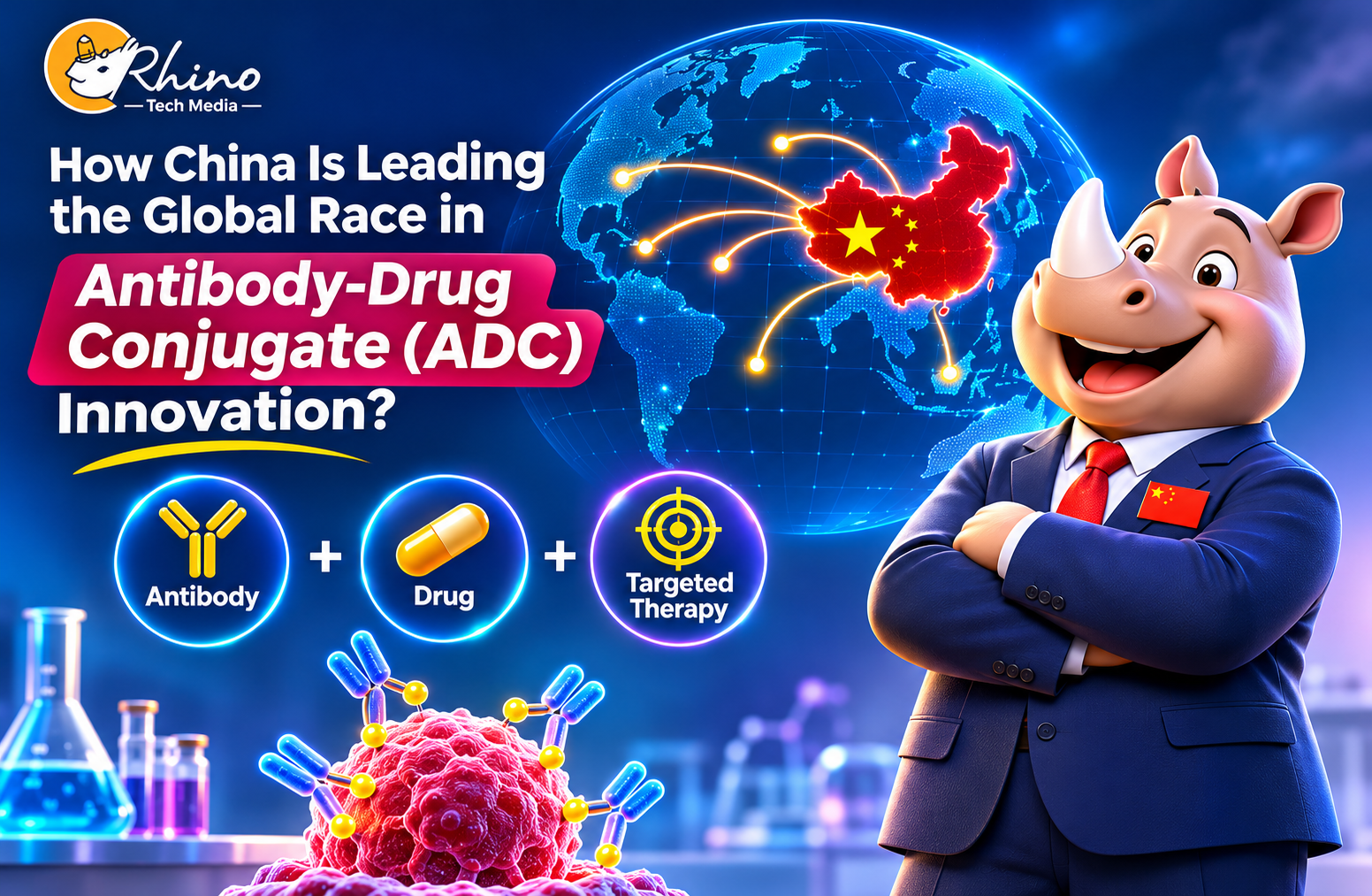
ADCs combine three components to deliver targeted cancer treatment:
- Antibody: Recognises a specific protein or target on cancer cells.
- Linker: Connects the antibody to the drug payload.
- Payload: Contains a powerful cancer-killing agent.
Once the antibody attaches to its target, the ADC can enter the cancer cell and release its payload.
The goal is to deliver the drug more selectively. However, ADCs can still affect healthy tissues and cause serious side effects.
One real-world example is Kadcyla (ado-trastuzumab emtansine), an approved ADC used to treat certain patients with HER2-positive breast cancer.
Learn more about ADC treatment from the National Cancer Institute.
Why Is China Becoming a Global Leader in ADC Development?
China’s growing influence is supported by research investment, specialised biotechnology platforms, clinical development and international collaboration.
Here are five developments worth understanding.
1. China Is Building a Major ADC Research Pipeline
One of the clearest signs of China’s progress is the scale of its clinical research activity.
A global analysis published in 2026 examined 3,077 ADC clinical trials and reported the following:
| Research indicator | Number |
| Global ADC trials analysed | 3,077 |
| Trials associated with China | 1,481 |
| Trials associated with the United States | 1,320 |
These figures highlight China’s significant contribution to ADC research.
Why does this matter?
More clinical research creates opportunities to investigate new cancer targets, improve drug designs and explore treatment options for different patient groups.
However, a large pipeline does not guarantee successful medicines. Every candidate must demonstrate safety and meaningful clinical benefits.
Source: Global ADC Clinical Trial Analysis.
2. Chinese Biotech Companies Are Developing Real ADC Medicines
Statistics tell only part of the story. The companies and medicines behind these numbers show how China’s research is translating into actual pharmaceutical development.
Two examples stand out.
RemeGen: Developing Disitamab Vedotin
<PRIVATE_PERSON> RemeGen, a Chinese biotechnology company, developed disitamab vedotin (RC48), marketed in China as Aidixi.
It is a HER2-targeting ADC developed for certain patients with HER2-expressing gastric cancer, including gastroesophageal junction adenocarcinoma.
China’s National Medical Products Administration approved the medicine in 2021 for a specific treatment setting involving patients who had already received at least two systemic chemotherapy regimens.
This was an important milestone because it demonstrated that a Chinese-developed ADC could progress from research into an approved cancer treatment.
Explore RemeGen’s official product pipeline.
DualityBio: Taking ADC Innovation International
Another interesting example is DualityBio, which has developed next-generation ADC candidates.
Its collaboration with German biotechnology company BioNTech is particularly significant.
Their HER2-targeting ADC, trastuzumab pamirtecan (DB-1303/BNT323), achieved a major clinical milestone in September 2025.
The partners announced that a Phase III trial in patients with HER2-positive advanced or metastatic breast cancer met its primary endpoint of improving progression-free survival compared with trastuzumab emtansine.
In April 2026, China’s drug regulator accepted its application for review.
This is a meaningful example of Chinese biotechnology research progressing through international collaboration and advanced clinical development. Acceptance for review, however, is not the same as marketing approval.
Read the BioNTech clinical trial announcement.
3. Innovation Is Moving Beyond Traditional ADC Designs
Researchers are now looking beyond conventional ADC technology.
Chinese biotechnology companies are exploring more advanced approaches to address some of the limitations of existing treatments.
Three areas deserve attention:
Bispecific ADCs
These medicines are designed to recognise two different targets or binding sites. Researchers are investigating whether this approach could help address the complexity of certain tumours.
Dual-payload ADCs
Instead of carrying one type of cancer-killing agent, these ADCs aim to deliver two different payloads.
The idea is to explore multiple mechanisms of action and potentially address treatment resistance.
Improved linker technology
The linker controls how the drug remains attached to the antibody and when its payload is released.
Improving linker stability and drug-release behaviour could help researchers develop more effective and predictable treatments.
These approaches remain under investigation, and their potential benefits need to be confirmed through clinical studies.
4. International Partnerships Are Putting China on the Global Map
Developing a new cancer medicine requires years of research, significant funding and specialised expertise.
International pharmaceutical partnerships can help promising Chinese drug candidates reach wider markets.
For example, DualityBio’s partnership with BioNTech demonstrates how Chinese-developed ADC candidates can enter global clinical development.
Another notable example is China’s Kelun Biotech, which entered into an ADC licensing collaboration with Merck (MSD).
The agreement initially covered seven ADC programmes, demonstrating the international interest in Chinese-developed drug candidates.
These collaborations can help companies:
- Share research and development responsibilities.
- Access international clinical trial networks.
- Expand regulatory and commercial expertise.
- Bring promising medicines to more markets.
For China, this represents an important shift from being primarily a manufacturing destination to becoming a source of innovative pharmaceutical research.
Read more about China’s ADC partnerships.
5. Clinical Research Is Expanding Across Different Cancers
The real value of ADC innovation lies in whether these medicines can help patients.
Chinese companies are investigating ADC candidates across several cancer types, including:
- Breast cancer.
- Lung cancer.
- Gastric cancer.
- Ovarian cancer.
- Other solid tumours.
Clinical trials help researchers understand how well a medicine works, what side effects it may cause and which patients could benefit.
The process generally includes:
- Phase I: Initial safety and dosage assessment.
- Phase II: Evaluation of treatment effectiveness.
- Phase III: Larger studies comparing treatments.
- Phase IV: Monitoring after regulatory approval.
For patients, these stages matter because a promising laboratory result is not enough. A medicine needs strong clinical evidence before doctors can confidently use it.
Explore ongoing ADC clinical trials.
What Could China’s ADC Growth Mean for Cancer Patients?
For someone living with cancer, pharmaceutical competition is not about which country develops the most medicines. It is about having better treatment possibilities.
If new ADC candidates prove successful, they could contribute to:
- More targeted treatment options: Medicines designed for particular cancer-related targets.
- New treatment combinations: Opportunities to study ADCs alongside immunotherapy and other medicines.
- Alternative treatment approaches: Potential options for patients whose cancers do not respond to existing therapies.
- Greater global access: International partnerships that could support wider development and distribution.
Of course, not every experimental drug will become an approved treatment. Availability, suitability and effectiveness depend on clinical evidence and regulatory approval.
Challenges China Must Still Overcome
Despite its progress, China’s ADC industry has several challenges ahead.
- Safety: ADCs can still damage healthy tissues and cause significant side effects.
- Drug resistance: Some cancers may stop responding to particular treatments.
- Regulatory approval: Companies must meet strict requirements in different international markets.
- Manufacturing quality: ADC production requires specialised technology and consistent quality control.
- Global competition: Pharmaceutical companies across the United States, Europe and Asia are also developing next-generation ADCs.
The real test will be turning promising research into safe, reliable and clinically meaningful treatments.
Conclusion
China’s growing influence in Antibody-Drug Conjugate innovation is more than a pharmaceutical industry success story. It represents a changing approach to cancer research, where biotechnology companies are exploring ways to make treatments more targeted and potentially more effective.
The progress of companies such as RemeGen and DualityBio shows how Chinese research is moving from laboratory development into approved medicines and international clinical programmes. Growing partnerships with global pharmaceutical companies further demonstrate the industry’s changing position.
But the most important question is not how many ADC candidates China can develop. It is how many can safely demonstrate meaningful benefits for patients.
For families facing a cancer diagnosis, every genuine treatment advancement matters. Better-targeted medicines, stronger clinical evidence and wider access could make a real difference in the years ahead.
China still has scientific, regulatory and manufacturing challenges to overcome, but its contribution to ADC research is worth watching.
The future of cancer care will be shaped by discoveries that work beyond the laboratory and reach the people who need them most. And China’s growing role in ADC innovation is becoming an important part of that journey.
