AI is becoming part of everyday business.
It can write emails, answer customer questions, analyze data, recommend products, and automate repetitive tasks.
But AI can also get things wrong.
A chatbot may give incorrect information. An AI hiring tool could overlook a qualified candidate. A generative AI system might confidently provide false information.
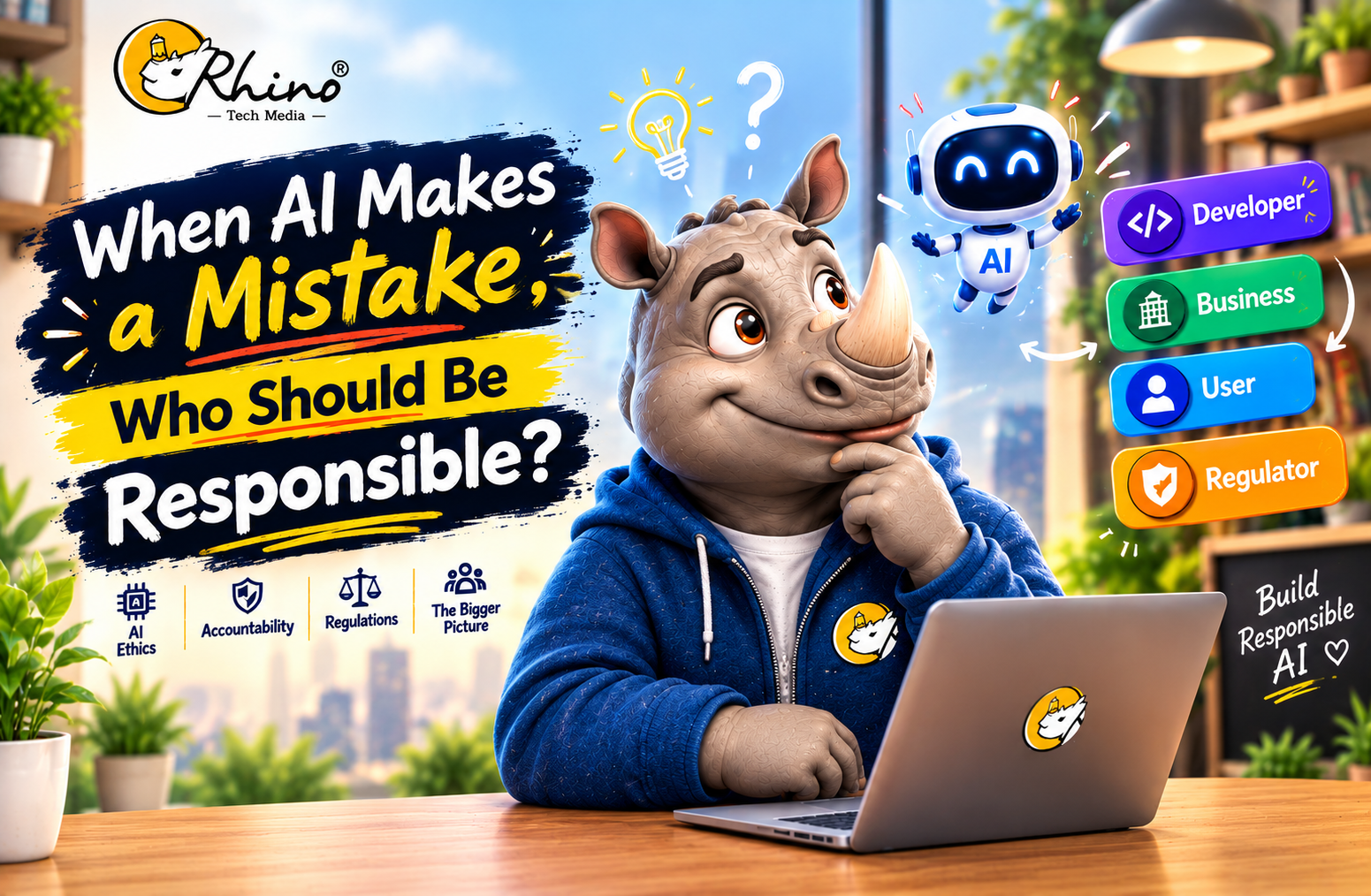
So, when AI makes a mistake, who is responsible?
The answer depends on the situation. But one thing is clear: businesses can’t simply blame “the AI” and move on.
AI Mistakes Can Become Business Problems
The system reviews hundreds of applications and recommends candidates. Later, the company discovers that qualified people from certain groups are being overlooked.
The problem could come from:
- Biased or poor-quality data
- Weak testing
- Poor system design
- Inadequate monitoring
- Lack of human review
This shows why responsible AI isn’t just a technology issue. It also involves people, data, processes, and business decisions.
The NIST AI Risk Management Framework provides guidance for managing AI risks throughout the system lifecycle.
Who Should Take Responsibility?
Responsibility depends on how the AI was developed, deployed, and used. In some cases, several parties may share it.
AI Developers Have a Role
AI developers and vendors should make reasonable efforts to:
- Test their systems
- Identify limitations
- Explain intended uses
- Communicate important risks
- Provide useful documentation
Businesses should ask questions before adopting an AI tool:
What does it do? What are its limitations? What happens when it gets something wrong?
NIST’s Trustworthy and Responsible AI guidance covers areas such as reliability, security, accountability, transparency, privacy, and fairness.
Businesses Have Responsibility Too
Suppose a bank uses AI to flag suspicious transactions and the system incorrectly blocks a legitimate payment.
The bank can’t simply say, “The AI made the mistake.”
The business chose the system and decided how it would be used. It needs processes for reviewing questionable results and resolving customer problems.
This applies to AI used in:
- Recruitment
- Finance
- Healthcare
- Insurance
- Customer service
- Employee management
AI can support decisions, but it shouldn’t replace accountability.
A Human in the Loop Isn’t Enough
Having a person involved doesn’t automatically make an AI system responsible.
Imagine an AI system rejects a loan application. An employee reviews the result but cannot understand why the system reached that decision or override it.
There’s a human in the process, but there’s little meaningful oversight.
Good human oversight means people can:
- Question AI recommendations
- Review important decisions
- Override results
- Escalate serious issues
- Stop the system when necessary
The NIST AI RMF Playbook provides practical guidance around Govern, Map, Measure, and Manage.
Data Can Also Cause AI Problems
Sometimes the issue isn’t the AI model itself. It’s the data behind it.
For example, a customer-service chatbot trained on outdated product information may give customers old or incorrect answers.
AI systems can be affected by data that is:
- Outdated
- Incomplete
- Incorrect
- Biased
- Poorly labelled
That’s why AI governance and data governance need to work together.
NIST’s Generative AI Profile offers additional guidance on managing generative AI risks.
Why AI Governance Matters?
AI adoption is moving quickly, but governance isn’t always keeping pace.
IBM’s 2025 Cost of a Data Breach research found that:
- 63% of organizations studied lacked an AI governance policy or were still developing one.
- 97% of organizations experiencing an AI-related security incident lacked proper AI access controls.
- 1 in 5 reported a breach linked to shadow AI, meaning unauthorized AI use.
- Organizations with high levels of shadow AI reported average breach costs $670,000 higher than organizations with low or no shadow AI.
These findings show why AI adoption needs strong governance and security controls.
Read IBM’s 2025 Cost of a Data Breach research.
What Should Businesses Do?
Businesses don’t need to assume AI will never fail. They need to be ready when it does.
1. Assign Clear Ownership
Decide who:
- Monitors the system
- Reviews important decisions
- Investigates incidents
- Can stop the system
- Communicates with affected users
2. Identify High-Risk Uses
An AI tool suggesting blog topics isn’t the same as one influencing hiring, healthcare, or financial decisions.
Ask:
“What could happen if this system gets it wrong?”
Higher-risk uses need stronger safeguards.
3. Keep Testing
AI systems should be monitored after launch for:
- Incorrect results
- Bias
- Security problems
- Privacy issues
- Unexpected behavior
4. Have an Incident Process
When something goes wrong, employees should know what to do.
A simple process is:
Detect → Review → Contain → Correct → Document → Improve
Transparency Matters
People don’t need to understand every technical detail behind an AI model.
But they should know when AI affects them and, where appropriate:
- What the AI is being used for
- What its limitations are
- Whether a human reviews important decisions
- How they can challenge an outcome
The NIST AI Resource Center provides resources for evaluating and validating AI systems.
Conclusion
AI can help businesses work faster and smarter, but automation doesn’t remove responsibility.
Developers need to build responsibly. Businesses need to deploy carefully. Employees need meaningful oversight. Leaders need clear governance.
The goal isn’t to create AI that never makes mistakes. The goal is to make sure mistakes can be detected, investigated, corrected, and learned from.
Before adopting AI, businesses should ask three simple questions:
Where are we using it? What could go wrong? And who is responsible if it does?
Those answers can make AI adoption safer, more transparent, and more trustworthy.
Related Reads of Rhino Tech
1. AI is About to Completely Change How You Use Computers
2. Google Launches Gemini Enterprise
3. Why AI Frameworks Fail in Production
