
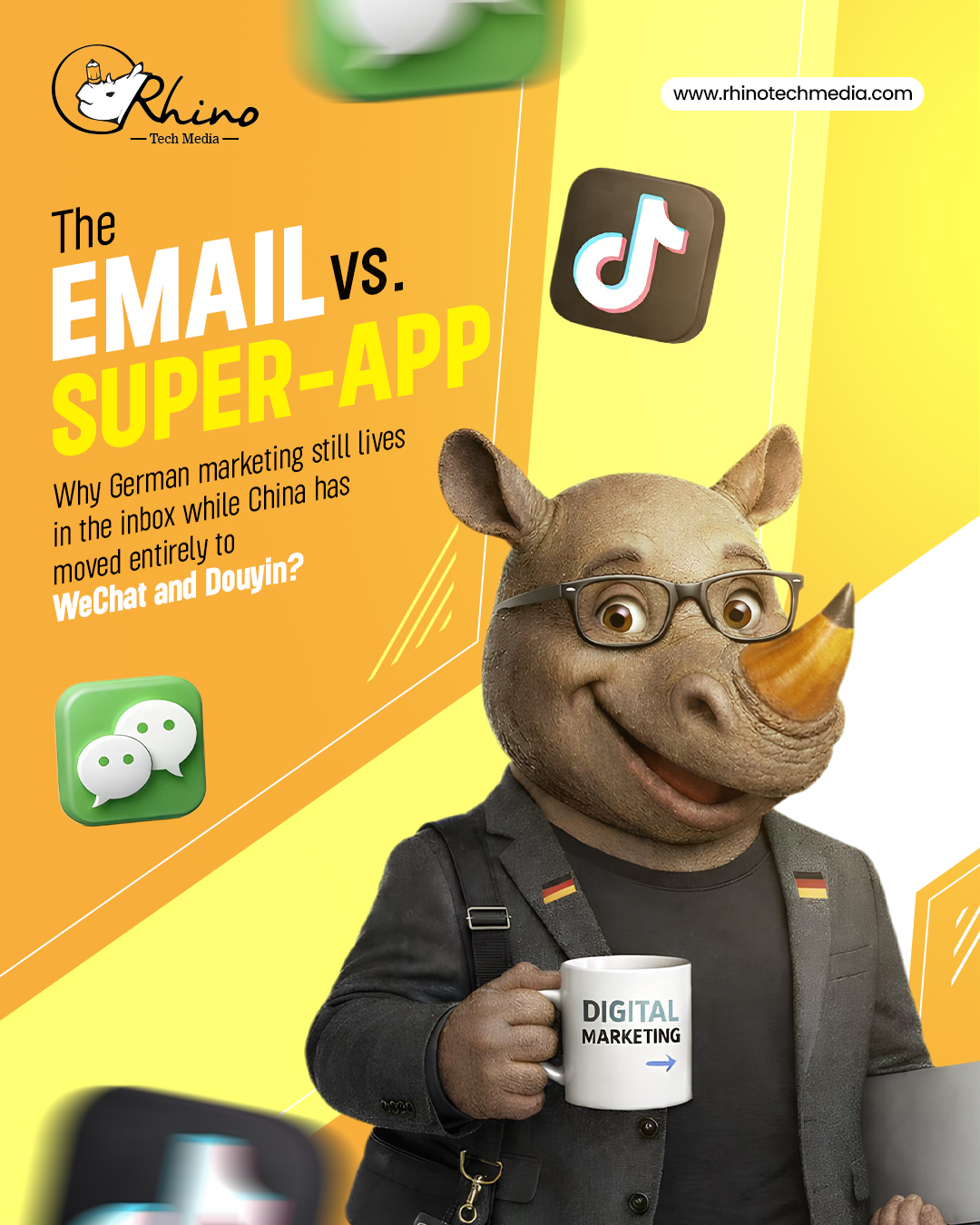
In the world of digital marketing, the channels brands use to reach consumers aren’t merely technical choices,they reflect deep differences in culture, consumer behaviour, regulatory environments, and platform ecosystems. Today, few contrasts illustrate this better than the divide between Germany’s inbox-friendly marketing landscape and China’s all-encompassing super-app ecosystem driven by platforms like WeChat and Douyin.
The German Marketing Mindset: Inbox, Consent, and Structure
In Germany,as in much of Western Europe and North America,email remains one of the foundational pillars of digital marketing. For decades, companies have built their customer communication strategies around newsletters, segmented lists, automated campaigns, and permission-based outreach. Several factors help explain this:
- Cultural and Regulatory Norms
German consumers and marketers alike have strong habits around email: it’s a formal, familiar tool for both personal and business communication. The marketing industry has matured around this channel, with performance metrics (open rates, CTR, conversions) deeply embedded into campaign planning. Moreover, stringent privacy regulations such as the GDPR have shaped a marketing culture where explicit consent and trust are paramount, and email,a channel where consent can be clearly documented and controlled,fits well into this framework. - Digital Ecosystem Structure
In Germany, digital life typically revolves around specialised apps rather than single monolithic platforms. Messaging, payments, social networking, shopping, and entertainment live in separate ecosystems,like WhatsApp for communication, Amazon or local e-commerce platforms for shopping, and Spotify or YouTube for media. This fragmentation reinforces the role of email as a cross-platform touchpoint for brands wanting to reach consumers across these diverse spaces. - Channel Stability and Business Use
For B2B especially, email is the lingua franca of professional communication. It serves as the default channel for contracts, inquiries, newsletters, and formal engagements. Many companies still regard email automation as the most reliable way to nurture leads and build long-term customer relationships.
In short, German (and broader Western) digital marketing still lives in the inbox because email fits established norms of brand communication, consent-driven consumer contact, and regulatory comfort.
China’s Super-App Revolution: WeChat and Douyin as Marketing Ecosystems
Contrast this with China, where email has never dominated consumer attention in the way it has in the West. Instead, platforms like WeChat and Douyin have become the central hubs of users’ digital lives, reshaping not just social interaction but the very practice of marketing.
Super-Apps: More than Communication Tools
The term super-app refers to platforms that bundle a wide range of services — messaging, payments, social media, commerce, and utilities — into a single seamless environment. WeChat, developed by Tencent, is the archetypal example: it combines messaging, WeChat Pay, mini-programs, content feeds, group interactions, and brand interfaces into one ubiquitous mobile platform. Douyin (the Chinese version of TikTok) anchors a video-first leisure and commerce environment where discovery, engagement, and purchasing can happen in one flow.
The effect? Chinese users spend a lot of their digital lives inside these platforms, which are virtually impossible to avoid if a brand wants visibility. WeChat alone remains the primary channel for everyday digital activity — communication, shopping, payments, customer service, and even official documentation.
Email’s Marginal Role in China
Unlike in Germany, email in China is not a default or regularly checked communication channel. Many Chinese internet users rarely open or use email, and as a result traditional email marketing campaigns have historically yielded negligible engagement,studies by China-focused marketing experts suggest that fewer than 5% of Chinese users regularly check email and that it is not used for professional communication, which happens instead through WeChat and other messaging tools.
This shift has major implications:
- Brands don’t send newsletters to inboxes,they build official accounts and content channels inside WeChat or Douyin.
- Marketing content,from product launches to customer service,happens where users already spend their time.
- Commerce is native to social and messaging platforms, not external to them as in email links to websites.
China’s digital ecosystem has effectively leapfrogged the inbox, with messaging and discovery tightly integrated with payment and purchase experiences,something email could never offer at scale.
Why the Divide Exists: Culture, Regulation, and Technology
So why does this difference persist?
1. Regulatory and Privacy Landscapes
In Europe, strict privacy frameworks (e.g., GDPR) encourage explicit consent and transparency. Email marketing systems naturally align with these rules because they require opt-ins, clear opt-outs, and controlled database management. This makes email a relatively safe and compliant marketing channel in German markets.
In China, by contrast, different regulations and digital governance have allowed platforms like WeChat to centralise identity and digital services in a way that ties consumer behaviour to a single ecosystem. Platforms govern usage data and interactions, and marketing can leverage these rich behavioural signals inside the same environment where transactions occur.
2. Market and Consumer Behaviour
Chinese consumers are overwhelmingly mobile-first, with smartphone usage dominating how people access services and content. Super-apps fit seamlessly into this behaviour, collapsing communication, socialisation, entertainment, and shopping into one touchpoint. Western markets,including Germany,still operate with multiple specialised tools (WhatsApp for chat, email for formal messaging, dedicated apps for payments, etc.), which dilutes the centrality of any one platform and leaves room for email to thrive.
3. Ecosystem Fragmentation vs. Consolidation
China’s digital market consolidated around a few dominant platforms early on, offering the convenience of one login for everything. In the West, digital services are fragmented across competitors,messaging (WhatsApp, Messenger), search (Google), e-commerce (Amazon), payments (various players), and so on. With no single platform capturing users’ entire attention, email remains a unifying channel that cuts across these disparate digital experiences.
Looking Forward: Can the West Ever Catch Up?
There is growing discussion about whether Europe,and Germany specifically,might eventually produce its own super-app equivalents. Startups and fintech innovators are experimenting with combined services, and surveys suggest that West European consumers are not inherently opposed to unified app experiences — adoption intentions depend largely on trust and perceived value.
Yet substantial barriers remain: regulatory complexity, market fragmentation, and entrenched consumer habits all slow down the rise of a super-app model in the West. For now, email,familiar, measurable, and compliant — continues to anchor German marketing strategies.
Conclusion
The divide between German email marketing and China’s super-app ecosystem is more than a technological preference,it reflects deep cultural, regulatory, and structural differences in how digital life is organised. German marketers still invest heavily in inbox engagement because email aligns with European norms of consent, privacy, and formal communication. Chinese marketers, by contrast, operate within super-apps like WeChat and Douyin where communication, commerce, and social interaction are fused in one platform. The result is two distinct digital marketing universes,each effective within its own context, but increasingly difficult to reconcile on a global scale.