
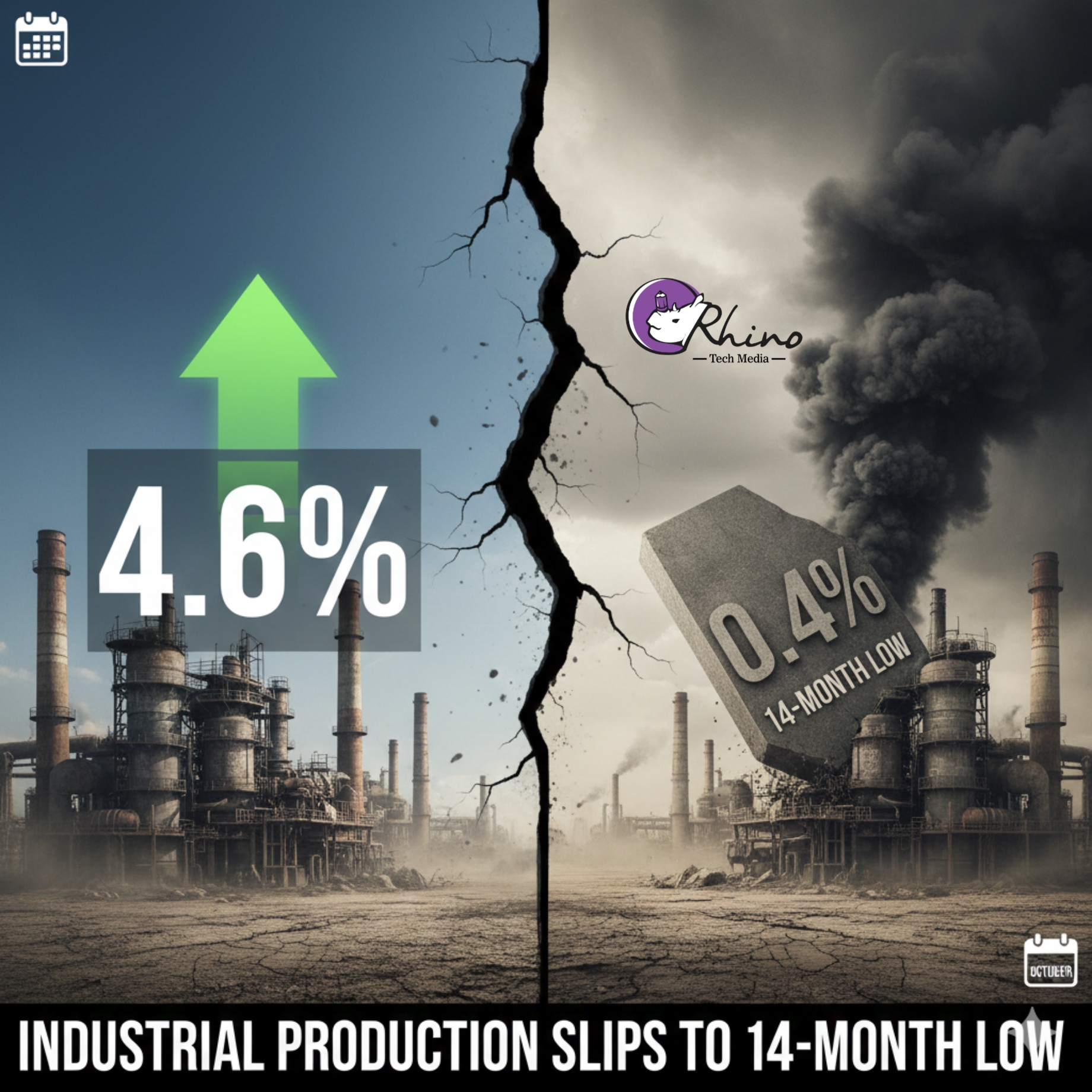
The Festive Slowdown: India’s Industrial Production Crawls to a 14-Month Low
The publication of official data revealing that India’s Index of Industrial Production (IIP) grew by a mere 0.4\% in October 2025—the lowest rate in 14 months—signals a sharp deceleration in the nation’s factory output. This unexpected stall, dramatically down from the revised 4.6\% recorded in September, has prompted the Ministry of Statistics and Programme Implementation (MoSPI) and economic analysts to pinpoint a combination of seasonal, structural, and environmental factors behind the subdued performance. While the dip may be partially temporary, stemming from the clustering of major festivals, it draws attention to underlying softness in key segments of the economy.
Sectoral Weakness: The Primary Drag Factors
The sharp decline in the headline IIP figure was primarily a result of weakened performance across the three core components of the index: Manufacturing, Mining, and Electricity.
The Manufacturing sector, which accounts for the largest share of the IIP, managed only a 1.8\% expansion. This was a significant step down from the preceding month, suggesting that the inventory build-up seen in September—partially driven by a GST rate cut and pre-festive stocking—had run its course. Crucially, less than half of the 23 industry groups within manufacturing reported positive growth, indicating a broad-based softening of activity.
Even more significant were the contractions in the other two major components:
- Electricity Generation registered a sharp decline of -6.9\%. The official explanation attributed this to extended monsoonal rainfall and comfortable ambient temperatures across many states, which substantially lowered the demand for power, particularly for irrigation and cooling purposes.
- Mining output contracted by -1.8\%, marking the second consecutive month of negative growth and reflecting subdued production activity in primary materials.
Use-Based Classification: The Consumer Demand Indicator
Further scrutiny of the IIP data, categorized by end-use, revealed a concerning trend in consumer demand, a crucial driver of India’s economic momentum. - The Consumer Durables segment saw a contraction of -0.5\%, down from robust growth in September.
- The Consumer Non-Durables segment faced an even steeper decline, contracting by -4.4\% annually.
The negative figures in consumer goods suggest that while pre-festive stocking occurred in the supply chain (manufacturing), the actual festival consumption demand may have been uneven or that inventory drawdowns were limited. Conversely, sectors related to investment and government spending fared better, with Infrastructure/Construction Goods growing by 7.1\% and Capital Goods rising by 2.4\%, providing a small silver lining amidst the broader slowdown. - The Overriding Calendar Effect and External Headwinds
- MoSPI officially attributed the slow growth primarily to the “calendar effect”—specifically, the fewer number of working days in October due to a dense cluster of major national festivals, including Dussehra, Diwali, and Chhath. During these holidays, production across factories and mines typically slows or halts entirely.
- Beyond the seasonal dampener, analysts pointed to persistent external headwinds: a substantial decline in merchandise exports and the potential lingering impact of global uncertainties, including US tariffs and penalties, on certain manufacturing sub-segments. These factors suggest that the global environment continues to impart a degree of uncertainty to India’s industrial outlook.
Conclusion - The October IIP figure of 0.4\% represents a significant hiccup in India’s industrial recovery narrative. While the government and economists are keen to view the slump as an aberration driven by the festive calendar and unseasonal rains, the accompanying contraction in mining and electricity, coupled with the sharp drop in consumer non-durables, merits careful monitoring. The true test of the economy’s underlying health and whether momentum has been lost will be revealed by the performance figures for November and December, once the temporary festive drag has dissipated and production returns to normal capacity. For now, the data serves as a cautious reminder that sustained industrial growth is dependent not just on policy intervention but also on robust, consistent demand across all key sectors.
